Macklemore redirects $1 million from the Loop Tour to Palestinian organizations as support acts leave Ed Sheeran’s lineup.

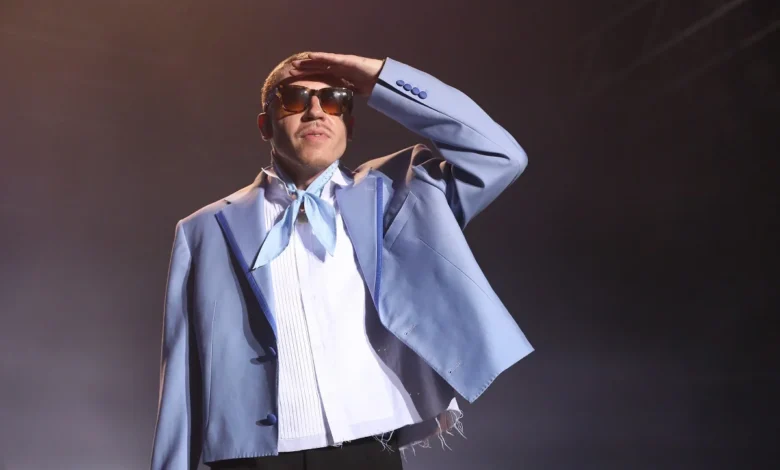
The intersection of global political activism and the high-stakes world of international touring has reached a boiling point, culminating in a significant financial pivot from rapper Macklemore. Following his involuntary removal from Ed Sheeran’s "Loop Tour," the Seattle-based artist announced on Wednesday that he would be donating his entire $1 million in net earnings from the tour to six humanitarian organizations providing aid to Palestinians. This development marks a dramatic escalation in a controversy that has pitted high-profile musical acts against stadium ownership, corporate interests, and the complexities of free speech in the entertainment industry.
A Chronology of the Dispute
The tension originated during performances at MetLife Stadium in East Rutherford, New Jersey, on September 4 and 5. During these shows, Macklemore, who was serving as a supporting act, utilized his platform to advocate for Palestinian rights. He wore a traditional keffiyeh, projected imagery from Gaza, and performed his track "Hind’s Hall," a song dedicated to student protesters and the humanitarian crisis in Gaza. During these sets, he explicitly called for a "Free Palestine."
The response from advocacy groups and stadium stakeholders was swift. The Israeli-American Council (IAC) spearheaded a petition demanding the rapper’s removal from the tour, labeling his rhetoric as inflammatory. According to communications later disclosed by Macklemore, Robert Kraft, the billionaire owner of the New England Patriots and the primary stakeholder of Gillette Stadium, became a focal point of the opposition. Macklemore alleged that Kraft exerted pressure on promoters to have him removed from future dates, citing concerns over the nature of his public commentary.
By mid-September, the Messina Touring Group, the primary promoter for the tour, confirmed that multiple venues had effectively barred Macklemore from appearing on their stages. The decision was not merely a matter of artistic preference but a logistical ultimatum: venue operators threatened to cancel scheduled concert dates entirely if the rapper remained on the bill. Ed Sheeran subsequently clarified that the decision to remove Macklemore was made by the promoters and venue operators, not by him, emphasizing that he sought to keep his shows apolitical to preserve the livelihoods of the touring crew and musicians.
The Financial and Humanitarian Pivot
Macklemore’s response to his removal has moved beyond public statements into direct financial action. In a five-panel Instagram post released Wednesday, the artist pledged $1 million to six organizations working on the ground in the Middle East. He explicitly challenged Robert Kraft to match this donation, framing the request as a non-partisan call for the protection of human life.
"I want to center the parents carrying their children into hospitals without the basic resources to treat them, and the physicians, paramedics, journalists and aid workers who keep going back in," Macklemore stated. He underscored that while he is providing financial aid, he recognizes that the current crisis in Gaza is a "manmade injustice" that requires political, rather than purely humanitarian, solutions. By choosing to donate his net earnings, the artist has effectively utilized the financial proceeds of a tour from which he was banned to support the very cause that led to his exclusion.
The Exodus of Support Acts
The controversy has triggered a ripple effect throughout the tour’s infrastructure. Following Macklemore’s removal, the tour’s supporting lineup began to disintegrate. Finneas, the producer and songwriter, canceled six planned South American appearances. In a statement, Finneas argued that artists should not be silenced or penalized for expressing solidarity with oppressed populations.
Similarly, the Irish singer Aaron Rowe, the Danish ensemble Lukas Graham, and Beoga—the Irish group that served as Sheeran’s primary touring band—all withdrew from the tour. While the departing artists maintained varying degrees of personal friendship with Sheeran, their collective exit highlighted a growing divide within the music industry regarding the role of performers in political discourse. As of late September, Ed Sheeran is scheduled to continue his tour, including a major stop in Philadelphia, without the previously announced supporting roster, forcing promoters to navigate the logistical vacuum created by the sudden departures.
Industry Implications and the "Apolitical" Dilemma
The dispute underscores a widening chasm between the expectations of stadium owners and the evolving culture of modern musical performance. Stadiums, which are often owned by corporations or individuals with significant political and business interests, are increasingly viewing the stage as an extension of their public brand. For owners like Robert Kraft, the stage is a commercial venue that must be insulated from potentially divisive political rhetoric. Kraft has defended his stance, characterizing Macklemore’s remarks as "hate speech" and "antisemitic," while insisting that his decision was based on maintaining a neutral environment for all fans.
However, legal and industry experts note that this case sets a difficult precedent. The tension between the First Amendment rights of artists and the private property rights of venue owners is rarely litigated, but it is frequently negotiated through the power of the purse. By threatening to pull tour dates, venue operators successfully utilized their economic leverage to effectively "cancel" an artist’s platform. This raises questions about the future of touring for artists who engage in political activism. If promoters and venue owners continue to prioritize ideological comfort over artistic freedom, it may lead to a homogenization of live music, where only "apolitical" content is permitted in major stadium circuits.
Contextualizing the Humanitarian Crisis
The organizations receiving Macklemore’s donation are operating in a region defined by extreme instability. According to data from the United Nations Office for the Coordination of Humanitarian Affairs (OCHA) and the World Health Organization (WHO), the healthcare infrastructure in Gaza has been severely compromised, with a significant majority of hospitals rendered non-functional or operating at limited capacity. The influx of aid is often hindered by border closures and the ongoing military conflict, making the work of the aid groups the rapper is supporting critical to the survival of the local population.
Macklemore’s emphasis on the death of civilians and the suffering of children aligns with international reports of the mounting toll of the conflict. By bringing attention to individuals like 15-year-old Muhammad al-Zinati, the artist is attempting to personalize a geopolitical conflict that is often discussed in abstract or sterile terms. His stated position—that "a Palestinian life is no less valuable than any other life"—serves as the ethical bedrock of his current advocacy.
The Road Ahead
As Ed Sheeran’s "Loop Tour" proceeds in a truncated form, the industry remains in a state of flux. The tour, which was intended to be a celebration of musical cohesion, has instead become a case study in the risks of the modern "culture wars." For Macklemore, the $1 million donation is an attempt to define his legacy not by his presence on a stadium stage, but by his commitment to his stated political values.
The challenge issued to Robert Kraft remains unanswered, and it is unlikely that the two parties will find common ground. However, the incident has successfully brought the issue of Palestinian humanitarian aid into the mainstream music discourse. As more artists grapple with the pressures of industry gatekeepers, the "Macklemore incident" will likely be cited as a seminal moment where the financial, political, and artistic lines of the entertainment world were drawn with unprecedented clarity. The broader impact remains to be seen, but it is clear that the expectation for artists to remain "apolitical" is increasingly at odds with a generation of performers who view their global reach as an inherent responsibility to advocate for the disenfranchised.