Best Tape Delay Pedal: Get the Sounds of Echoplex and Space Echo on your Board!

The market for guitar and keyboard effects is populated by countless sonic architectures, ranging from transparent digital processors to organic analog bucket-brigade circuits. Yet, few effect categories evoke as much distinct sonic character and historical reverence as the tape delay. Characterized by warm analog warmth, endlessly cascading saturation, and distinct mechanical modulation, tape delay remains a cornerstone of modern sound design. For musicians seeking the authentic warmth of vintage tape echoes, finding the right pedal requires navigating a vast ecosystem of emulations modeled after the golden era of recording history.

Historical Origins and Evolution of Tape Delay Technology
To understand why modern stompboxes strive to replicate tape delays, one must examine the technological landscape of the mid-20th century. Before the advent of digital signal processing or compact solid-state electronics, studio engineers in the 1950s and 1960s pioneered mechanical delay systems. By utilizing modified tape recorders, engineers captured incoming audio signals on magnetic tape and routed the playback output milliseconds later. This created a discrete physical delay governed by the distance between the recording head and the playback head, as well as the linear speed of the tape transport.

Crucially, this architecture introduced feedback by routing a portion of the delayed signal back into the record head. Each successive repetition passed through the magnetic medium anew, resulting in a progressive degradation of high frequencies, rising low-mid saturation, and subtle tape compression. This distinct degradation created the signature warm, darkened echo that defined countless dub, reggae, and psychedelic rock productions.
Two legendary hardware units cemented this sonic profile into music history: the Maestro Echoplex EP-3, prized for its robust solid-state preamp and dynamic tape saturation, and the Roland RE-201 Space Echo, a multi-head unit that combined magnetic tape delay with a physical spring reverb tank. Today, modern pedal manufacturers employ sophisticated digital signal processors (DSPs) and analog-digital hybrid circuits to recreate these elusive mechanical nuances on pedalboards worldwide.
An Analysis of Top Tape Delay Pedals for 2027
Modern pedal manufacturers offer options spanning multiple price points, feature sets, and fidelity levels. Below is an examination of the leading tape delay stompboxes available on the market, categorized by their distinct feature sets and market positioning.

Mooer Reecho: Best Budget Entry Point
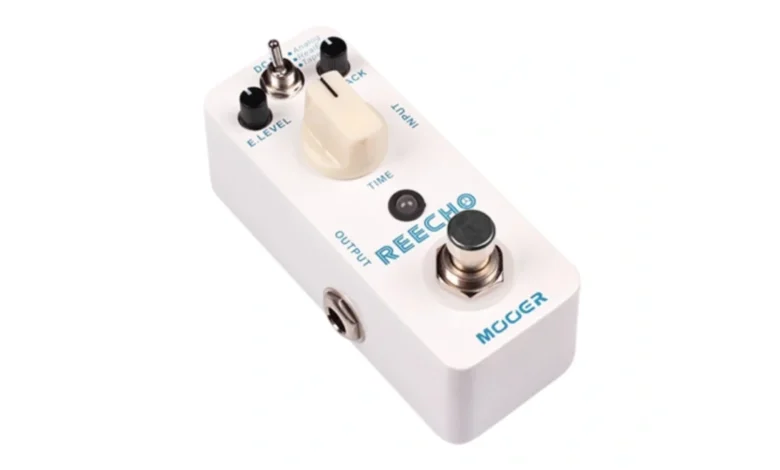
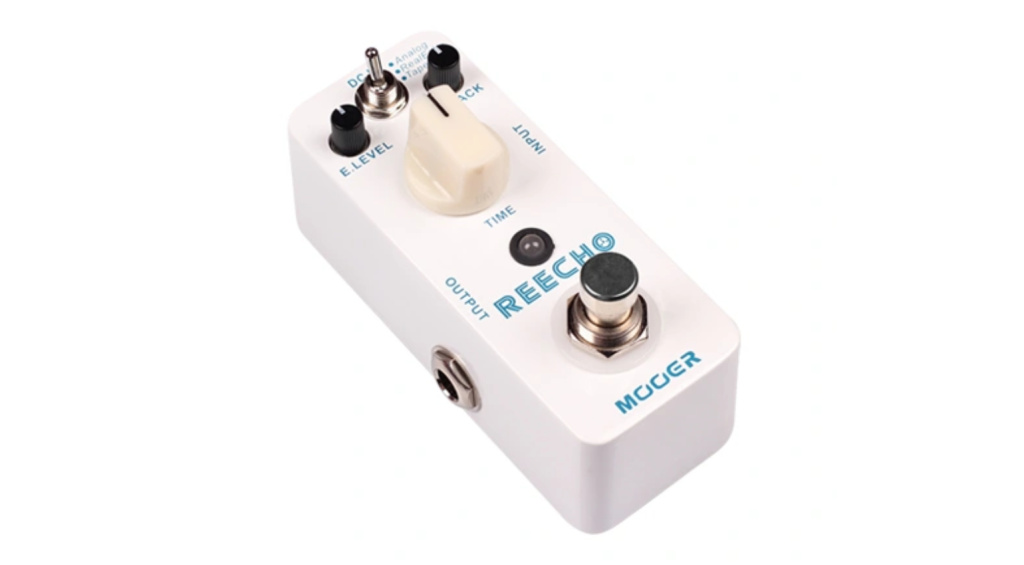
For musicians exploring the realm of tape delays without a substantial financial commitment, ultra-compact micro pedals have revolutionized accessibility. The Mooer Reecho provides a straightforward, highly affordable entry point into ambient echo textures. Featuring a simplified three-knob layout—Feedback, Time, and Effect Level—alongside a toggle switch to select between Analog, RealEcho, and TapeEcho modes, the pedal delivers delay times ranging from 5 milliseconds to 780 milliseconds. Incorporating true-bypass switching to preserve dry signal integrity, the Reecho serves as an efficient tool for beginners seeking foundational slapback and ambient wash capabilities.

Nobels DEL-mini Delay: Compact Stereo Versatility
Expanding upon the micro-pedal format, the Nobels DEL-mini Delay introduces advanced routing and control options typically reserved for larger chassis formats. Alongside standard tape delay modes, the DEL-mini incorporates a tap-tempo function accessible via a two-second footswitch hold, a comprehensive stereo signal path, and user-selectable true or buffered bypass operation. This combination of space-saving design and professional input-output routing makes it an ideal solution for crowded pedalboards requiring stereo integration.

JHS Pedals 3 Series Tape Delay: Accessible Space Echo Character
Aimed at budget-conscious enthusiasts of the Roland RE-201 aesthetic, the JHS Pedals 3 Series Tape Delay delivers simplified controls mapped directly to vintage sonic territory. Utilizing a three-knob interface for Mix, Tape Speed, and Repeats, supplemented by a dedicated Flutter switch, this unit replicates the characteristic pitch-shifting anomalies and lo-fi modulation associated with aging magnetic tape. The integration of the Tape Speed dial allows users to generate pitch-warping oscillation effects in real time, making it a popular choice for indie rock and ambient textures.

Universal Audio UAFX Orion Tape Echo: Studio-Grade Echoplex Emulation
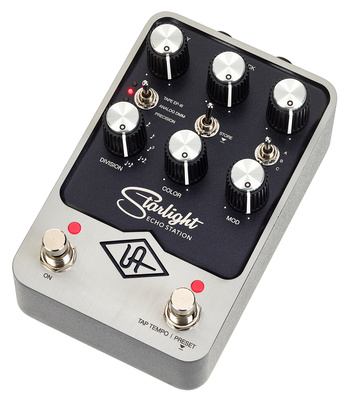
Universal Audio brings its extensive DSP heritage to the compact pedal format with the UAFX Orion Tape Echo. Modeled explicitly after the vintage Maestro Echoplex EP-3 unit, the Orion focuses heavily on authentic preamp saturation and mechanical artifact simulation. Users can select between three distinct virtual tape ages—ranging from pristine fidelity to heavily worn, degraded media—while the "Wonk" control introduces variable mechanical noise and wow. Additionally, the pedal features a switchable emulation of the EP-3’s legendary solid-state preamp, providing a subtle harmonic boost even when the delay effect is bypassed in trails mode. For players requiring broader sonic palettes, Universal Audio’s Starlight Echo Station offers a dual-engine architecture incorporating a premier stereo tape delay alongside other classic delay topologies.

Boss RE-2 and RE-202 Space Echo: The Benchmark Emulations
As the corporate descendant of Roland, Boss occupies a unique position in the tape delay market. The compact Boss RE-2 packs the multi-head configuration of the original RE-201 into a standard stompbox enclosure, offering 11 distinct delay modes, stereo input and output capability, wow and flutter controls, and selectable preamp coloration. For professional applications requiring maximum control and historical accuracy, the flagship RE-202 expands upon this foundation with 12 delay modes, an authentic physical spring reverb emulation, 127 user preset locations, and expanded foot-control options, establishing an industry benchmark for hardware-based tape echo reproduction.

Strymon El Capistan V2: The Touring Professional Standard
Widely regarded by professional touring musicians as the definitive tape delay pedal, the Strymon El Capistan V2 offers deep control over the physical parameters of magnetic tape. Featuring three primary tape modes—Fixed, Multi, and Single—each equipped with three sub-modes, the El Capistan provides extensive versatility ranging from pristine studio echo to ruined lo-fi soundscapes. Version 2 introduces an integrated spring reverb algorithm, alongside dedicated secondary controls for tape age, wow and flutter, tape bias, and low-end contour. With 300 internal preset slots and full MIDI implementation, the El Capistan remains a staple in professional rigs.

Comparative Analysis of Delay Architectures
To assist musicians in selecting the appropriate hardware, distinguishing between fundamental delay typologies is essential. Traditional digital delays process audio via analog-to-digital converters, storing exact numerical representations of the audio signal in memory before outputting them with pristine clarity and zero degradation across repeats. Conversely, tape delays and their DSP emulations introduce intentional nonlinearities, including high-frequency roll-off, harmonic saturation, dynamic compression, and cyclical speed variations known as wow and flutter.

While ambient producers requiring pristine note articulation often favor digital processors, instrumentalists pursuing organic warmth, dynamic interaction, and atmospheric depth consistently gravitate toward tape-voiced circuits. The inclusion of modern conveniences such as tap tempo bridges the gap between historical inaccuracy and modern performance demands, allowing musicians to lock vintage-sounding echoes directly to contemporary live set tempos.
Implications and Market Outlook
The enduring popularity of tape delay pedals highlights a broader macroeconomic trend within the music instrument industry: the fusion of vintage analog aesthetics with advanced digital processing power. As component manufacturing matures, manufacturers can pack complex multi-head algorithmic models into increasingly compact, affordable enclosures. This accessibility democratizes professional-grade spatial processing, enabling bedroom producers and touring professionals alike to integrate the organic imperfections of 1960s studio technology into modern digital audio workstations and pedalboard configurations.