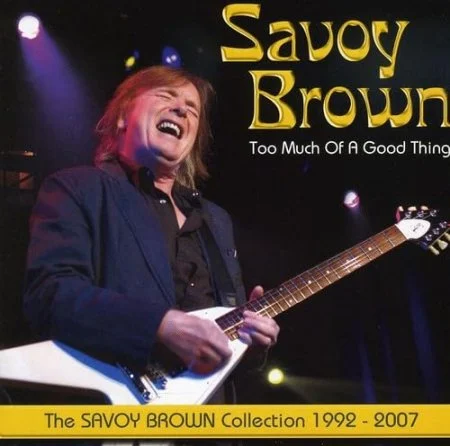
Panache Records has officially made available an expanded digital download edition of the definitive retrospective compilation, Too Much of a Good Thing: The Savoy Brown Collection 1992-2007. Originally curated, produced, and self-released in 2009 by legendary guitarist, bandleader, and founder Kim Simmonds on his own Panache label, this newly updated collection arrives as a vital historical document honoring one of British blues-rock’s most enduring architects. Simmonds, who passed away in December 2022 at the age of 75 following a courageous battle with stage 4 colon cancer, spent more than half a century shaping the global landscape of boogie-infused blues. This 14-track, 72-minute collection serves not merely as a retrospective of a productive 15-year creative window, but as a deeply personal labor of love compiled by Simmonds to celebrate his favorite compositions, career milestones, and the extraordinary roster of world-class musicians who passed through the revolving-door lineup of Savoy Brown over the decades.
The newly expanded digital release elevates the original 2009 tracklist by incorporating a rare, previously unreleased live recording captured at Boston’s renowned House of Blues in the year 2000. Featuring Simmonds’ trademark gruff, impassioned vocal delivery and his searing, fuzz-intoned slide guitar work, the collection captures power blues in its rawest, most unvarnished form. As music historians and longtime fans re-examine the vast catalog of a band that helped launch the late-1960s British blues boom alongside contemporaries like Fleetwood Mac, Ten Years After, and Chicken Shack, this collection offers a panoramic window into the later-era maturity of a master craftsman who steadfastly refused to compromise his artistic integrity.
Background Context of the Artist and the Era
To fully understand the significance of Too Much of a Good Thing, one must look back at the origins of Savoy Brown and the tumultuous history that defined the band’s longevity. Formed in 1965 in the working-class London suburb of Battersea by Kim Simmonds and vocalist John Poulton, the group initially named itself Savoy Brown Blues Band before shortening it to Savoy Brown. Simmonds, recognized widely as a teenage guitar prodigy, positioned himself at the vanguard of the British blues movement, soaking up the vinyl records of American blues legends such as Muddy Waters, Elmore James, and Howlin’ Wolf, and translating those delta and Chicago traditions for European audiences.
Unlike many of their British Invasion peers who quickly pivoted toward arena-filling hard rock or psychedelic experimentation, Savoy Brown maintained an unyielding commitment to traditional blues shuffles, driving boogies, and high-energy blues-rock. However, the band became almost as famous for its hyper-transient lineup as it was for its musical output. Over five decades, Simmonds remained the sole constant anchor while dozens of musicians cycled through the ranks. Famously, in 1970, a mass exodus saw several core members depart to form the successful offshoot band Foghat. Despite constant lineup permutations, shifting commercial tides, and the periodic waning of mainstream interest in guitar-driven blues, Simmonds kept the flame burning, touring relentlessly across North America and Europe, releasing critically acclaimed studio albums, and earning a reputation as a tireless workhorse of the genre.
The 1992–2007 window covered by this collection represents a particularly fascinating era of artistic stabilization and creative rejuvenation for Simmonds. Having weathered the shifting production styles of the 1970s and 1980s, Simmonds entered the 1990s with a renewed focus on roots authenticity. Operating independently through his Panache imprint, he cultivated an environment where top-tier sidemen could stretch out, experiment, and contribute to a sophisticated yet deeply visceral body of work.
An All-Star Cast of Sidemen and Collaborators
One of the defining characteristics of Savoy Brown during the period spanning 1992 to 2007 was the caliber of talent Simmonds attracted to the studio and the stage. Rather than relying on anonymous session players, Simmonds surrounded himself with virtuosos, many of whom had established stellar reputations as bandleaders, sidemen, and solo artists in their own right.
The revolving lineup featured on the tracks compiled in Too Much of a Good Thing reads like a contemporary blues-rock hall of fame. Guitar duties, in addition to Simmonds’ blistering leads, are shared by luminaries such as Duke Robillard—a co-founder of Roomful of Blues and an acknowledged master of jump blues and jazz-inflected guitar—and David Malachowski. The keyboard department boasts foundational contributions from the late, great David Maxwell, whose barrelhouse and Chicago-style piano work added immense depth to the arrangements, alongside keyboardist Rick Jewett.

The rhythm sections were similarly stacked with powerhouse players. Bassists Nathaniel Peterson, Leo Lyons (of Ten Years After fame), Andy Ramirez, Jim Heyl, and Gerry Sorrentino anchored the low end with precision and groove. Behind the drum kits, heavy-hitters Tom Compton, Dave Olson, Joe Pierleoni, and “T” Xiques drove the tempos with a dynamic blend of swing and rock power. The sonic texture is further enriched by the soulful, weeping harmonica stylings of Pete McMahon, alongside uncredited appearances by legendary harp players like Paul Oscher.
Track-by-Track Chronology and Musical Analysis
The 14-track journey of Too Much of a Good Thing is sequenced with the care of a master DJ, balancing high-octane boogies with slow-burning, introspective lamentations of heartbreak and endurance.
The collection opens with "Going Down to Mobile," a Delta-flavored shuffle that immediately establishes the high-water musical mark of the record. Featuring the interplay of Robillard and Maxwell, alongside the atmospheric harp work of Paul Oscher, the track pays direct homage to the geographic roots of the blues while filtering it through a contemporary, high-fidelity lens. The momentum surges seamlessly into the driving, seven-minute workout "Little Wheel." Here, the rhythm section led by Olson and Heyl sits high in the mix, giving the track an infectious, relentless pulse that is punctuated brilliantly by sharp reed and harp accents from McMahon.
The energy shifts downward into a sweeter, more contemplative space with the ballad "Keep on Rollin’." This track highlights Simmonds’ capacity for melodic lyricism, showcasing his well-modulated work on the strings and proving that his expressive phrasing was just as potent at slower tempos as it was during full-throttle boogies.
The initial all-star lineup reconvenes for the following two numbers. "That’s All I Want Baby" offers a gentle, rolling boogie that captures a lighter, romantic mood, announcing the singer’s direct intentions toward a romantic interest. This flows organically into "The Blues Keep Me Holding On," a mid-tempo piece recounting a music-infused gathering down by the riverside. The slow-dancing groove of the ensemble underscores a thematic truth running through Simmonds’ catalog: when all else fades, it is the healing power of the blues alone that sustains him through life’s trials.
Shifting format, the album transitions into a stripped-down trio configuration featuring Sorrentino and Cotton anchoring a rock-solid rhythm on "I Don’t Remember You." The song cooks slowly in its opening minutes before Simmonds unleashes a flurry of rapid-fire notes mid-song, capturing the psychological haze of romantic estrangement. This is complemented by the searing instrumental track "Flat Out," which grants Simmonds expansive room to stretch his technical muscles, displaying the fluid, stinging fretboard mastery that became his signature.
Heartbreak and relational turbulence emerge as dominant thematic motifs in the album’s latter half. "When It Rains" delivers a biting commentary on a fickle partner who vanishes during sunlit days only to return when storms roll in. The suffering deepens with "Yesterday’s Blues," recorded after the partner has departed for good, and the funk-infused grooves of "Monday Morning Blues," which paints a vivid picture of betrayal with a former lover in the arms of another man.
The emotional spectrum broadens further with the instrumental ballad "Feel Like Crying," the slow, menacing boogie of "She’s Leaving," and the deeply poignant, traditional-leaning "Where Has Your Heart Gone." Each of these tracks approaches the topography of emotional pain from a distinct angle, demonstrating Simmonds’ versatility as a songwriter who could convey profound sorrow without uttering a single word.
The collection reaches its emotional and historical climax with the previously unreleased bonus track, the title-piece "Too Much of a Good Thing." Captured live in front of an appreciative audience at Boston’s House of Blues in 2000, the performance encapsulates the raw, unfiltered electricity of a Savoy Brown live show. Driven by Simmonds’ fuzz-intoned slide guitar and commanding stage presence, the track serves as a fitting exclamation point for a career built on sweat, road miles, and uncompromising artistic vision.

Broader Impact and Industry Implications
The commercial and critical reception of the expanded release of Too Much of a Good Thing arrives at a crucial moment for the preservation of blues history. In the years following Kim Simmonds’ passing, the global blues community has engaged in widespread reflection regarding the foundational generation of artists who brought American blues to British shores and subsequently exported it back to the United States via legendary tours at venues like the Fillmore East and West.
Music industry analysts note that independent releases and archival expansions of this nature play an indispensable role in maintaining the cultural legacy of heritage artists in the streaming era. While major labels often focus on commercial box sets for mainstream legacy acts, independent efforts spearheaded by artists during their lifetimes—and preserved by their estates and dedicated labels like Panache Records—ensure that the unvarnished artistic truth of working musicians remains accessible to new generations of listeners.
Furthermore, this collection challenges any lingering misconceptions that Savoy Brown was merely a revolving door of temporary talent. Instead, Too Much of a Good Thing reframes the lineup instability not as a weakness, but as a testament to Kim Simmonds’ unique magnetism as a bandleader. By consistently drawing top-tier instrumentalists into his orbit and empowering them to shine within his tightly constructed blues frameworks, Simmonds created a collaborative ecosystem that continually regenerated itself over five decades.
Official and Critical Assessment
While contemporary reviews of the collection acknowledge that a compilation of later-era work cannot entirely replicate the explosive cultural impact of Savoy Brown’s late-1960s peak—such as seminal albums like A Step Further (1969) or Raw Sienna (1970)—critics universally agree that the musicianship on display throughout this 15-year span is of an exceptionally high caliber.
Simmonds’ guitar playing, in particular, is frequently cited as being in peak form during this era. Having refined his tone over decades of touring, his command of sustain, slide intonation, and phrasing on tracks like "Flat Out" and the live Boston recording demonstrates an artist who continued to grow and deepen his craft long after many of his peers had settled into nostalgic repetition.
For dedicated followers of the band, blues-rock purists, and students of electric guitar history, the expanded digital release of Too Much of a Good Thing: The Savoy Brown Collection 1992-2007 is regarded as an essential addition to any comprehensive music library. It stands as a monument to Kim Simmonds—a quiet giant of the British blues who spent his entire adult life keeping the boogie alive, one gritty note at a time.