Four in five respondents want fully AI-generated and AI-assisted music clearly identified.

The rapid proliferation of generative artificial intelligence has fundamentally altered the landscape of the music industry, prompting a significant shift in how listeners interact with the platforms they use to discover and consume art. A comprehensive new survey, commissioned by music streaming giant Deezer and executed by global research firm Ipsos, has brought the brewing tension between technological convenience and artistic integrity to the forefront. The study, which aggregates the perspectives of 9,000 participants across eight key international markets—the United States, Canada, Brazil, the United Kingdom, France, the Netherlands, Germany, and Japan—reveals a clear mandate from the public: listeners demand radical transparency regarding the origins of the tracks appearing in their daily rotations.
According to the data, 80% of respondents advocate for mandatory, clear labeling of both fully AI-generated and AI-assisted music. This figure represents a broad consensus that cuts across demographics, suggesting that the "black box" nature of current streaming algorithms is becoming an increasing point of friction for the average consumer.
The Disconnect Between Perception and Reality
One of the most striking revelations in the Ipsos study is the profound gap between user awareness and the actual composition of streaming libraries. When surveyed, 74% of streaming platform users expressed confidence that their personal playlists were free of AI-generated content. However, internal data from Deezer suggests a much different reality. Analysis of over 53,000 new subscribers who joined the platform this past October indicates that 57% of these users already had at least one AI-generated track present within their existing playlists—often without their explicit knowledge or consent.
This discrepancy highlights a critical issue in the modern digital music economy: the lack of metadata standards that distinguish human labor from algorithmic output. As generative models become more sophisticated, the acoustic "uncanny valley" is closing, making it increasingly difficult for the untrained ear to discern the difference between a studio-recorded performance and a machine-synthesized composition.
A Chronology of the AI Surge
The rise of AI-generated music is not a sudden phenomenon but rather the culmination of years of technological acceleration. To understand the current climate, one must look at the timeline of the industry’s adoption and subsequent regulation of these tools:
- 2023–2024: The "Gold Rush" phase of generative AI. Large-scale models, trained on vast datasets of copyrighted music, begin to flood streaming platforms with low-effort, high-volume tracks, often mimicking the styles of famous artists or generating background "mood" music.
- Early 2025: Facing mounting pressure from rights holders and a deteriorating user experience, major streaming platforms begin implementing rudimentary detection and labeling systems. Deezer, acting as an early adopter of these protocols, formally begins the process of identifying AI-generated content within its ecosystem.
- Late 2025: The scale of the issue becomes apparent. Deezer reports that it is receiving nearly 90,000 AI-generated tracks daily. On peak days, these machine-made submissions account for over 50% of the platform’s total music deliveries.
- 2026: Regulatory and public demand for transparency reaches a tipping point. The Deezer-Ipsos survey is launched to quantify the depth of consumer anxiety regarding the "devaluation" of human-led musical production.
Economic and Creative Implications
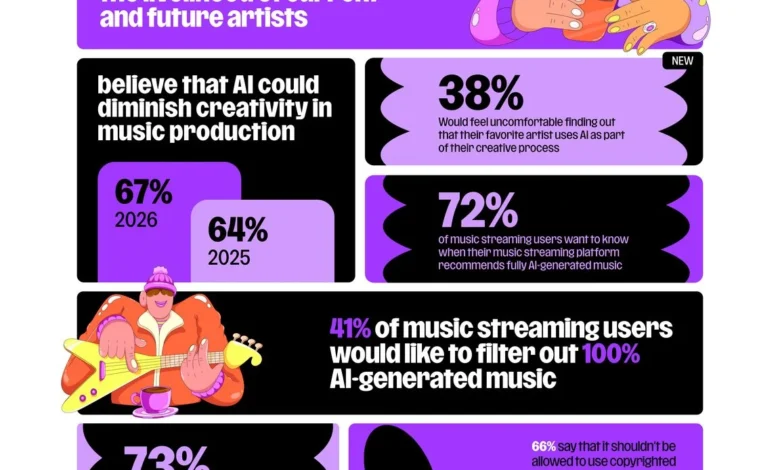
The concerns raised by respondents are not merely aesthetic; they are deeply rooted in fears regarding the sustainability of the music profession. Approximately 69% of those surveyed expressed a belief that the rise of fully AI-generated music represents a direct threat to the livelihoods of current and future artists. The concern is that as AI tracks saturate platforms, the pool of royalty revenue—already historically thin for the majority of independent creators—will be further diluted by mass-produced, automated content.

Furthermore, 67% of participants identified a risk to creative innovation. The argument here is that if platforms prioritize AI-generated music—which is cheap to produce and requires no ongoing talent development—the ecosystem may move away from the risk-taking and cultural expression that characterize human artistry. This concern is echoed in the 60% of respondents who explicitly stated that AI-generated tracks should not be permitted to chart alongside human-made recordings. By allowing these tracks to compete for visibility, platforms may be inadvertently stifling the discovery of genuine human artists, thereby homogenizing the cultural landscape.
Industry Responses and Regulatory Pressure
The findings have been met with swift commentary from advocacy groups. The United Musicians & Allied Workers (UMAW) has used the release of the survey to bolster its ongoing campaign for structural reform within the streaming economy. The organization’s official stance emphasizes three pillars: mandatory, industry-wide labeling of all AI-generated content; strict limitations on the volume and placement of AI tracks on streaming platforms; and the establishment of a fair compensation model that ensures human artists are not marginalized by the influx of non-human generated data.
From a platform perspective, Deezer has positioned itself as a leader in the movement toward "AI-literate" streaming. By identifying more than 13.4 million AI-generated tracks since the inception of its labeling initiative in 2025, the company is attempting to establish a "trust layer" for its users. Looking ahead, the company has committed to introducing an opt-out feature by the end of 2026. This tool will allow users to filter their listening experience, effectively enabling them to block AI-generated music from their personalized recommendations and search results. This represents a significant shift in platform philosophy, moving from a neutral delivery service to an active curator that respects user agency.
The Future of the Streaming Economy
The implications of this research extend far beyond a single platform or a single survey. We are witnessing the birth of a "post-generative" era in music consumption, where the value of human authorship is being re-evaluated in real-time. The 72% of streaming users who explicitly requested to be notified when a platform recommends an AI track underscore a fundamental shift in consumer demand. Users are no longer content with passive discovery; they want to know the provenance of the art they consume.
The challenge for the music industry will be to balance the innovation potential of AI with the economic and psychological needs of the human creative community. If platforms fail to provide the transparency that 80% of listeners are now demanding, they risk alienating their core user base. Conversely, by implementing rigorous labeling and opt-out technologies, streaming services may be able to differentiate themselves in a crowded marketplace, positioning themselves as "human-centric" platforms.
Ultimately, the data suggests that while technology has made music creation more accessible, it has also made the distinction between "content" and "art" more critical than ever. The industry’s ability to respond to these findings will likely dictate the future of the professional musician in the 21st century. As AI tools continue to evolve, the demand for "human-verified" music may well become a premium category, fundamentally altering the economics of the streaming business model. Whether this leads to a renaissance of human-made music or a permanent bifurcation of the industry into "human" and "AI" streams remains to be seen, but the public’s message is unequivocal: the human element in music is not an optional feature, but a requirement for the audience of the future.