Unearthing the Echoes of Eatonville: The 1935 Expedition and the Preservation of Florida Blues

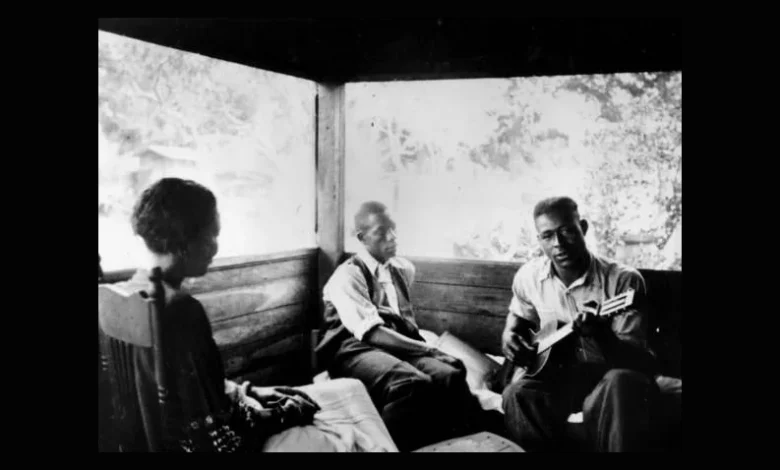
In June 1935, Zora Neale Hurston, the acclaimed novelist and anthropologist, joined folklorist Alan Lomax and educator Mary Elizabeth Barnicle on a pivotal expedition through Florida and the Bahamas. This journey, aimed at capturing the ephemeral sounds of a changing American South, resulted in a collection of recordings that have become foundational to the study of Black musical traditions. Among the most significant artifacts from this trip is a photograph taken in Eatonville, Florida—the first incorporated Black municipality in the United States—depicting Hurston alongside singer and guitarist Gabriel Brown and local resident Rochelle French. While the image is modest, the preservation of the music it captures represents a monumental effort to document a Florida blues voice that existed entirely outside the mechanisms of the commercial recording industry of the era.
A Chronology of the 1935 Field Expedition
The 1935 expedition was not a spontaneous endeavor but a carefully coordinated mission under the auspices of the Federal Emergency Relief Administration and the Library of Congress. Alan Lomax, who would go on to become one of the most prolific musicologists in American history, was tasked with expanding the Archive of American Folk Song. By the mid-1930s, the Great Depression had decimated the music industry, yet it had also prompted a national interest in documenting the "authentic" American experience.
- Early June 1935: The team establishes a base of operations in Eatonville, Florida. Hurston’s familiarity with the town—her childhood home—provided the researchers with an unprecedented level of access to local performers who were historically wary of outsiders.
- Mid-June 1935: The expedition transitions to deeper field recordings, capturing the sounds of turpentine camps and rail lines.
- Late June 1935: The team moves toward the Bahamas to document syncretic musical traditions, mapping the links between Caribbean rhythms and American folk music.
- July 1935: The recordings are cataloged and transported to Washington, D.C., where they are deposited into the Library of Congress archives, serving as a primary source for subsequent generations of ethnomusicologists.
The Musical Legacy of Gabriel Brown
Gabriel Brown occupies a unique space in the history of American music. As a singer, guitarist, and storyteller, his repertoire did not conform to the rigid genre distinctions later imposed by the record labels of the mid-20th century. Instead, Brown’s work fluidly moved between blues, folk ballads, and older narrative traditions that dated back to the 19th century.
The Library of Congress holds multiple recordings from the Eatonville sessions, most notably a performance of "Careless Love." When listening to this recording, one encounters a soundscape that predates the standardization of "Delta blues" or "Chicago blues." Brown’s performance is a testament to the fluidity of oral traditions, illustrating how music traveled via person-to-person transmission before the rise of radio and mass distribution. His guitar technique, often characterized by syncopated picking and a rhythmic intensity adapted from the percussive needs of work songs, provides a window into a stylistic evolution that was occurring simultaneously across the Florida peninsula.
Hurston as Anthropologist and Facilitator
The involvement of Zora Neale Hurston in this expedition is frequently misunderstood as a peripheral role. While history often paints the "collector" as an outsider who descends upon a community to extract raw materials, Hurston’s participation fundamentally altered the dynamic. As a trained anthropologist who had studied under the renowned Franz Boas at Barnard College, Hurston understood that the "truth" of a performance was contingent upon the level of trust between the performer and the collector.
Hurston’s presence in Eatonville ensured that the musicians were not merely subjects of study, but active participants in the preservation of their own cultural history. She understood that language, local dialect, and the social context of the performance were essential components of the documentation. By facilitating these sessions, she neutralized the colonialist undertones of the "discovery" narrative, replacing it with a model of community-centered archiving. Her influence can be observed in the relaxed, conversational nature of the recordings, which stand in stark contrast to the stilted, formal atmosphere typical of commercial studio sessions of the 1930s.
Florida’s Position in the Blues Map
Historically, Florida has been marginalized in the narrative of blues history, which has traditionally focused on the Mississippi Delta and the Chicago urban scene. However, the 1935 expedition serves as a powerful counter-narrative. The geographic and cultural position of Florida acted as a nexus for various influences. The state was a melting pot of Caribbean rhythmic sensibilities, the grueling soundscapes of turpentine camps, the transient nature of railroad culture, and the deeply entrenched traditions of Black church music.
Data from the expedition suggests that Florida musicians were not merely imitating imported styles; they were actively synthesizing them. The "Florida sound" was defined by its mobility and its ability to absorb disparate influences—from the maritime music of the Bahamas to the work songs of the inland farms. By documenting these sounds, the 1935 expedition provided evidence that Florida was a central, rather than peripheral, node in the transmission of Black musical culture in the United States.
The Limitations and Value of Archival Documentation
It is important for contemporary scholars and historians to acknowledge the inherent limitations of archival recordings. An archive can never fully replicate the sensory experience of a performance—the humidity of the Florida air, the communal setting of a front porch, or the social tensions of the Jim Crow era. Furthermore, documentation is always subject to the "blind spots" of the collectors. The choices made by Lomax, Barnicle, and Hurston regarding which songs to record and which performers to prioritize were influenced by their own biases and the specific research goals of the Library of Congress at the time.
However, the value of these artifacts lies in their function as a bridge. The photograph of Hurston, Brown, and French is not just a relic; it is a point of entry for the modern listener. It grounds the music in a specific place and time, reminding the audience that the blues is not a static genre but a lived experience. When we listen to these recordings, we are engaging with a specific group of people who, despite the lack of commercial recognition, were the true architects of a major American musical movement.
Broader Implications for Cultural Preservation
The Eatonville work underscores a critical lesson for modern archivists: preserving the blues requires the preservation of context. In the decades following the 1935 expedition, the music industry moved toward a model of homogenization. Songs were stripped of their local context to suit the demands of commercial viability. The 1935 recordings serve as a reminder of what was lost during that process.
Today, the Eatonville collection is viewed as a foundational resource for scholars of Southern studies and ethnomusicology. It challenges the "great man" theory of music history, which often credits a handful of famous artists for the development of the blues, and instead highlights the collaborative, decentralized nature of folk music. The implications of this work continue to resonate in contemporary efforts to digitize and democratize access to folk archives. By making these recordings accessible to the public, the Library of Congress and other institutions ensure that the legacy of artists like Gabriel Brown is not relegated to obscurity.
Furthermore, the 1935 expedition serves as a case study for the integration of humanities and social sciences. By combining Hurston’s ethnographic expertise with Lomax’s technical documentation, the project achieved a depth of insight that neither could have managed in isolation. This collaborative model remains a gold standard for field research today.
As we look back at the surviving photograph of that June day in 1935, we are reminded that the preservation of music is, at its heart, an act of historical justice. It is an effort to acknowledge that every song, every performer, and every local tradition contributes to the broader tapestry of human history. The Eatonville sessions continue to speak to us, not merely as music, but as a vital, enduring record of the people who shaped the American sonic landscape.