Pioneering Virtual Analogue Synthesizers of the 1990s: How Five Hardware Legends Shaped Modern Electronic Music Production

The evolution of electronic music production is inextricably linked to the technological leaps made during the 1990s. While the preceding decade belonged to the birth and commercial expansion of digital synthesis—exemplified by the crystalline, punchy tones of frequency modulation (FM) and sample-playback workstations—the 1990s marked a deliberate return to the tactile immediacy of analogue circuitry, albeit through a digital lens. Synthesizer manufacturers faced a growing demand for the warm, organic, and aggressive grunt of vintage analog hardware, yet without the accompanying tuning instability, high maintenance costs, and component degradation that had driven musicians toward digital alternatives in the 1980s.
This tension birthed virtual analogue (VA) technology. By utilizing digital signal processing (DSP) algorithms to mathematically model the behavior of oscillators, filters, and envelope generators, engineers successfully bridged the digital-analogue divide. While hybrid instruments like the Roland D-50 had previously combined sample playback with digital synthesis, and Yamaha’s pioneering VL1 and VP1 explored physical modeling of acoustic instruments, the mid-1990s saw developers focus squarely on replicating traditional electronic circuitry. Five defining instruments emerged from this era, establishing workflows, sonic identities, and aesthetic paradigms that continue to influence both hardware and software synthesizer design today.
The Dawn of Virtual Analogue: Clavia Nord Lead (1995)
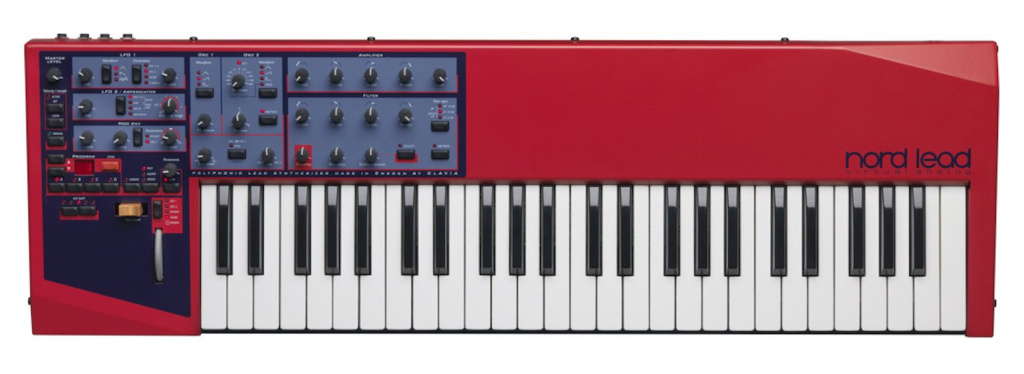
The commercial viability of virtual analogue synthesis was proven definitively in 1995 with the introduction of the Clavia Nord Lead. Developed in Sweden by Clavia—a company previously renowned for its electronic percussion hardware—the instrument immediately captured the industry’s attention with its striking red, angular metal chassis and a control surface dedicated entirely to hands-on manipulation.

Out of the box, the original Nord Lead operated as a four-voice polyphonic, four-part multitimbral synthesizer. However, its architecture could be expanded to 12 voices via an optional hardware voice expansion card, which also introduced a PCMCIA card slot for patch storage and performance memory. Mechanically, the instrument rejected traditional pitch wheels in favor of an iconic wooden "Pitch Stick" and a modulation wheel capable of executing smooth, real-time patch morphing between two distinct parameter states. Sound generation relied on two oscillators per voice capable of hard synchronization, routed through a versatile filter section that included 12dB/octave low-pass and 24dB/octave multi-mode filters.
The Nord Lead’s influence extended far beyond its technical specifications. Its vivid industrial design broke the industry standard of somber black and grey enclosures, establishing a visual signature that Clavia maintains on global stages to this day. Uniquely among its 1990s peers, the Nord Lead lineage has remained in continuous production through various iterations, culminating in modern descendants like the Nord Lead A1. The instrument’s enduring legacy has also crossed into the software domain, inspiring emulations such as discoDSP’s Discovery Pro, Daichi’s freeware classic Synth1, and modern community-driven projects like The Usual Suspects’ Nodal Red 2X.
Physical and Analogue Synthesis Convergence: Korg Prophecy (1995)
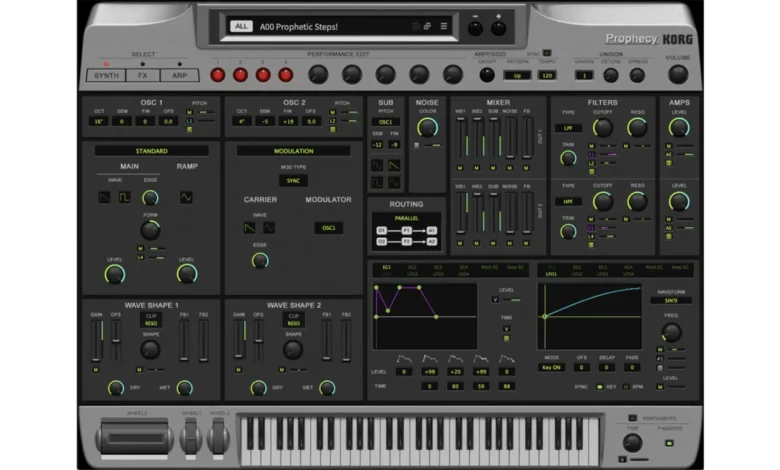
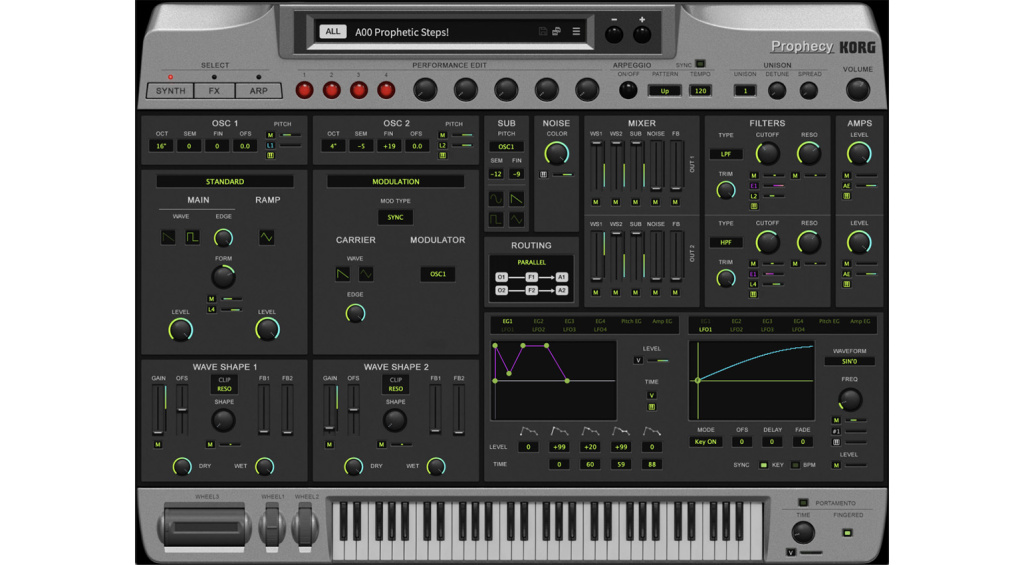
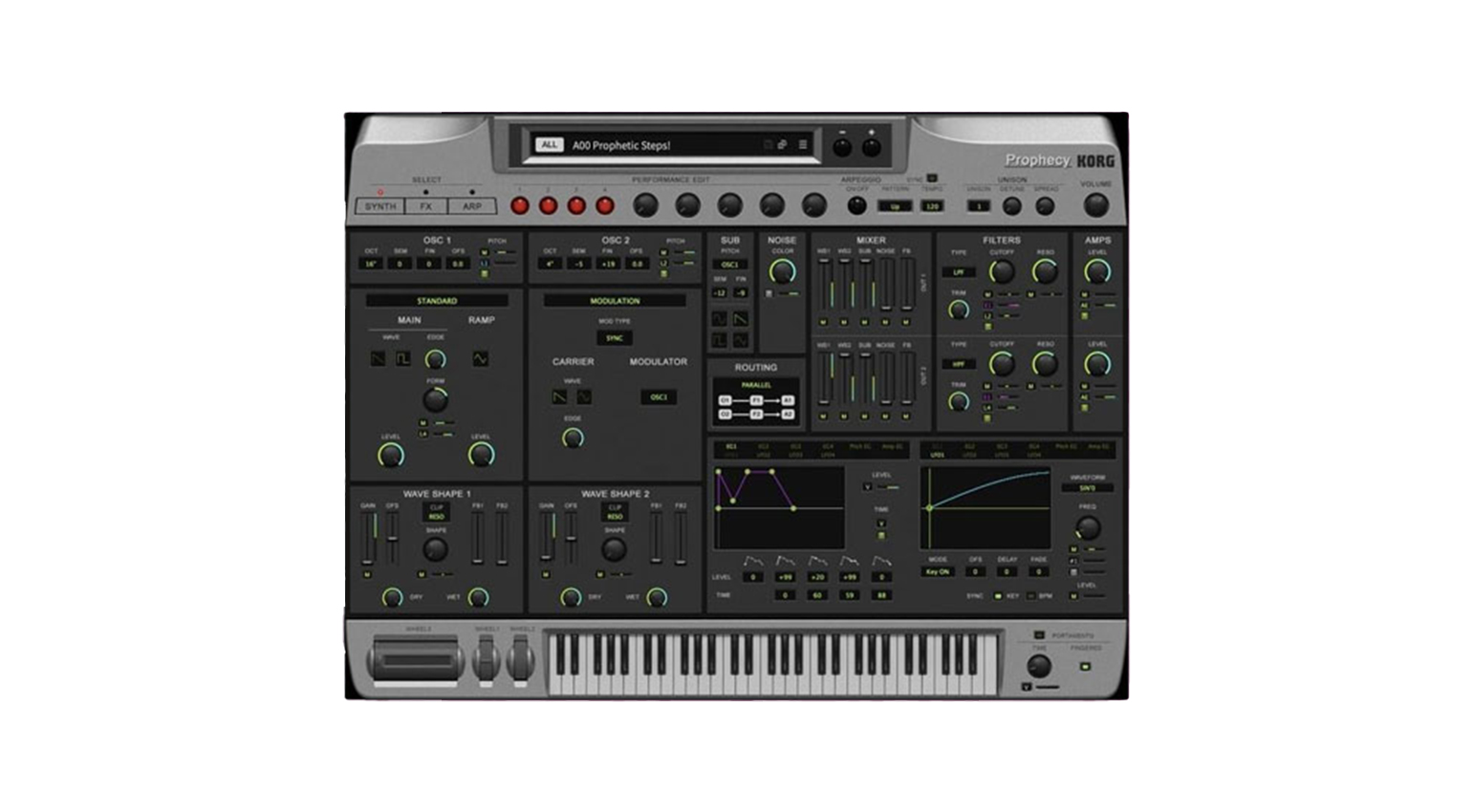
Releasing in the same year as Clavia’s flagship, the Korg Prophecy approached the digital modeling paradigm from a fundamentally different architectural standpoint. Derived from Korg’s advanced OASYS (Open Architecture Synthesis System) research and development project, the Prophecy utilized the Multi-Oscillator Synthesis System (MOSS) engine. This allowed the 37-key monophonic instrument to execute not only virtual analogue modeling but also physical modeling of acoustic brass and plucked strings, Variable Phase Modulation (VPM)—Korg’s proprietary take on FM synthesis—comb filtering, and ring modulation.
Initial market reception was skeptical. Industry observers questioned the value proposition of a monophonic synthesizer with a compact keyboard retailing at a substantial price point. Yet, upon release, the Prophecy earned critical and commercial acclaim due to its unprecedented expressive capabilities. Its physical modeling engine responded dynamically to physical performance controllers, accurately simulating air pressure for brass instruments and implementing authentic, stepped pitch-bend behaviors.

As a virtual analogue monosynth, the Prophecy delivered aggressive, cutting basslines and soaring lead tones. Its sonic footprint defined major electronic records of the late 1990s, most notably featuring heavily across The Prodigy’s seminal 1997 album, The Fat of the Land. Korg subsequently expanded the MOSS engine into polyphonic territory with the Z1 synthesizer and later introduced the MS-2000 virtual analogue workstation. In recent years, Korg has validated the Prophecy’s enduring status by releasing an official, highly accurate software plugin emulation within the Korg Collection, bringing its complex hybrid engine into modern digital audio workstations.
The Dance Music Staple: Yamaha AN1x (1997)
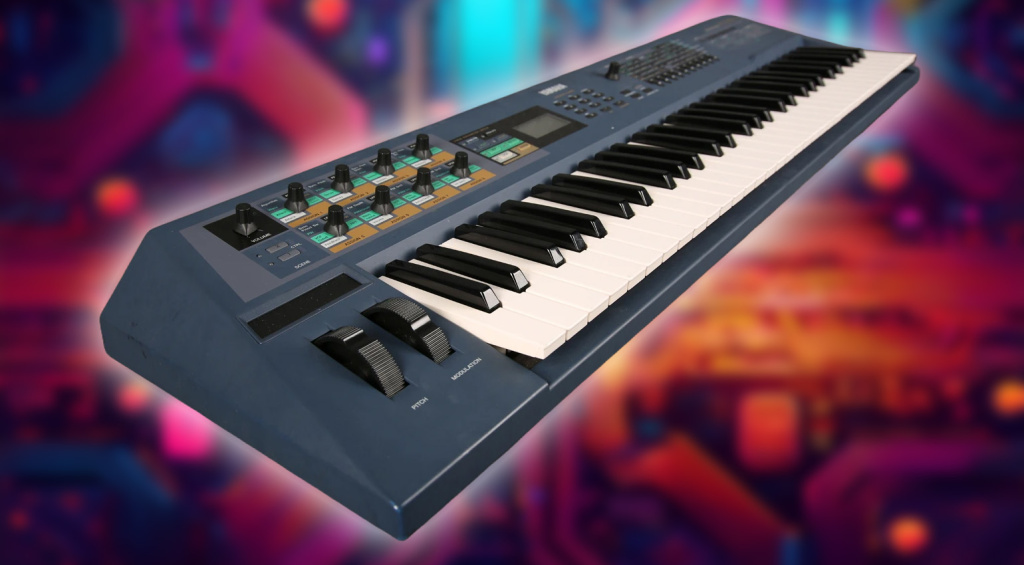
Yamaha’s entry into the dedicated virtual analogue market arrived in 1997 with the AN1x, following the release of its sample-based sibling, the CS1x. While the CS1x utilized a lightweight AWM2 PCM sample engine styled after the Nord Lead’s aesthetic, the darker blue AN1x housed a sophisticated DSP engine designed to emulate vintage analog polysynths, drawing structural inspiration from legendary instruments like the Sequential Circuits Prophet-5.

The AN1x offered 10 voices of polyphony, two-part multitimbrality, a ribbon controller, and comprehensive parameter scene morphing. Beneath its plastic chassis lay a hybrid engine that leveraged FM mathematics to generate warm, rich analogue-style waveforms and complex harmonic textures. Despite its sonic prowess, the hardware interface relied on an eight-knob matrix system that required users to navigate multi-layered parameter pages, though Yamaha mitigated this with the pioneering computer-based editor software, AN1xEdit.

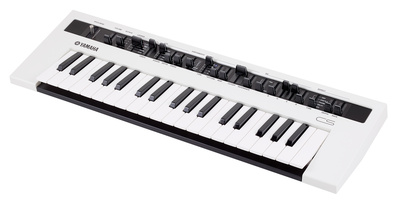
While Yamaha eventually transitioned its virtual analogue technology into modern workstations like the Montage M and MODX M series, as well as the portable Reface CS, the secondary market continues to value original AN1x units. Furthermore, contemporary hardware and software developers have recognized its enduring appeal; boutique developers such as Isla Electronics have developed faithful software and hardware emulations, including the VANIX engine designed for their hybrid synthesizer platforms, cementing the AN1x’s reputation as a mid-90s masterclass in DSP programming.

The Trance Anthem Machine: Roland JP-8000 (1996)
Released in 1996, the Roland JP-8000 positioned itself firmly at the vanguard of the virtual analogue revolution, providing a comprehensive, hands-on control surface and a digital architecture tailored explicitly for electronic dance music producers. Available both as a 61-key keyboard and as the rackmount JP-8080—which added increased polyphony and an integrated vocoder—the instrument became a fixture in professional studios worldwide.

The defining characteristic of the JP-8000 was the "Supersaw" waveform. Engineered specifically to cut through dense mixes, the Supersaw combined seven detuned sawtooth oscillators per voice into a single, massive, harmonically rich wave. This single feature became the sonic bedrock of the global trance and techno explosion of the late 1990s and early 2000s, deployed universally for anthemic leads, pads, and rhythmic arpeggios.

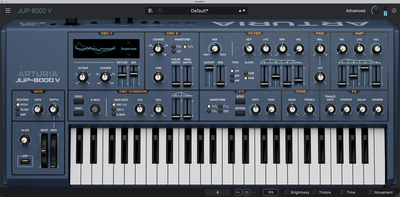
Beyond its signature oscillator topology, the JP-8000 featured a robust multi-mode filter, an onboard real-time phrase sequencer, and a comprehensive effects section. Its direct workflow and immediate tactile feedback loop established a benchmark for hardware synthesizer ergonomics. Today, the instrument’s legacy is preserved both through rising vintage hardware valuations and modern software recreations, including Arturia’s Jup-8000 V and independent DSP emulations like The Usual Suspects’ JE-8086, ensuring the Supersaw remains accessible to contemporary producers.

The DSP Heavyweight: Access Virus (1997)
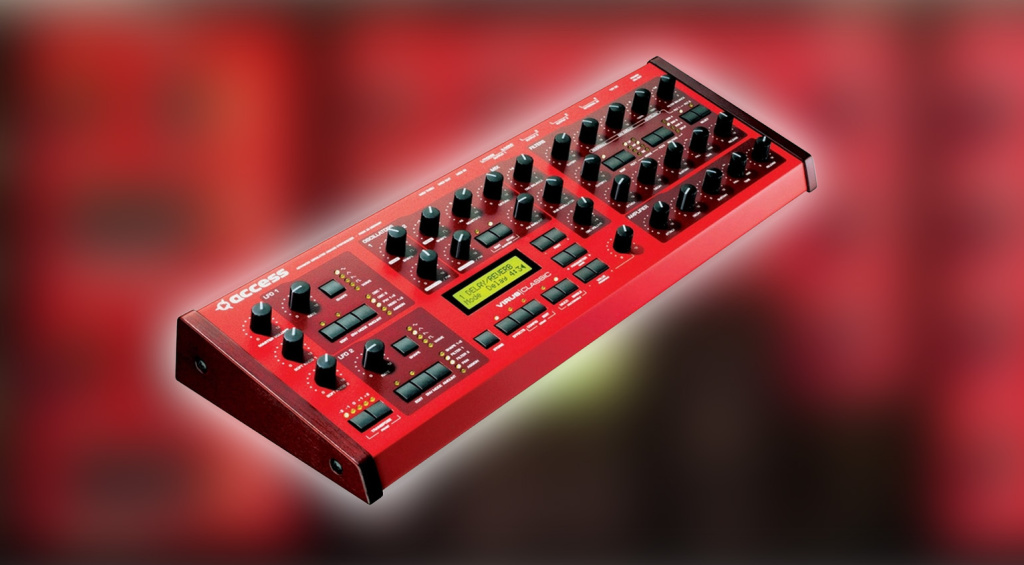
Arriving slightly later in the 1990s wave of virtual analogue instruments, the Access Virus series established a reputation for sonic depth and versatility that many engineers consider peerless. Manufactured by German company Access Music, the original Virus A debuted in 1997 as a compact tabletop and rackmount unit powered by Motorola 56000-series DSP chips. It was followed in 1999 by the extensively revised Virus B, which introduced expanded polyphony, improved hardware specifications, and a highly anticipated keyboard configuration. Subsequent iterations included the Virus C and the advanced Virus TI (Total Integration) series.

The architecture of the original Virus family was celebrated for its lush resonant multi-mode filters, flexible modulation matrix, and high-quality onboard digital effects. It provided users with deep sound-design capabilities wrapped in a logical, efficient user interface, positioning it as a serious professional alternative to the flagship hardware offerings of major Japanese manufacturers.

Although official hardware production of the Virus series concluded in the 2010s, the platform’s footprint in electronic music history remains profound. Advanced DSP emulation projects, such as Osirus and Ostirus, have successfully ported the exact behavioral code of the Motorola 56k architectures to native computer environments, allowing modern users to harness the exact sonic characteristics of the Virus A, B, C, and TI generations within contemporary production environments.
Conclusion
The virtual analogue synthesizers introduced during the 1990s successfully transformed electronic music production by merging the reliable stability of digital processing with the expressive workflow of traditional subtractive synthesis. The Clavia Nord Lead, Korg Prophecy, Yamaha AN1x, Roland JP-8000, and Access Virus each approached the emulation of analogue circuitry through distinct engineering philosophies. Together, they laid the technical and aesthetic foundation for modern virtual instrument design. Decades after their initial releases, these five pioneering instruments continue to command significant attention on the secondary market and through software adaptations, proving that the digital innovations of the 1990s achieved a timeless musical relevance.