Morphoice Unveils EightyTen: A Dual Vintage Roland Synthesizer Emulation Enters Free Beta

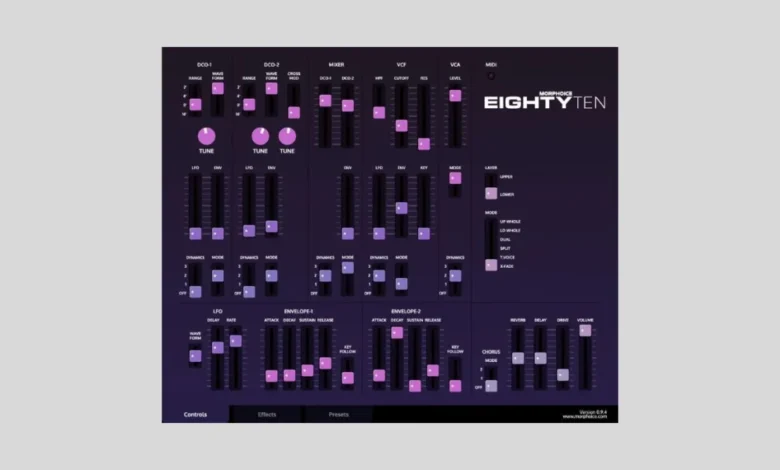
Developer Morphoice has launched EightyTen, a new free beta software instrument that meticulously recreates the sonic architecture of two iconic vintage Roland synthesizers: the JX-8P and its more expansive sibling, the SuperJX-10 (and its rackmount counterpart, the MKS-70). This release continues Morphoice’s recent trajectory of delving into the rich heritage of analog synthesis, offering musicians a powerful and accessible tool to capture the distinctive sounds of the 1980s. EightyTen is available now for macOS, Windows, and Linux in AU, VST, and VST3 plugin formats.
A Legacy of Emulation: Morphoice’s Vintage Synth Journey
Morphoice has rapidly established a reputation for its dedication to preserving and reinterpreting classic synthesizer sounds. In a relatively short period, the independent developer has brought forth notable emulations, including the Yamaha CS-80 (Unstable), the Roland Juno-6 (EightySix), and the Roland Jupiter-8 (EightyEight). Each of these previous releases has been characterized by a commitment to sonic authenticity, aiming to provide users with the character and functionality of the original hardware instruments within a modern digital workflow.
EightyTen follows this established pattern. It is being offered as an early beta, a common practice for Morphoice that allows users to engage with the software during its development phase. This approach also carries a specific licensing model: while the beta is freely available, there is an implicit understanding that future, fully released versions might transition to a paid model. However, Morphoice is incentivizing early adoption and support by offering a lifetime license to any user who contributes $10 or more to the project. This tiered approach acknowledges the development costs while democratizing access to cutting-edge emulation technology.
The Sonic Fusion: JX-8P and SuperJX-10/MKS-70
The core of EightyTen’s appeal lies in its ambitious integration of two influential Roland instruments. The Roland JX-8P, released in 1985, was a programmable six-voice polyphonic analog synthesizer known for its distinctive string, pad, and lead sounds. It featured a DCO (Digitally Controlled Oscillator) per voice, a resonant low-pass filter, and a non-resonant high-pass filter, alongside two ADSR envelope generators and Roland’s signature stereo chorus effect. Its relatively straightforward architecture made it a popular choice for those seeking warm, analog textures.
Building upon the JX-8P’s foundation, Roland introduced the SuperJX-10 in 1986. This flagship instrument doubled the polyphony to twelve voices and, crucially, integrated two JX-8P sound engines into a single unit. This dual-engine design allowed for the layering of two distinct six-voice patches, creating richer, more complex sonic textures and significantly expanding the instrument’s expressive capabilities. The SuperJX-10 also offered advanced performance features and a more intuitive interface, especially when paired with the optional PG-800 programmer. The MKS-70 is the rackmount variant of the SuperJX-10, offering the same dual-engine power in a more studio-friendly format.
EightyTen aims to encapsulate the best of both worlds. It provides access to the fundamental sound-generating capabilities of the JX-8P while also offering the expanded polyphony and layering potential inherent in the SuperJX-10 and MKS-70. This duality allows users to explore both the focused, classic JX-8P tones and the more expansive, layered soundscapes achievable with its successors.
Key Features: Unlocking the Vintage Sound Palette
EightyTen meticulously recreates the key sonic elements that defined the JX-8P and SuperJX-10. At its heart are the DCOs, which provide stable and rich analog waveforms. A standout feature inherited from these Roland classics is Cross Modulation. This technique allows the output of one DCO to modulate the pitch of the other, a feature that opens up a world of FM-like timbres. This capability is particularly noteworthy for its ability to generate gritty, metallic, and harmonically rich sounds that were previously the exclusive domain of FM synthesizers like the Yamaha DX7. This feature alone offers producers a powerful tool for recreating iconic 80s sounds, such as the distinctive synth basslines and lead melodies heard in tracks like Chaka Khan’s "I Feel For You."
The instrument also faithfully replicates the JX-8P’s sophisticated filter section. This includes a 24 dB/octave low-pass filter, known for its warm and musical cutoff characteristics, capable of producing everything from smooth basses to searing leads. Complementing this is a non-resonant high-pass filter, which allows for precise tonal shaping by removing unwanted low frequencies without adding unwanted coloration.
Each voice in EightyTen is equipped with two ADSR envelope generators. These envelopes control the amplitude and filter cutoff over time, providing essential control over the dynamic evolution of a sound. The ability to independently shape the attack, decay, sustain, and release for both amplitude and filter offers significant expressive flexibility.
No emulation of these Roland synths would be complete without the inclusion of Roland’s legendary stereo chorus effect. EightyTen offers this iconic effect with both fast and slow settings, allowing users to add width, depth, and shimmering analog character to their sounds. This chorus is a hallmark of the JX series and is indispensable for achieving those classic Roland pad and string textures.
Furthermore, EightyTen incorporates velocity and aftertouch response. This ensures that the plugin behaves like a true hardware synthesizer, allowing for dynamic and expressive performances. Playing with velocity sensitivity can alter the loudness or filter cutoff, while aftertouch can modulate parameters like vibrato or filter resonance, adding a human and nuanced feel to the sound. The interface is also designed to be intuitive, drawing inspiration from the familiar layout of the PG-800 programmer, which was the de facto controller for the JX-8P and SuperJX-10, making parameter tweaking a more direct and tactile experience.
Modern Enhancements: Beyond Pure Emulation
In line with Morphoice’s established approach, EightyTen doesn’t limit itself to a purely historical recreation. The developer has thoughtfully integrated modern effects that complement the vintage sound engine, offering expanded creative possibilities.
Among these enhancements is the DarkStar Reverb, an effect inspired by the acclaimed Strymon BigSky multi-effects pedal. This high-quality reverb provides a wide range of atmospheric textures, from subtle room simulations to vast, ethereal soundscapes, bringing a contemporary polish to the vintage tones.
Additionally, EightyTen includes a lo-fi tape delay effect. This adds a distinct character, emulating the imperfections and warmth of analog tape echo. It can introduce subtle saturation, wow, and flutter, lending a nostalgic and slightly gritty texture to any sound.
Rounding out the modern additions is the HeatBurn drive and distortion effect. This effect allows users to push the analog signals into saturation and overdrive, adding grit, aggression, and harmonic richness. It’s a versatile tool for transforming smooth analog pads into powerful leads or adding edge to basslines. These integrated effects mean users can achieve complex and polished sounds directly within the EightyTen plugin, reducing the need for external processing.
Beta Program and Community Engagement
The release of EightyTen as a free beta underscores Morphoice’s commitment to community-driven development. By making the software available in its early stages, Morphoice invites musicians and sound designers to provide valuable feedback, identify bugs, and suggest improvements. This collaborative approach helps shape the final product, ensuring it meets the needs and expectations of its target audience. The beta period is also an excellent opportunity for users to explore the capabilities of these classic Roland synths without financial commitment, fostering a broader appreciation for their sonic legacy.
The availability of EightyTen across multiple operating systems (macOS, Windows, and Linux) and in standard plugin formats (AU, VST, VST3) ensures broad compatibility with most modern digital audio workstations (DAWs). This accessibility is crucial for independent developers like Morphoice, allowing their creations to reach a wide and diverse user base.
The Broader Impact: Democratizing Vintage Synthesis
The continued release of high-quality, accessible emulations like EightyTen has a significant impact on the music production landscape. For many aspiring musicians, acquiring vintage hardware synthesizers can be prohibitively expensive or logistically challenging. Software emulations bridge this gap, providing authentic sonic experiences at a fraction of the cost and with the convenience of digital integration.
Morphoice’s strategy of offering beta versions for free and incentivizing donations for lifetime licenses is a sustainable model that balances accessibility with the need for developer support. It allows the community to directly influence the development process and contribute to the ongoing availability of these valuable tools.
The inclusion of features beyond pure emulation, such as the DarkStar Reverb and HeatBurn drive, demonstrates a forward-thinking approach. It recognizes that while the core of vintage synthesis is invaluable, modern production often benefits from contemporary effects and processing capabilities. EightyTen, therefore, offers a potent blend of nostalgia and innovation.
As the music industry continues to embrace a hybrid workflow of hardware and software, instruments like EightyTen play a crucial role. They not only preserve sonic history but also empower a new generation of creators to experiment, innovate, and craft unique musical identities using the sounds that shaped modern music. The EightyTen beta is a testament to this ongoing evolution, offering a compelling glimpse into the vibrant future of digital synthesis.
Download Information:
EightyTen is currently available as a FREE beta. Contributions of $10 or more grant users a lifetime license.
Download Link: https://www.morphoice.com/eightyten