The landscape of music production, mixing, and sound design continues to evolve at a breakneck pace, driven by rapid advancements in digital signal processing (DSP), machine learning, and workflow optimization. As software developers push the boundaries of what is possible inside a Digital Audio Workstation (DAW), audio engineers and producers are continually forced to re-evaluate their toolkits. While standard DAW stock plugins have reached an unprecedented level of quality—often satisfying the technical requirements of professional-grade mixing on their own—third-party developers must offer something genuinely transformative to justify their place in modern sessions. Rather than merely recreating analog hardware, the standout software releases of 2026 focus heavily on intelligent workflow integration, multi-dimensional processing, and hybrid sound-shaping capabilities that bridge the gap between mixing utilities and experimental instruments.
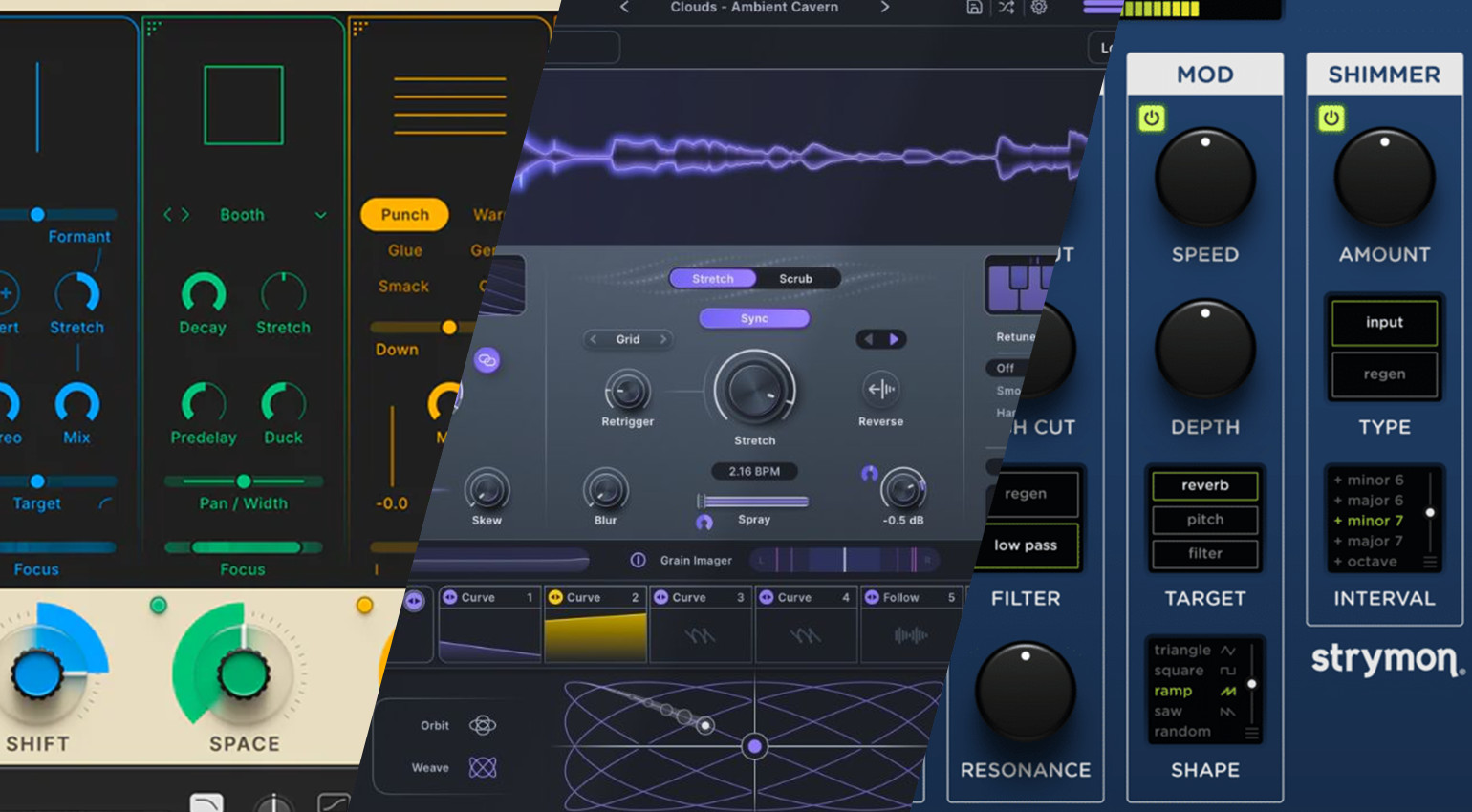
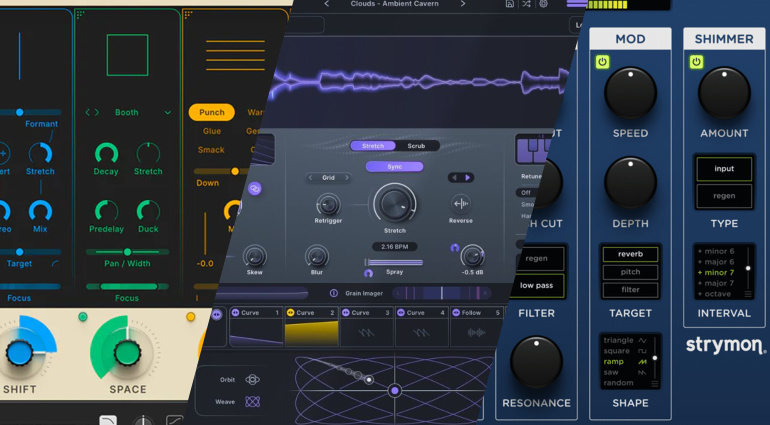
A retrospective analysis of the software releases over the course of the year reveals a clear dichotomy in industry demand. On one end of the spectrum, engineers require ultra-precise, transparent mixing tools that can solve complex frequency and dynamics issues in dense arrangements. On the other end, electronic music producers and sound designers lean toward granular engines, multi-effects suites, and pedal-to-plugin ports that expand the sonic footprint of software synthesizers. Evaluating these releases against the baseline of modern stock plugins provides a clear window into how the industry determines value, focusing on efficiency, creative inspiration, and sonic fidelity.
FabFilter Pro-C 3: Redefining Dynamic Control within an Integrated Ecosystem
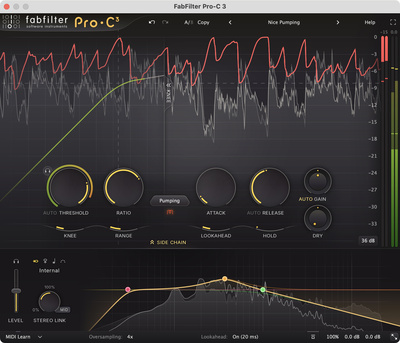
Among the most anticipated utility releases of the year, FabFilter’s Pro-C 3 arrived as the latest iteration of an industry-standard compressor plugin. The compressor market is saturated with emulations of vintage hardware and algorithmic designs, yet Pro-C 3 carved out significant market share by expanding its architectural flexibility while maintaining the clean, intuitive graphical user interface that the brand is known for. The plugin introduces a total of 14 distinct compression styles, incorporating six new algorithms: Vari-Mu, Op-El, Upward, Versatile, Smooth, and TTM (To The Max). This broad selection equips engineers with specific character responses tailored for everything from delicate vocal leveling to aggressive drum bus glue.
Beyond topological emulation, Pro-C 3 addresses modern hybrid mixing demands by integrating three dedicated analog modeling saturation modes—Tube, Bright, and Diode—which can be routed either pre- or post-compression. Triggering options have also been significantly upgraded, featuring an intelligent Auto Threshold feature and DAW host BPM synchronization modes that simplify sidechain ducking and rhythmic pumping effects. For spectral control, the built-in 6-band sidechain EQ now supports per-band mid-side processing, allowing users to isolate frequencies and spatial dimensions before they hit the detector circuit.

Perhaps the most consequential advancement of the Pro-C 3 release is its integration into the broader FabFilter ecosystem. By linking directly into the Pro-Q 4 instance list, the compressor becomes part of a centralized monitoring and management network. Engineers can access and navigate every active instance of the plugin from a single view, streamlining large sessions and significantly reducing the cognitive load associated with complex mixing environments.
Three-Body Technology UNMASK: Tackling Frequency Conflicts with Spectral Precision

Frequency masking remains one of the most persistent bottlenecks in modern mixing, often muddying dense arrangements and robbing individual elements of their punch. To combat this, Three-Body Technology introduced UNMASK, an advanced multi-dimensional audio processor designed to perform continuous, real-time analysis of input signals to maximize clarity and instrument separation. Moving beyond traditional sidechain compression or static dynamic EQ, UNMASK utilizes a three-pronged analytical approach targeting spectral, tonal, and temporal anomalies.
The spectral (SPEC) section functions as an intelligent resonance suppressor, identifying and attenuating harsh frequency build-ups whether they sit prominently in the mix or are buried beneath layers of instrumentation. Concurrently, the tonal (TILT) section applies sophisticated target frequency curves to balance the overall spectral profile, ensuring that tracks meet modern loudness and tonal distribution standards without requiring excessive manual automation.
The temporal (TIME) processing capabilities address time-based masking, a frequent issue where transient-heavy sounds like drums obscure the sustained tails of vocals or melodic instruments. By utilizing psychoacoustic processing—specifically via the EXT Glue feature—UNMASK optimizes the transient relationship between overlapping elements, such as the kick drum and bass guitar, creating distinct acoustic space without sacrificing low-end weight or dynamic integrity.
XLN Audio DB-30 Drum Butter: Specialized Multi-Effects for Rhythm Section Shaping

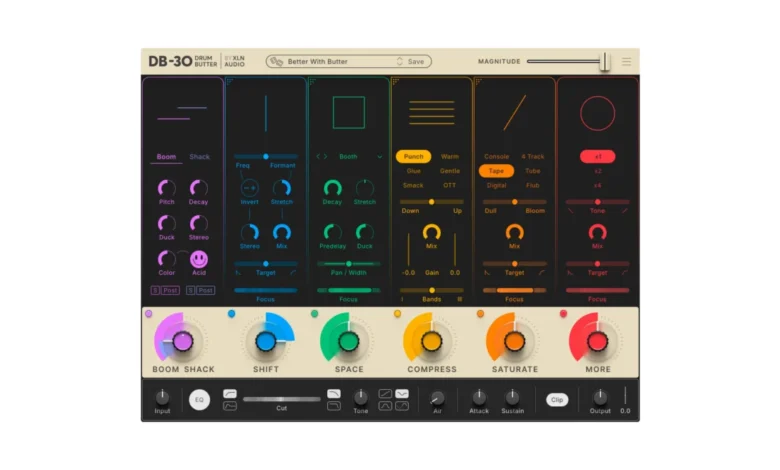
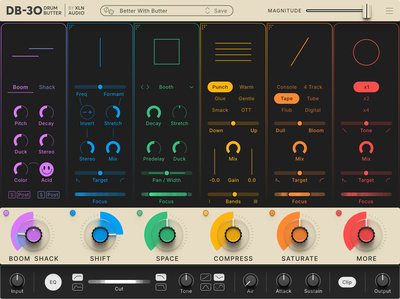
Following the enduring success of their vintage multi-effect processor RC-20 Retro Color, XLN Audio expanded its product line with the release of DB-30 Drum Butter, a specialized processor engineered explicitly for drums and percussion. Recognizing that rhythm sections require a distinct combination of transient manipulation, saturation, and spatial depth, XLN Audio built DB-30 around six interchangeable processing modules housed within a modular workflow architecture.
The module lineup includes Boom Shack for low-end enhancement and noise generation, Shift for pitch and formant manipulation, Space for ambient reverb application, Compress featuring six distinct operational modes, Saturate with six saturation topologies, and More for advanced waveshaping and hard clipping. Users can reorder these modules freely to taste, and control the aggregate processing intensity via a global Magnitude parameter. Furthermore, most individual modules include a Focus control, enabling producers to target specific frequency ranges rather than applying broad-stroke processing to the entire drum bus. Backed by over 250 professionally designed presets and comprehensive global transient-shaping and clipping controls, DB-30 Drum Butter established itself as an indispensable tool for producers working across hip-hop, electronic, and modern pop genres.

Strymon NightSky: Bringing Hardware Ambient Reverb into the DAW Environment
The blurring line between hardware effects pedals and software plugins reached a new milestone with the release of Strymon’s NightSky plugin, a direct software adaptation of the company’s acclaimed experimental reverb pedal. Designed primarily for sound designers, ambient artists, and electronic music producers, NightSky moves far beyond traditional room and plate simulations to offer deeply manipulable spatial soundscapes.

The plugin offers three distinct core reverb architectures: a reflective Sparse mode, a rapid and dense plate-like setting, and a gradual Diffuse mode designed for evolving ambient swells. Its defining characteristic, however, is its pitch-quantization engine. As the reverb tail expands, the underlying pitch can be altered across 11 selectable musical scales, creating cascading, harmonically rich textures that track the key of a composition. This pitch behavior can be automated for organic, evolving results.
Additional creative tools include a Shimmer effect for pitch-shifting reverb tails up or down by musical intervals, a Glimmer effect to emphasize upper harmonics, and a Drive stage for analog-style saturation. Supported by an onboard modulation section driven by assignable LFOs and envelope generators, NightSky functions less like a conventional mixing utility and more like an expressive extension of software synthesizers and melodic instruments.

Minimal Audio Lucid: Surreal Granular Sound Manipulation in Key
Rounding out the standout releases of the year, Minimal Audio introduced Lucid, a surrealist granular multi-effects processor capable of transforming standard audio signals into complex textures while strictly adhering to predetermined musical keys. Lucid captures audio in real-time, feeding it into a granular engine controlled by Stretch and Scrub parameters. While Stretch locks time-stretching tasks to the host DAW’s timeline, Scrub allows users to manually navigate through the internal audio buffer for stutter and glitch effects.

Lucid’s internal pitch-detection architecture ensures that all generated grains are automatically transposed to fit a selected scale, complemented by a dedicated Chord mode and an integrated arpeggiator with adjustable note intervals. To maintain production-ready control over the resulting surreal soundscapes, the plugin features a multi-mode filter, a stereo image processor, and a grain-level delay system. An advanced modulation matrix equipped with six modulation slots, paired with an eight-effect processing rack featuring compression, EQ, distortion, and frequency shifting, solidifies Lucid’s position as a powerful, highly musical creative processor.
Broader Industry Implications and Outlook
The software release cycle demonstrates that the current audio plugin market is maturing past simple hardware emulations. Developers are increasingly focusing on computational efficiency, deep DAW integration, and cross-plugin ecosystems—as seen with FabFilter’s unified instance tracking—while simultaneously delivering specialized tools like XLN Audio’s drum processor and Strymon’s experimental reverb port. As machine learning-assisted mixing tools and advanced granular engines become more accessible, the barrier between technical corrective mixing and creative sound design continues to dissolve, giving producers unprecedented control over their sonic palettes.
Related posts: