The Genesis of an Obsession: From Magazine Feature to Compendium
The trajectory of The Drum Thing began not as a sprawling literary project, but as a focused assignment for a magazine. Irish-born photographer Deirdre O’Callaghan, who relocated to London in her early adulthood to pursue her craft, initially set out to document only eight drummers. However, the scope of the project expanded exponentially following a chance encounter with the legendary jazz drummer Roy Haynes at Ronnie Scott’s Jazz Club in London.
The realization that the drum kit is an extension of the drummer’s personality—and that their living space reflects the rhythm of their lives—prompted O’Callaghan to broaden her vision. Collaborating with Sarah Lowe, wife of Bad Seeds drummer Jim Sclavunos, O’Callaghan began systematically mapping the global drumming community. This research phase, which spanned several years, transformed a fleeting magazine feature into a comprehensive cultural document.
The chronology of the project highlights the dedication required to capture such an elusive subject matter. Between the initial spark in the mid-2000s and the final publication, O’Callaghan meticulously curated a list that bridged generations and genres. By moving away from the "live performance" aesthetic, the photographer successfully captured the domestic reality of artists who are typically only seen under the harsh, artificial light of concert venues.
The Architecture of Rhythm: Personal Spaces and Creative Habitats
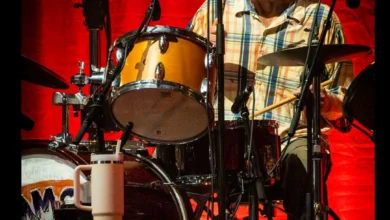
Central to the success of the book is O’Callaghan’s deliberate choice to photograph subjects in their own environments. In an era where digital content often prioritizes the "polished" image, O’Callaghan’s approach is refreshing in its groundedness. She notes that for a drummer, the placement of the kit is rarely incidental; it is a manifestation of their relationship to the instrument.
One of the most profound examples documented in the book is the studio of the late avant-garde icon Milford Graves. Describing his workspace as a "wizard’s lair," O’Callaghan provides a rare glimpse into the laboratory of a man who treated drumming as a scientific and spiritual pursuit. Such spaces serve as physical evidence of the musician’s internal process. O’Callaghan’s methodology—setting up shots in situ rather than capturing candid, "fly-on-the-wall" moments—allows for a deliberate, artistic collaboration between the photographer and the subject. This technique ensures that the resulting imagery is not merely a record of a person, but a portrait of their creative ecosystem.
Comparative Perspectives: Voices from the Kit
The book is enriched by interviews that accompany the photography, offering a cross-section of philosophies regarding the art of percussion. The dialogue included in the volume demonstrates a wide spectrum of thought, from the pragmatic to the philosophical.
Patrick Carney of The Black Keys offers a democratic view of the instrument, suggesting that the capacity for greatness is latent in anyone willing to pursue it. Conversely, legendary R&B drummer James Gadson presents a more traditional, perhaps more fatalistic perspective, echoing the sentiment that rhythm is an innate, inherited trait rather than a learned skill.
More analytical contributions, such as those from Lenny White, provide historical context for the evolution of jazz percussion, particularly in the shadow of Miles Davis. Tyshawn Sorey, an artist whose work defies simple categorization, offers a modern, structuralist view of the instrument. His assertion that he views himself primarily as an "orchestrator" rather than a "timekeeper" reflects the shifting role of the drummer in contemporary music—a move toward melodic and harmonic integration that marks the current era of drumming.
The Evolution of Documentary Photography
Before the success of The Drum Thing, O’Callaghan gained critical recognition for her long-term social documentary project, Hide That Can. For that work, she spent four years embedded with the men of Arlington House, a hostel in Camden, London. That project established her ability to gain the trust of marginalized or guarded communities, a skill she translated effectively to the world of world-class musicians.
The photographic style of the new volume, characterized by its vibrant color and staged compositions, marks a transition from the starker, monochromatic documentary work of her earlier career. While some critics argue that the "staged" nature of the shots may detract from the raw, kinetic energy of a live performance, the result is a cohesive aesthetic that elevates the drummer to the status of a fine art subject. The production quality of the 256-page volume reflects the prestige of the publisher, Prestel, ensuring that the work is not only an intellectual resource but a tactile, visual experience.
Broader Implications for Music Historiography
The publication of this compact edition of The Drum Thing serves as a significant contribution to music history. By centralizing the drummer, O’Callaghan challenges the traditional hierarchy of the rock and jazz band, which often prioritizes vocalists or lead instrumentalists.
From an academic perspective, the project functions as an oral history. The varying degrees of insight provided by the subjects allow future researchers to map the shifting professional identity of the musician over the last decade. The data points—ranging from the influence of technological advancements in drum kit manufacturing to the changing socioeconomic conditions of working musicians—are embedded within these interviews and images.
Furthermore, the book highlights the importance of archiving the environments of creative professionals. Just as the architecture of a studio informs the sound of a record, the living environment informs the psyche of the musician. By capturing these spaces, O’Callaghan has preserved a vanishing cultural geography, especially as home studios become increasingly digitized and less reliant on the physical "wizard’s lairs" of the past.
Final Assessment and Market Impact
As a comprehensive resource, the book remains a staple for fans of percussion and students of music photography. With its inclusion of diverse genres—spanning jazz, blues, rock, and experimental music—the work avoids the trap of genre-specific insularity. The compact edition is specifically designed to make this extensive archive more accessible to students and enthusiasts who may have found the original 2016 hardcover edition prohibitive.
The Drum Thing by Deirdre O’Callaghan, published by Prestel, continues to occupy a unique space in the publishing market. It is a work that succeeds because it refuses to treat the drummer as a peripheral figure. By shifting the lens to the person behind the kit, and the environment behind the person, O’Callaghan has produced a work that is as much about the human condition as it is about the technical craft of music. For those seeking to understand the rhythm of the industry—both literally and metaphorically—this volume provides a window into the private world of those who keep the beat.