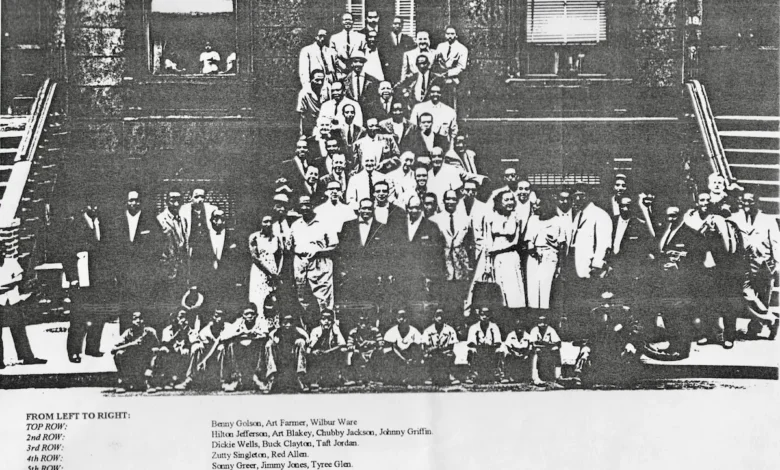
In the summer of 1958, a young freelance photographer named Art Kane embarked on an ambitious project that would unintentionally become a cornerstone of cultural history. His vision was simple: to capture the leading figures of the American jazz scene in a single frame. Kane sent out tentative invitations to musicians, expecting perhaps a handful of local performers to arrive at a Harlem brownstone. Instead, he was met with the sight of nearly 60 legends—including Dizzy Gillespie, Thelonious Monk, Coleman Hawkins, and Lester Young—gathering on a stoop at the ungodly hour of 10:00 a.m. This photograph, titled A Great Day in Harlem, became an immortal artifact of the 20th century, eventually inspiring a documentary that solidified its status as the most significant group portrait in the history of the genre. Decades later, this iconic moment served as the blueprint for a British recreation that would capture the vibrant, albeit smaller, soul of London’s jazz community.
The Genesis of the Soho Recreation
The concept of replicating the 1958 phenomenon in a British context was spearheaded by jazz enthusiast Ray Bolden. Recognizing that the original Harlem gathering was a spontaneous, chaotic, and ultimately magical convergence of musical giants, Bolden sought to translate that energy to the historic jazz district of London. The chosen location was the grounds of St. Anne’s Church on Wardour Street in Soho—a site steeped in the history of the London jazz scene, located near the legendary Archer Street, once the primary hub for musicians seeking work and exchanging industry news.
The event, officially dubbed "The Great Day in Soho," was scheduled for June 24. While the formal call time for the musicians was set for 11:15 a.m., the reality of the community’s enthusiasm was immediate. By 11:00 a.m., the churchyard was already swarming with activity. Veteran musicians, many of whom had not seen one another in months, were observed exchanging warm greetings, reflecting the tight-knit nature of the London jazz circuit during that era.
Logistical Challenges and Orchestration
Organizing a congregation of professional musicians is notoriously difficult, a fact mirrored in the chaotic logistics of the original 1958 shoot. At St. Anne’s, the challenges were threefold: the constant flow of musicians arriving and departing, the curiosity of local passersby and children, and the physical constraints of the church grounds.
To achieve the necessary perspective for the wide-angle commemorative shots, the lead photographer, Peter Symes, positioned himself in a first-floor window of the church tower. This vantage point provided the elevation required to capture the full breadth of the crowd. However, corralling the musicians proved to be a formidable task. In a moment of improvisational leadership, the organizers utilized a loudhailer—reminiscent of a cinematic police standoff—to direct the crowd. Instructions such as "Come out, we know you are in there" served to break the tension and motivate the musicians to organize themselves into sections. By grouping them by their respective instruments—reeds, brass, percussion, and rhythm sections—the team managed to capture a series of cohesive photographs that preserved the identities of the individual artists while highlighting the collective strength of the British jazz movement.
Attendance Figures and Historical Context
Determining the exact number of participants in the Soho event remains a subject of minor debate among those present. While the 1958 Harlem photograph featured 57 legends, the London recreation saw a significantly larger turnout. Estimates provided by organizers and observers suggest that the total attendance fell somewhere between 150 and 200 musicians.
This discrepancy in numbers highlights the evolution of the jazz community from the mid-20th century to the period of the recreation. In 1958 Harlem, the invitation was exclusive and targeted toward the "titans" of the industry. In Soho, the gathering was more inclusive, representing a broader spectrum of the working jazz scene in London, which included established veterans alongside emerging talent. A final wide-angle shot taken by Peter Symes serves as the primary historical record of the event. While it does not capture every single attendee due to the transient nature of the crowd, the photograph offers a definitive visual testimony to the density of the jazz scene in the heart of London at the time. The background of the frame features the historic Archer Street, providing a tangible link to the legacy of the neighborhood.

Official Documentation and Correspondence
Following the event, the dialogue surrounding the success of the gathering continued through professional correspondence. Ray Bolden wrote to Jazz Journal in its September issue, officially titled "Swinging Day In Soho," to express his profound gratitude to the musicians who had taken the time to participate.
There exists a minor archival discrepancy regarding the naming of the event. While the photograph in the Jazz Journal files was initially labeled under the title of Bolden’s letter, the event itself was formally recognized by the organizers as "The Great Day in Soho." This naming convention was an intentional nod to the Harlem predecessor, serving to bridge the gap between the American originators and their British contemporaries. The editorial notes from the time emphasize that regardless of the title, the intent was to honor the legacy of the Harlem gathering by creating a similarly historic visual repository for the British scene.
Broader Impact and Cultural Implications
The significance of both the Harlem original and the Soho recreation extends beyond photography. These events act as cultural census records, documenting who was active, present, and influential within the jazz community at specific moments in time.
For jazz historians, these photographs are invaluable tools for identifying the social networks and professional hierarchies of the era. The 1958 Harlem photograph has been analyzed extensively, with historians noting that the image reflects the racial dynamics and the professional struggles of African American jazz musicians during the late 1950s. Similarly, the Soho recreation provides a snapshot of the post-war British jazz explosion, reflecting a period when Soho served as the epicentre of European jazz innovation.
The use of an informal, spontaneous approach to such a monumental task demonstrates the ethos of the jazz community itself: a reliance on improvisation, collective contribution, and mutual respect. The fact that an event organized with little more than a loudhailer and a group of willing participants could result in a permanent historical record speaks to the enduring dedication of the musicians involved.
Analysis of the Legacy
The legacy of "The Great Day in Soho" is twofold. First, it serves as a testament to the influence of the American jazz tradition on British artists. By consciously replicating Art Kane’s work, the British musicians were not merely mimicking a trend; they were participating in a global tradition of jazz camaraderie. Second, the event highlights the importance of institutional memory in the arts. By capturing these musicians in a collective space, the organizers ensured that a generation of talent—many of whom might otherwise have faded into the background of club history—would be preserved in a high-resolution, archival context.
As the years progress, these photographs gain value. They transition from simple group portraits to historical artifacts that allow future generations to "meet" the faces behind the records. The Soho gathering, while occurring in the shadow of the Harlem original, successfully carved out its own niche in the annals of music history, proving that the spirit of jazz is not confined to a single geography or era. It remains a definitive example of how community-driven initiatives can elevate a local scene into a matter of lasting historical importance. The final photograph by Peter Symes remains a vital piece of the Jazz Journal archives, serving as a reminder that with the right level of coordination and the necessary passion, even the most fleeting of musical gatherings can be rendered eternal.