The modern digital audio workstation has revolutionized the landscape of music production, providing creators with infinite track counts, pristine digital audio resolution, and limitless routing possibilities. Yet, as recording technology has advanced, producers and mix engineers have increasingly found themselves seeking ways to reintroduce the warmth, grit, and character associated with vintage hardware. This pursuit has driven the evolution of saturation plugins, tools that emulate the physical traits of analog circuit components—such as transistors, vacuum tubes, transformers, and magnetic tape—to enhance modern mixes.

Understanding the Mechanics of Harmonic Saturation
At its core, saturation occupies a unique space between a creative effect and a functional mixing tool. Historically, audio engineers encountered saturation as an unavoidable byproduct of pushing physical hardware to its operational limits. When magnetic tape or analog circuitry is driven hard, it introduces subtle amplitude distortion, generating even and odd harmonic overtones that enrich the frequency spectrum. Furthermore, this process performs natural peak shaping, acting similarly to soft-knee compression by rounding off fast transients and increasing perceived loudness without destroying dynamic range.

In contemporary digital signal processing (DSP), advanced analog modeling allows software developers to replicate these intricate physical behaviors within a digital environment. Unlike hard digital clipping, which produces harsh, unpleasant square waves, well-designed saturation plugins behave organically. They can be applied aggressively across individual tracks, buses, or the final master output while maintaining a musical and natural presentation.
Entry-Level Processing: Softube Saturation Knob
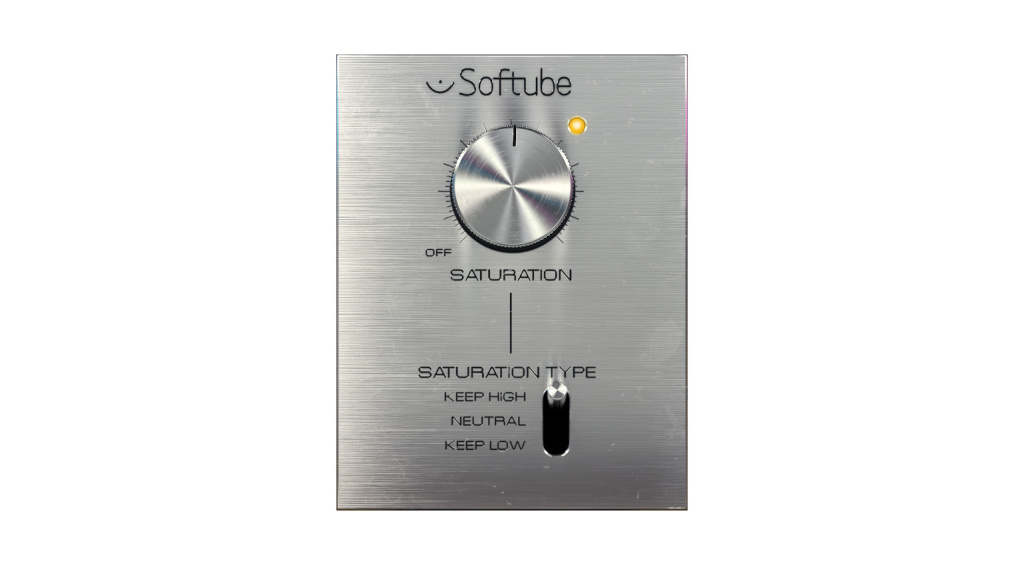
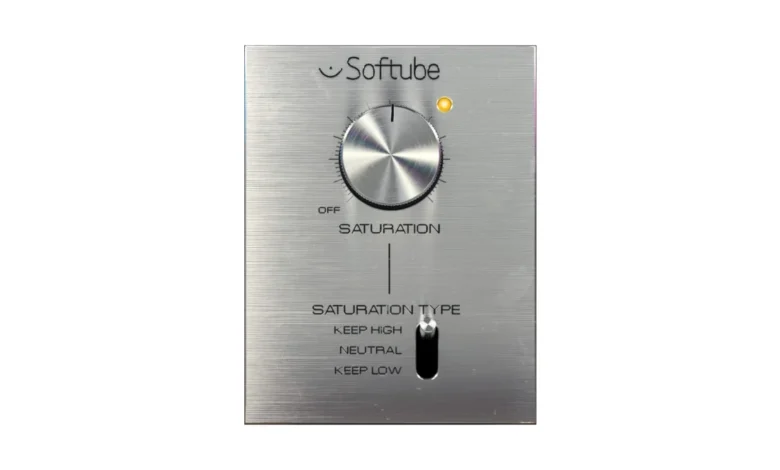
For producers beginning their journey into analog emulation, hardware-inspired simplicity often serves as the most effective educational tool. The Softube Saturation Knob provides a clear, cost-free entry point into the world of harmonic coloring. Utilizing a streamlined single-knob interface, the plugin allows users to immediately grasp how driving a signal impacts harmonic generation without navigating complex parameters.
Despite its minimalist exterior, the plugin features three distinct processing modes tailored to specific frequency ranges. The Neutral mode applies saturation evenly across the entire frequency spectrum. Conversely, the Keep High mode preserves high-frequency details by restricting processing to frequencies below approximately 2.5 to 3 kHz, making it ideal for maintaining vocal clarity or cymbal brightness. The Keep Low mode performs the inverse function, safeguarding low-end sub-frequencies below 150 to 200 Hz from muddying the mix. Because these modes are rooted in dynamic analog modeling, the internal filter behaviors shift in response to the character and level of the incoming audio signal, offering a realistic simulation of hardware circuitry.

Precision and Control: Wavesfactory Spectre
As mixing requirements demand more surgical precision, standard single-knob saturators often give way to advanced multiband and frequency-specific processors. Wavesfactory approached this challenge by designing Spectre, a plugin that merges the workflow of a parametric equalizer with multiband saturation architecture.
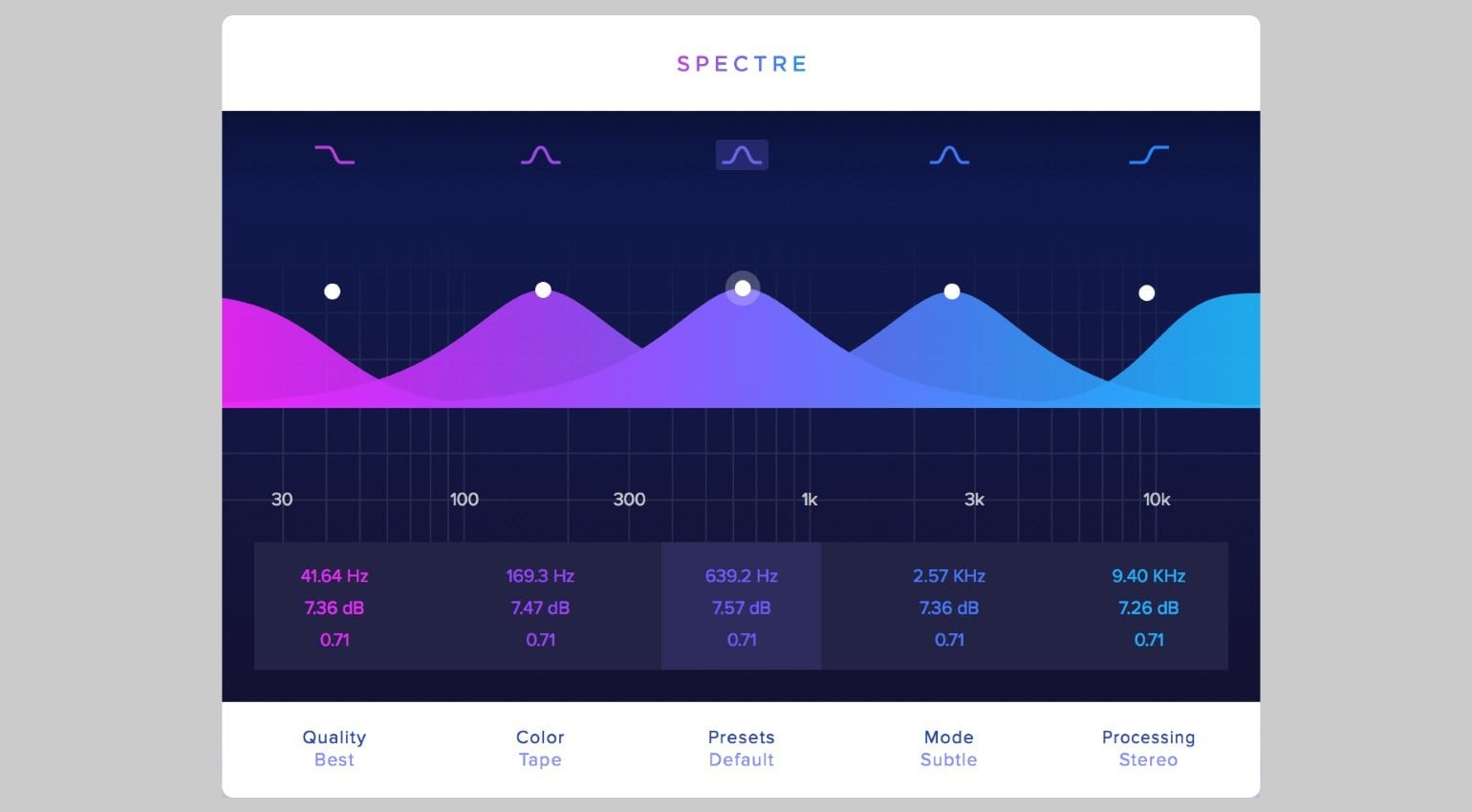
Spectre operates as a boost-only multiband processor across five adjustable frequency bands. When a band is boosted, only the newly added portion of the audio signal passes through a selection of ten distinct saturation algorithms, including tape, tube, solid-state, quantization, and rectifier models. To prevent excessive gain staging from overwhelming the mix engineer’s perception, Spectre incorporates a de-emphasis feature that proportionally pulls back gain at the boost point. This workflow allows engineers to apply specialized saturation characters to lows, mids, and highs—or target mid-side channels independently—while maintaining absolute control over spectral balance.
Synthesis-Level Complexity: FabFilter Saturn

For producers seeking deep sound design capabilities alongside standard mixing utility, FabFilter Saturn represents a benchmark in the software industry. Known for its distinct graphical interfaces and robust DSP architecture, Saturn offers twenty-eight diverse saturation and distortion modes, encompassing classic transformer, tube, and tape emulation alongside experimental options like guitar amplifiers, rectifiers, and digital bit-crushing algorithms.
Saturn’s multiband engine enables users to divide an audio signal into up to six adjustable frequency bands with variable slope controls. Each band can house a completely different saturation profile and be routed independently through a mid-side processing matrix. To maintain pristine audio fidelity during heavy processing, the plugin incorporates high-quality oversampling and a Linear Phase mode. However, Saturn’s defining feature is its extensive modulation matrix. By utilizing a drag-and-drop routing system, producers can assign 16-step XLFOs, envelope followers, envelope generators, and XY controllers to virtually any parameter, transforming saturation into a rhythmically reactive, synthesis-driven effect.

Industry Standard Character: Soundtoys Decapitator
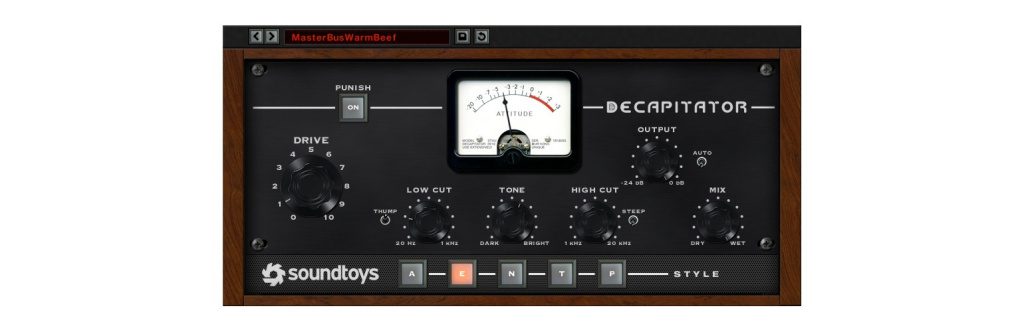
When industry professionals discuss analog hardware emulation, Soundtoys Decapitator consistently emerges as a preferred staple for mixing consoles worldwide. Decapitator simplifies the saturation workflow by synthesizing five distinct hardware models into a single, highly responsive interface.
The plugin’s analog selections are designated by letter-coded switches. The "A" setting emulates the tube preamp of an Ampex 350 tape machine, delivering a smooth, rounded drive. The "E" mode replicates the legendary EMI TG channel strip, prized for its rich midrange presence. The "N" setting captures the rare Neve 1057 germanium transistor channel strip, offering a distinct vintage texture. Finally, the "T" and "P" modes are modeled on the Thermionic Culture Vulture, providing even-order triode warmth and aggressive odd-harmonic bite, respectively.
Decapitator’s functional design extends beyond its saturation models, featuring integrated low-cut and high-cut filters positioned before and after the saturation stage to sculpt how processed audio sits within a dense arrangement. For moments requiring extreme energy, the signature "Punish" button injects an additional 20 decibels of gain into the circuit, generating a heavy, driven aesthetic suited for parallel processing and drum bus destruction.
Advanced Multiband Loudness: Soundtheory Kraftur
Representing a more recent technological advancement in British audio engineering, Soundtheory Kraftur approaches saturation and soft-clipping with a focus on maximizing perceived loudness while safeguarding critical transient information on the mix bus. Sold alongside its companion plugin, Kraftur Focus—which facilitates phase-coherent parallel processing—this high-end processor redefines traditional mixing paradigms.

Rather than relying on a conventional dry/wet mix control, Kraftur employs a vector-based blending interface that balances three distinct audio streams: the unprocessed dry signal, a broadband-processed signal, and a phase-coherent multiband split signal with variable crossovers. Engineers can adjust parameters such as Drive to control input gain, Knee to alter saturation transitions, Offset to target quieter signal details, and frequency-specific shifts to manage thresholds. Combined with built-in loudness matching and output brickwall limiting, Kraftur provides a sophisticated solution for modern mastering environments.
Broader Implications for Modern Music Production
The proliferation of advanced saturation plugins highlights a broader philosophical shift in contemporary audio engineering. While early digital production strove for sterile, transparent perfection, the contemporary consensus embraces controlled imperfection. By utilizing tools that reintroduce harmonic complexity, producers can achieve professional, commercially competitive loudness and warmth without sacrificing the clarity enabled by digital workstations. As DSP technology continues to evolve, the boundary between physical analog hardware and software emulation grows increasingly narrow, cementing saturation as an indispensable pillar of modern sound engineering.
Related posts: