Historical Context and the Evolution of the 1U Format
The Eurorack standard, originally popularized by Dieter Doepfer in the mid-1990s, is primarily defined by its 3U height. However, the empty space often found above or below these modules led to the development of the 1U format. Initially, this space was utilized sparingly for basic utilities—simple mults, attenuators, or power distribution. Over the last decade, however, the 1U standard has faced a challenge: a lack of universal consistency. With both Intellijel and Pulp Logic establishing competing 1U mounting standards, adoption remained fragmented for years.
The current resurgence is marked by a newfound stability in the market, as manufacturers increasingly align their output with the needs of the modern, mobile, and space-conscious performer. By integrating complex logic, signal processing, and even sequencing into these narrow strips, developers are successfully proving that the 1U row is no longer just for "utility" but is a legitimate home for performance-ready instrumentation.
Koma Elektronik: Expanding the Experimental Palette
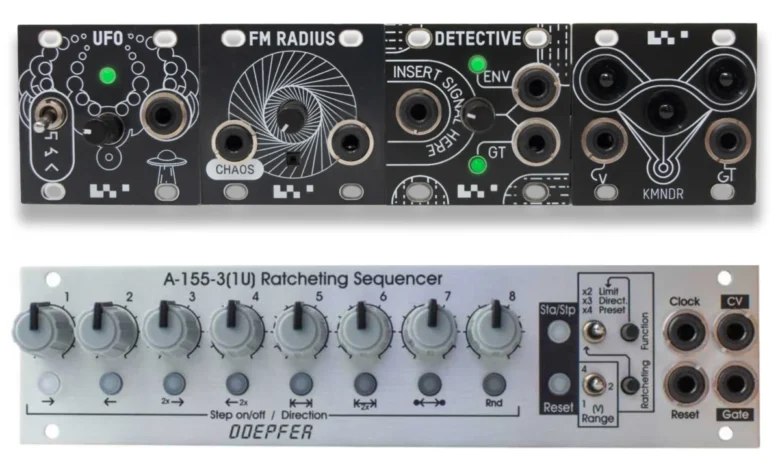
Koma Elektronik has positioned itself at the forefront of this 1U expansion, emphasizing unconventional interface design. Their latest suite of modules focuses on bringing leftfield, hands-on control to the compact form factor. The company’s strategy appears to be one of "essential experimentation," where they provide modules that alter how a user interacts with their system.
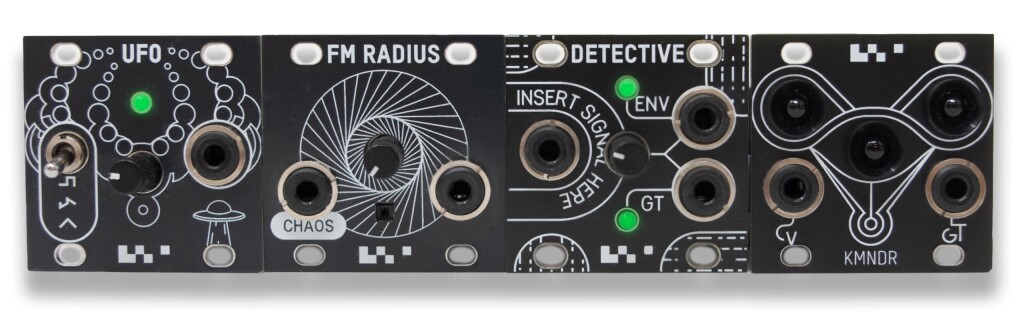
The KMNDR, or 1U Kommander, represents a notable entry in this space. By utilizing infrared light to sense hand proximity, it transforms a performer’s physical movement into Control Voltage (CV) and gate signals. This shifts the focus of modular synthesis from purely patch-cable logic to a gestural performance art. Similarly, the FM Radius brings a fully voltage-controllable FM radio receiver to the rack. By allowing the FM broadcast spectrum to be integrated into the signal path—whether as a source of modulation or as an raw audio input for filters and processors—Koma encourages the incorporation of "found" signals, a staple of experimental sound design.
Rounding out their current lineup are the Detective envelope follower and the UFO LFO. The Detective module provides a compact solution for extracting amplitude envelopes from external audio sources, a critical component for those wishing to integrate acoustic instruments or external hardware with their modular rig. The UFO LFO, with its three distinct waveforms, provides the modulation foundations necessary to keep these experimental inputs moving. These modules are currently available as part of a promotional campaign through the end of September, signaling an aggressive push to populate as many empty 1U rows as possible.
Doepfer’s Strategic Entry into 1U
The involvement of Doepfer, the company that effectively created the Eurorack market, carries significant weight. When Doepfer announced their 1U modules alongside a dedicated 7U case at Superbooth, it signaled that the format had officially achieved "first-class" status within the industry. Doepfer’s approach differs from the experimental leanings of Koma; they have focused on fundamental building blocks, refined through decades of experience.
The Doepfer 1U collection addresses the most common pain points for Eurorack users: the scarcity of VCA space and the need for flexible mixing. Their dual VCA module is a direct response to the recurring complaint that users never have enough gain stages to manage complex modulation routings. The 6-input/2-output mixer offers the versatility required for both mono and stereo sub-mixing, allowing users to consolidate signals before they hit the main output stage.
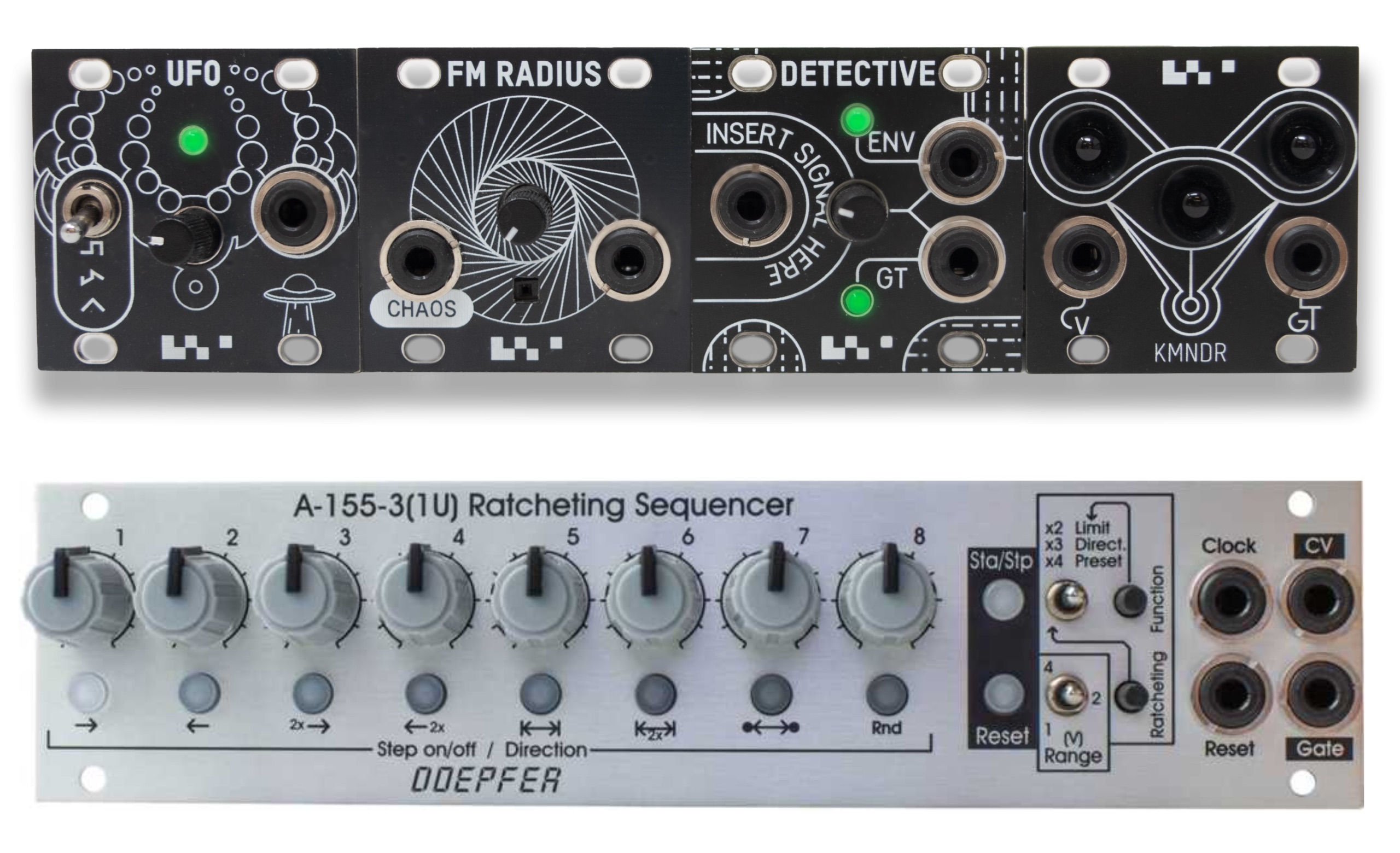
Perhaps the most ambitious addition is the A-155-3, a mini ratcheting sequencer. Traditionally, sequencing in 1U was limited to simple clock dividers or rudimentary logic. By introducing a sophisticated, ratcheting step-sequencer, Doepfer has demonstrated that the 1U row can sustain the creative engine of a patch. This module allows for rhythmic complexity that would otherwise require several times the horizontal space in a traditional 3U format. Coupled with their new MIDI-to-CV module, which uses standard minijacks to interface with external sequencers and DAWs, Doepfer has provided a comprehensive ecosystem that supports both standalone modular performance and hybrid studio setups.
Technical Implications and Market Impact
The shift toward high-density 1U integration has several implications for the modular synthesizer market. First, it addresses the "real estate" crisis inherent in professional and home studios. As the cost of high-quality Eurorack cases remains high, the ability to pack more functionality into a smaller footprint represents a significant value proposition. A 7U case equipped with a full 1U row provides a 14% increase in usable space compared to a standard 6U configuration, but the true value lies in the density of modulation and utility.
Second, the technical standardization of these modules—which now predominantly utilize the standard Eurorack power ribbon cables—reduces the barrier to entry for novice users. Historically, 1U modules often required specialized power adapters or custom mounting brackets. The current generation is largely "plug and play," compatible with any standard power bus board.
Third, there is a clear trend toward "Performance Utility." By placing envelope followers, sequencers, and infrared controllers within the 1U space, manufacturers are freeing up the main 3U rows for oscillators, complex filters, and unique sound sources. This creates a functional hierarchy within the system: the 1U row serves as the control and interaction layer, while the 3U rows serve as the synthesis engine.
Analysis of the Current Landscape
Industry observers note that the success of these new modules is intrinsically linked to the "Superbooth effect"—the annual Berlin-based trade show where innovation in modular synthesis is codified. The presence of Dieter Doepfer at recent demonstrations confirms that this is not a peripheral product line, but a central component of the company’s future roadmap.
From a production standpoint, the miniaturization of these circuits is a testament to advancements in Surface Mount Technology (SMT). By shrinking the physical footprint of control circuits, manufacturers can maintain the same signal-to-noise ratios and voltage ranges as their larger counterparts. However, this comes with a trade-off: the ergonomic challenge of dense patching. With jacks and knobs packed closer together, the 1U format requires a degree of precision and dexterity that may be daunting for some, but which many enthusiasts find liberating for the sake of portability.
Future Projections
As we move toward the final quarter of the year, the market is expected to see further consolidation of the 1U standard. The availability of these modules via major global retailers like Perfect Circuit and Thomann ensures that they are not relegated to boutique hobbyist sites, but are treated as standard inventory items. This level of distribution is a strong indicator of the long-term viability of the 1U format.
The ongoing "1Uesday" trend is more than a social media hashtag; it is a reflection of the maturation of the modular market. Users are moving past the "collection" phase—where the primary goal is to fill a case with expensive oscillators—and entering an "optimization" phase, where the goal is to make a system more musical, playable, and efficient. Whether through the experimental sensors of Koma Elektronik or the precision-engineered utilities of Doepfer, the 1U row is now an essential frontier of modern synthesis. For the modular user, the message is clear: if you have the rail, there is no longer any excuse for leaving it empty.