Best Pocket Synths: The Ultimate Guide to Portable Music Production and Compact Hardware

The landscape of modern music production has undergone a fundamental transformation over the past decade, shifting away from massive studio walls toward agile, ultra-portable gear. Whether driven by the desire to scratch a creative itch during long-haul travel or simply looking to experiment with sound design affordably after a day at the office, musicians and hobbyists increasingly turn to compact hardware. Devices that once blurred the line between sophisticated musical tools and novelties have evolved into powerful production powerhouses. Groundbreaking instruments like the Teenage Engineering OP-1, the Korg Volca series, and the Roland Boutique line redefined expectations for portable hardware. Today, manufacturers continue to push the boundaries of miniaturization, packing complex synthesis engines, advanced sequencers, and professional-grade effects into form factors that easily slip into a backpack or coat pocket.
The Evolution of Micro-Hardware and Portable Sound Engines
Historically, portable electronic instruments were heavily compromised. Musicians often had to choose between toy-like mini keyboards with limited sonic palettes or fragile, expensive vintage gear entirely unsuited for life on the move. However, advancements in digital signal processing (DSP), surface-mount technology, and ultra-efficient power management via USB-C have rewritten the rules. Modern pocket synthesizers are no longer restricted to simple square-wave beeps or primitive monophonic melodies. Today’s devices incorporate complex analog-digital hybrids, wavetable synthesis, vector architecture, and deep modulation matrixes. This technological leap has democratized electronic music production, allowing bedroom producers and touring professionals alike to sketch out full arrangements away from their primary Digital Audio Workstations (DAWs).
Behringer Pro-VS Mini: Vector Synthesis in the Palm of Your Hand
Among the most compelling options in the current micro-hardware market is the Behringer Pro-VS Mini, a desktop-and-pocket-friendly recreation of the legendary Sequential Circuits Prophet VS vector synthesizer engine. Originally released in the 1980s, vector synthesis allowed users to dynamically morph between four distinct oscillator sources using a joystick, creating evolving, shifting textures that standard subtractive synthesizers could not replicate.

Behringer successfully miniaturized this iconic architecture into a footprint small enough for mobile production. The Pro-VS Mini features four morphable oscillators controlled via an intuitive joystick, an analog low-pass filter for warmth and shaping, a built-in chorus effect to widen the stereo field, and a 16-step pattern sequencer. Crucially for mobile producers, the unit utilizes a modern USB-C connection, allowing it to run seamlessly off standard USB power banks without requiring a wall outlet. For traditionalists who prefer analog subtractive synthesis over vector engines, Behringer has expanded this form factor into a wider ecosystem, introducing pocket-sized variations such as the JT Mini, Phara-O Mini, D Mini, CZ-1 Mini, and UB-Xa Mini.
Cyma Forma RND: Unpredictability and Experimental Design

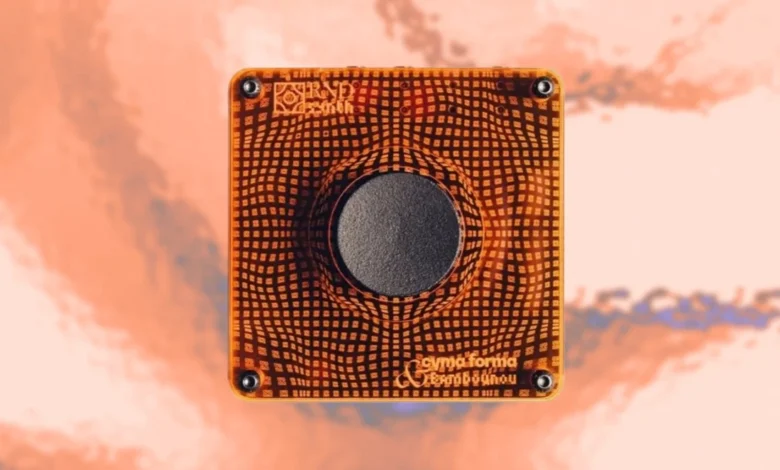
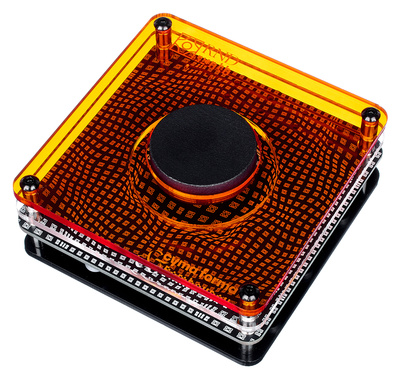
Pushing the avant-garde boundary of pocket hardware is the Cyma Forma RND, developed by the French boutique outfit Cyma Forma in collaboration with electronic artist Bambounou. Diverging radically from traditional knob-and-slider layouts, the RND features a striking minimalist interface anchored by a single button.
Beneath its deceptively simple exterior lies a robust digital instrument driven by eight distinct synthesis engines, a four-track Euclidean sequencer, and comprehensive onboard effects. The core philosophy of the RND centers on generative inspiration: pressing the single button instantly conjures one of over 4.29 billion possible sound combinations. While the hardware might initially appear unconventional, its implementation of MIDI and synchronization I/O ensures it integrates smoothly into existing hardware setups and DAW environments. Priced accessibly, the RND exemplifies how modern engineering can transform limitation into a powerful creative catalyst, offering surprise elements that keep composition fresh and unpredictable.

Korg NTS-1 MKII: The DIY Digital Powerhouse
For producers who enjoy a hands-on approach to their gear, the Korg Nu:Tekt NTS-1 MKII represents a unique entry point into the pocket synth category. Distributed as a DIY kit that requires no soldering—often likened to building with Lego Technic blocks—the second-generation NTS-1 builds significantly upon the success of its predecessor.
The primary strength of the NTS-1 MKII lies in its open-platform architecture. Users can load custom oscillator and effect models from Korg’s extensive LogueSDK library, vastly expanding the instrument’s sonic capabilities far beyond factory presets. Powered via USB-C and equipped with comprehensive MIDI connectivity, the NTS-1 MKII functions equally well as a standalone synthesizer, an experimental scratchpad, or a dedicated external effects processor for other hardware instruments. Its raw, exposed aesthetic and deep parameter accessibility make it a favorite among circuit-bending enthusiasts and modular synth practitioners looking for a lightweight travel companion.
Dubreq Stylophone Gen X-2: Vintage Nostalgia Meets Modern CV Connectivity

Stepping into the realm of retro-inspired hardware, the Dubreq Stylophone Gen X-2 honors the iconic stylus-played instruments of the 1960s while incorporating contemporary production features. Building upon the foundation of the earlier Gen X-1, the Gen X-2 introduces a multi-function expression strip and crucial CV/gate connectivity, enabling musicians to interface the pocket synth directly with modular Eurorack systems.
The internal architecture of the Gen X-2 features a genuine analog oscillator, a resonant low-pass filter, an attack-decay envelope, an LFO, and an analog delay circuit. For users seeking an even more extreme reduction in size, Dubreq also offers the Stylophone Mini—a fully functional miniature iteration that doubles as a keychain and flashlight. These instruments prove that retro novelty and functional studio utility can coexist successfully, providing immediate, tactile playability that requires virtually no learning curve.

Roland AIRA Compact J-6: Polyphonic Sequencing on the Move
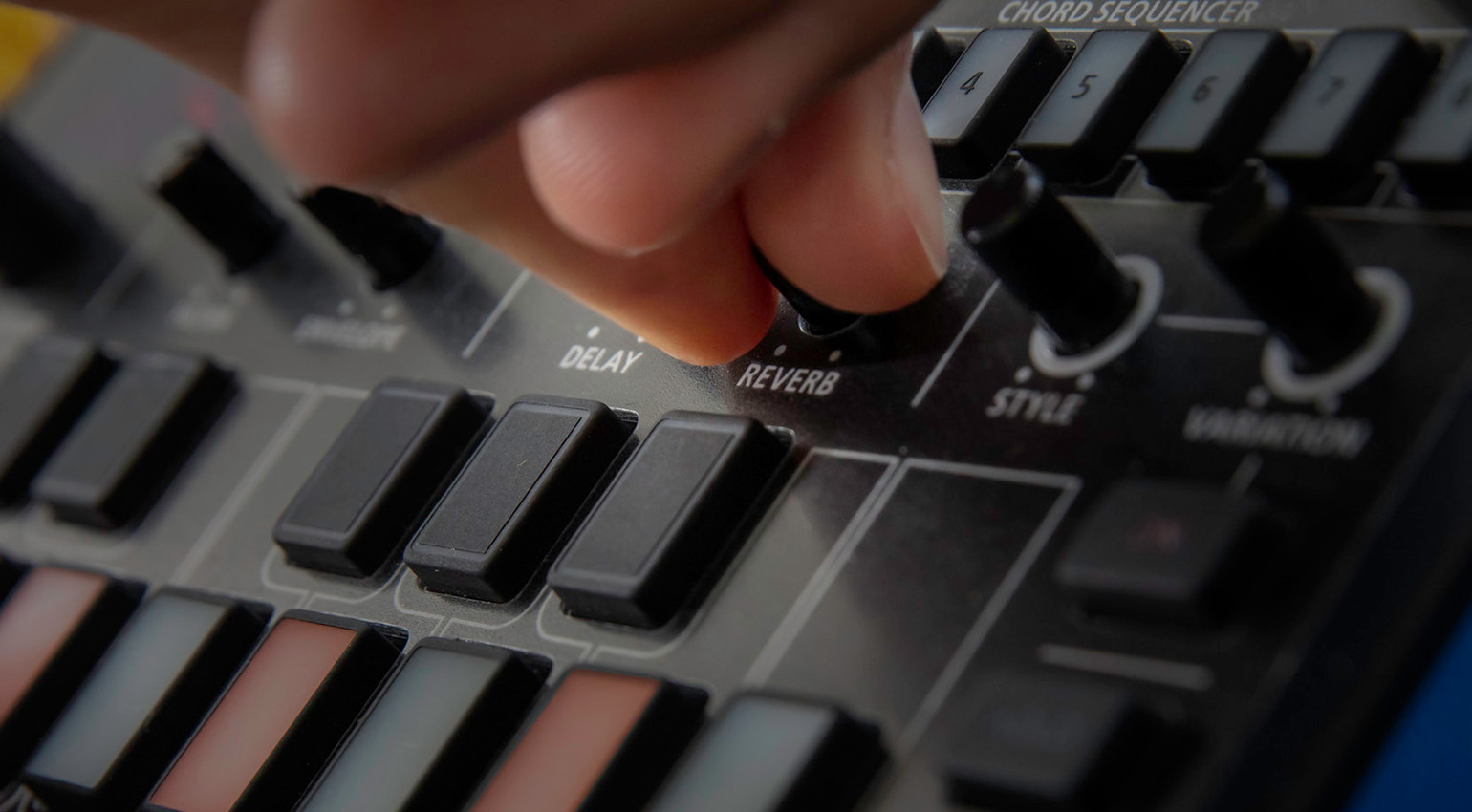
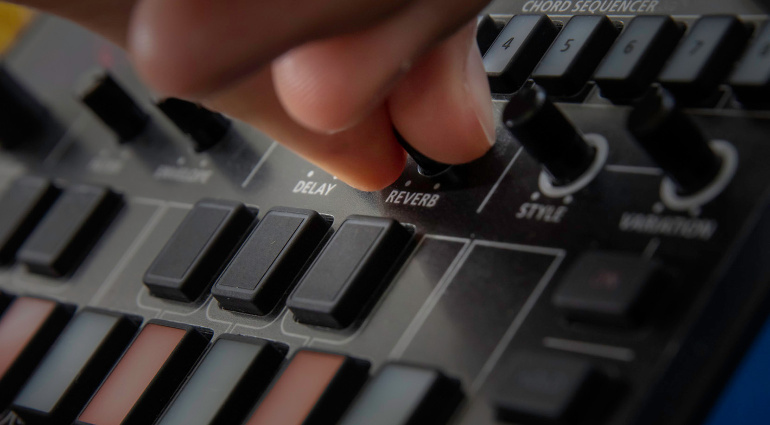
Roland entered the micro-hardware arena with its AIRA Compact series, offering an answer to long-standing portable grooveboxes. Among this lineup, the Roland J-6 Chord Synthesizer stands out by pairing the legendary analog circuit behavior (ACB) sound engine with a remarkably sophisticated polyphonic sequencer.

Rather than focusing solely on raw sound generation, the J-6 excels as a songwriting tool. It allows users to intuitively construct complex chord progressions and polyphonic patterns on the fly, making it an ideal companion for sketching out song structures away from the studio. Fully compatible with other members of the AIRA Compact family—such as the T-8 rhythm performer, E-4 voice Tweaker, and P-6 creative sampler—the J-6 anchors a powerful, pocket-sized production ecosystem that bridges the gap between quick sketching and serious composition.
Industry Implications and Market Outlook

The proliferation of high-end pocket synthesizers reflects a broader shift in consumer electronics and music technology. As micro-processors become more powerful and energy-efficient, manufacturers no longer need to sacrifice sonic fidelity to achieve portability. This democratization of music production tools lowers the barrier to entry for aspiring producers while offering seasoned professionals lightweight, inspiring alternatives for mobile workflows.
Market analysts note that the popularity of these devices underscores a growing demand for tactile, screen-free music creation. In an era where digital audio workstations often involve staring at computer monitors and manipulating software plugins, pocket hardware provides a physical, engaging connection to sound. Whether through the vector morphing of the Behringer Pro-VS Mini, the generative surprises of the Cyma Forma RND, the open-source flexibility of the Korg NTS-1 MKII, the analog nostalgia of the Stylophone Gen X-2, or the songwriting prowess of the Roland J-6, portable synthesizers have firmly established themselves as essential tools in the modern musician’s arsenal.