Deconstructing the Modern Sonic Narrative: Pianist Peter Saltzman Challenges Traditional Mediums with Blues, Preludes and Feuds: A Musical Memory

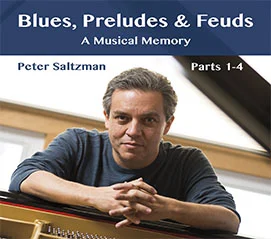
The intersection of classical rigor, avant-garde jazz improvisation, and modern digital publishing has yielded a fascinating anomaly in contemporary music release strategies. Pianist and composer Peter Saltzman has officially launched his latest monumental solo piano project, a deeply introspective, multi-layered recording titled Blues, Preludes & Feuds: A Musical Memory. In typical unconventional fashion, Saltzman challenges consumer expectations from the very opening lines of his liner notes, declaring that what listeners hold in their hands is deliberately not a standard compact disc. Instead, this ambitious release is distributed as a hybrid music-eBook, merging an expansive stream-of-consciousness audio narrative with written context designed to alter how audiences interact with recorded music.
The roots of this release trace back to Saltzman’s previous crowd-funded Kickstarter campaign for Piano Diaries. While that earlier project served as a vital exploratory workshop, Blues, Preludes & Feuds represents the fully realized culmination of those creative experiments. As a classically trained musician who eventually fell under the spell of jazz and the relentless pursuit of artistic originality, Saltzman has constructed a sprawling sonic autobiography. The resulting work functions less like a conventional track-by-track album and more like a peripatetic caravanserai—a literary and musical journey that bridges historical eras while interrogating the very nature of personal memory and political history.
Chronology and Evolution of a Musical Identity
To understand the architecture of Blues, Preludes & Feuds, one must examine the formative years of its creator. Raised against the backdrop of 1960s Chicago, Saltzman was shaped by a turbulent political climate characterized by civil unrest, cultural upheaval, and ideological conflict. This harsh environment left an indelible mark on his artistic temperament, instilling in him a sense of militant creativity that manifests explicitly in the fierce, combative sections of his new compositions.
Saltzman’s musical trajectory initially took root in the rigorous discipline of classical training. However, his curiosity soon drew him toward the boundless freedom of jazz. His past collaborations, notably his work with the adventurous Revolution Ensemble, further sharpened his capacity for collective and solo improvisation. Over the decades, his discography as a solo performer has steadily mapped an evolution toward total stylistic independence. The evolution from Piano Diaries to this current musical memory was neither linear nor accidental; it was a deliberate gathering of disparate influences—ranging from the majestic structural inventions of Johann Sebastian Bach to the whimsical, angular phrasing of Thelonious Monk and the monumental emotional weight of Ludwig van Beethoven.
This rich historical tapestry forms the spine of the new recording. Rather than merely quoting historical masters, Saltzman weaves their structural DNA into the cultural topography of his own modern inventions. The album is systematically divided into distinct movements that guide the listener through contrasting emotional and intellectual landscapes.
Album Structure and Repertoire
The comprehensive track listing of Blues, Preludes & Feuds reveals a carefully curated structural journey spanning four distinct parts, performed entirely by Saltzman on solo acoustic piano:
Part 1 sets the stage with an introduction of themes and counter-themes, featuring tracks such as Prelude – Overt? Sure!!, Blues for the End of Time, Or Not Blues, Part 1 – Prelude #0 (The Theme), Feud #0 (The Counter-Theme), Prelude #0, Two-Part Invention, and Signify.
Part 2 delves deeper into rhythmic complexity and emotional tension, encompassing Ostinato Asymmetrique, The Veiled Theme, Lullaby, The Other Theme, Ostinato Improvisique, Contention in E, Fanatical in A, and Temporary Cessation of Hostilities.
Part 3 bridges sacred history and modern deconstruction, opening with a poignant transition into Amazing Grace, followed by Bach Prelude #1 Remix, Bach Prelude #2, Bach Fugue #2ish, and Fantasy on Bach Fugue #2.
Part 4 brings the narrative to a sprawling conclusion with Star Spangled Minor, Prevaricate, Similitude, Prelude & Feud #1, Eggman’s Lament, and Blues en Français.
The Physics of an Alternate Sonic Universe
Music critics and theorists attempting to categorize Saltzman’s work often resort to metaphors of theoretical physics. The improvisational fluidity of the tracks has prompted comparisons to stream-of-consciousness literature, frequently drawing parallels to the dense, interconnected world of James Joyce’s Ulysses. Much like theoretical physicists grappling with post-Heisenberg uncertainties, listeners are forced to accept that the act of observing—or in this case, listening—actively shapes the experience of the music.
The tension between the "blues" and the "feud" elements of the record highlights Saltzman’s dual artistic identity. The blues components draw upon the deep wells of suffering, resilience, and historical memory forged in mid-century America. Conversely, the "feud" segments showcase a combative intellectualism—evident in the short, jabbing rhythmic motifs of pieces like Fanatical in A or the palpable, heavy sighs that characterize the transition from Temporary Cessation of Hostilities into a solemn, searching rendition of Amazing Grace.
Throughout the performance, the spectral presence of Thelonious Monk looms large. Saltzman adopts Monk’s penchant for dissonance, unexpected pauses, and rhythmic displacement, transforming these techniques into tools for personal storytelling. Yet, alongside Monk stands the classical ghost of Bach, whose contrapuntal mastery provides a stabilizing counterweight to Saltzman’s wilder improvisational flights.
Technological Innovation and the Hybrid eBook Format
Beyond its auditory merits, the release of Blues, Preludes & Feuds marks a significant statement regarding the distribution and consumption of contemporary art music in the digital age. By packaging the recording as a hybrid music-eBook, Saltzman addresses a persistent challenge facing independent musicians: how to provide adequate context for complex, long-form instrumental music in an era dominated by single-track streaming algorithms and diminished attention spans.
Industry analysts note that independent artists are increasingly seeking innovative ways to package physical and digital media to retain consumer interest and fair compensation. Saltzman’s decision to bypass the traditional compact disc format in favor of an integrated reading and listening experience reflects a growing desire among auteur musicians to reclaim ownership over the presentation of their work. The eBook component supplies the necessary literary framing—liner notes, compositional notes, and philosophical musings—that transforms passive listening into an active, intellectual engagement.
Broader Impact and Industry Implications
The release of Blues, Preludes & Feuds arrives at a critical juncture for solo acoustic jazz and avant-garde classical crossover projects. As major streaming platforms continue to homogenize listening habits, niche releases that demand deep, uninterrupted focus face substantial hurdles in reaching broader audiences. However, projects backed by direct-to-consumer models like Kickstarter—and enriched by multimedia components such as Saltzman’s hybrid eBook—demonstrate a viable pathway for artists operating outside major label ecosystems.
Critics have praised the album’s uncompromising dedication to originality. By refusing to pander to commercial radio formats or easily digestible genre boundaries, Saltzman has cemented his reputation as a fearless sonic architect. The implications of this release extend beyond Saltzman’s personal discography; it serves as a case study in how independent creators can leverage personal narrative, historical reverence, and technological packaging to create a unified artistic statement.
As listeners navigate the complex terrain of Blues, Preludes & Feuds, they are invited into a private world rendered public—a musical memory that successfully bridges the gap between the rigid beauty of the baroque era, the rebellious fire of 1960s Chicago, and the uncharted frontiers of twenty-first-century digital media.
Related posts: