Smithsonian Jazz Masterworks Orchestra: Ellington Masterworks and the enduring legacy of Tenor Madness

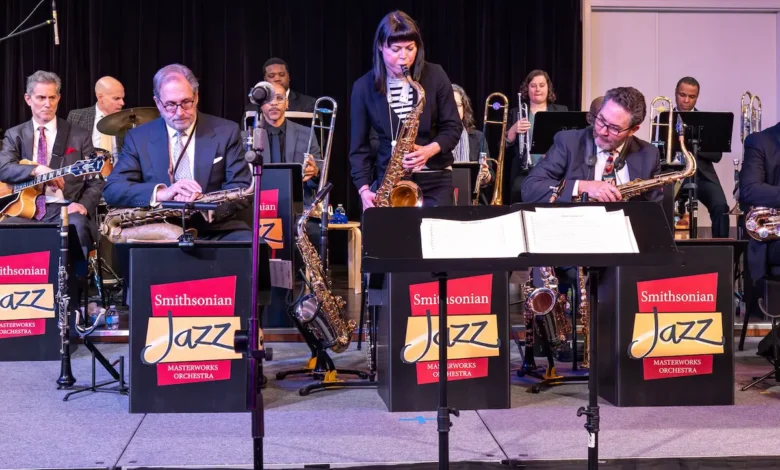
The Smithsonian Jazz Masterworks Orchestra (SJMO) has recently unveiled its latest recorded project, Ellington Masterworks, a collection that seeks to capture the expansive and intricate arrangements of Duke Ellington. Simultaneously, the jazz community has seen a resurgence of interest in Sonny Rollins’ seminal 1956 release, Tenor Madness, following a recent reissue by Jazz Wax. These two releases offer a study in contrast: the former representing an institutional effort to preserve the orchestral canon of the 20th century, and the latter serving as a definitive document of the spontaneous, improvisational spirit that defined the bebop and post-bop eras.
The Smithsonian Jazz Masterworks Orchestra: Preserving the Ellington Legacy
The Smithsonian Jazz Masterworks Orchestra, founded in 1990 under the auspices of the Smithsonian Institution’s National Museum of American History, occupies a unique position in the music world. As an ensemble dedicated to the repertoire of the great jazz orchestras, its mandate is essentially one of curation and preservation. Their latest offering, recorded at MCG Jazz in Pittsburgh on April 6, 2024, features a selection of compositions including The Flaming Sword, Tattoed Bride, and Ad Lib on Nippon.
The ensemble, under the direction of conductor and artistic director Charlie Young, employs a classic big-band configuration: five saxophones, four trumpets, three trombones, and a standard rhythm section. The performance reflects a high degree of technical precision. The logistical undertaking of recreating these pieces is significant; Ellington’s writing often relied on the specific personalities of his original sidemen, such as Johnny Hodges or Cootie Williams. For a modern ensemble, the challenge lies in balancing fidelity to the original score with the need for a contemporary performance that does not feel like a static museum piece.
Critics and historians have long debated the efficacy of "repertory orchestras." While proponents argue that such groups provide essential access to historical scores that would otherwise be lost to time, detractors often point to a lack of the "grit" or "zest" inherent in the original recordings. In the case of this specific release, the arrangements are executed with scholarly devotion. The development of pieces such as Oclupaca and The Shepherd demonstrates the technical capability of the orchestra. However, the overarching question remains: does a tribute album capture the "magic" of the original, or does it merely provide a high-fidelity echo?
Contextualizing Ellington: From Kenny Burrell to the SJMO
To understand the weight of an Ellington tribute, one must look at the history of those who have attempted to channel his spirit. In February 1975, less than a year after the composer’s passing, guitarist Kenny Burrell released Ellington Is Forever. Burrell, widely regarded as Ellington’s preferred guitarist, utilized a smaller ensemble to interpret these works. The project was notable for its intimacy, featuring jazz luminaries such as Jimmy Smith on organ and Thad Jones on flugelhorn.
The comparison between Burrell’s approach and the SJMO’s recent efforts illustrates the evolution of jazz interpretation. Where Burrell focused on the personal, blues-inflected connection he shared with Ellington, the Smithsonian orchestra focuses on the architectural brilliance of the big-band arrangements. This distinction highlights the inherent difficulty in tribute projects: the music of Duke Ellington was not merely a series of notes on a page, but a social organism driven by the specific interactions of his musicians. When modern orchestras approach this material, they are often attempting to reconstruct a sound that was, by its very nature, ephemeral.
Sonny Rollins and the Tenor Madness Sessions
In stark contrast to the institutional preservation of the SJMO, the recent reissue of Sonny Rollins’ 1956 Tenor Madness provides a masterclass in the immediacy of jazz. Recorded in Hackensack, New Jersey, on May 24, 1956, and March 22, 1956, the album is anchored by the title track, which features a historic exchange between Rollins and John Coltrane.
The significance of the Tenor Madness session cannot be overstated. It captured two of the most influential tenor saxophonists of the 20th century at a pivotal moment in their development. The 12-minute title track is a study in spontaneous composition. Rumors have persisted for decades regarding the dynamic between the two giants during the session, specifically regarding Coltrane’s later admission that he felt he was "playing with" Rollins. Whether or not this exchange was one of friendly competition or collaborative exploration, the result is a defining document of the medium-up swinger style.
Supporting this session was the rhythm section that served as the engine for Miles Davis during the mid-1950s: pianist Red Garland, bassist Paul Chambers, and drummer Philly Joe Jones. Their contributions provided a sophisticated, nudging foundation that allowed both Rollins and Coltrane the freedom to explore complex blues figures.
A Chronology of Jazz Evolution
The release of these two projects—one a contemporary big-band recording and the other a remastering of a 1956 classic—invites a reflection on the timeline of jazz history.
- 1956: Sonny Rollins records Tenor Madness in Hackensack, NJ. The album bridges the gap between the hard-bop era and the more experimental periods to come.
- 1966: Duke Ellington records The Far East Suite, featuring the original version of Ad Lib on Nippon, which serves as a benchmark for orchestral jazz.
- 1974: The death of Duke Ellington marks the end of an era for the big-band format, triggering a wave of tribute recordings, starting with Kenny Burrell’s 1975 sessions.
- 1990: The Smithsonian Jazz Masterworks Orchestra is established, formalizing the institutional approach to jazz preservation.
- 2024: The SJMO releases Ellington Masterworks at MCG Jazz, continuing the cycle of re-interpreting the Ellington catalog for a new generation.
Analytical Perspectives on Performance and Authenticity
The divergence in these two releases highlights a broader tension within the jazz industry: the balance between the "living" tradition and the "historical" archive.
The Smithsonian Jazz Masterworks Orchestra operates under the standard of "studied devotion." This approach is essential for educational purposes and the preservation of complex arrangements that require large ensembles. By documenting these works, the SJMO ensures that future musicians have access to the structural nuances of Ellington’s work. However, the limitation of this approach is the potential loss of the "grease and grit"—the unpredictable, spontaneous elements that define jazz as a living art form.
Conversely, the Tenor Madness session serves as a reminder of the "mellow magic" that occurs when musicians are given the space to interact without the weight of archival expectation. The inclusion of bonus tracks, such as the 1956 session with Richie Powell and Max Roach, demonstrates that even within the context of a "classic" album, there remains room for discovery and appreciation of the rhythm section’s role in shaping the soloist’s voice.
Broader Implications for the Jazz Industry
The simultaneous availability of these recordings has significant implications for listeners and collectors. For the casual fan, the SJMO release provides a gateway into the complexity of Ellington’s orchestral vision, effectively acting as an audio textbook. For the dedicated enthusiast, the Rollins reissue serves as a foundational text, a reminder of the era when jazz was the dominant pop music of the American cultural landscape.
The jazz industry continues to grapple with how to present these works to a modern audience. The "tribute" model has become a staple of jazz programming, both in live concert halls and on streaming platforms. While some critics argue that these efforts are redundant in the face of the original recordings, others maintain that the act of performance itself is a form of renewal.
Ultimately, the value of the Smithsonian Jazz Masterworks Orchestra’s effort lies in the technical proficiency of the ensemble and the continued visibility it provides to the Ellington canon. Whether or not these recordings will be played with the same frequency as the original 1966 suites remains to be seen. What is clear, however, is that both the preservation of the past and the celebration of spontaneous creation are necessary components of a healthy musical ecosystem. As the industry moves forward, the dialogue between the archival and the immediate will continue to define the evolution of the jazz genre.