The Classic Review Editorial Team Selects the 10 Best Recordings of Johannes Brahms A German Requiem

Johannes Brahms chose to bypass the traditional, liturgical Latin Mass for the dead, opting instead to curate his own scriptural texts from Martin Luther’s German translation of the Bible. The resulting masterpiece, Ein deutsches Requiem (A German Requiem), Op. 45, stands as a profound work of comfort and solace for the living rather than a formal intercession or prayer for the departed. Composed largely between 1865 and 1868—a period heavily influenced by the profound grief following the death of his mother, Christiane Brahms—the Requiem secured the composer’s international reputation. Brahms initially conducted a six-movement version at Bremen Cathedral on Good Friday in 1868 to overwhelming critical and public acclaim. He subsequently added a soprano movement, culminating in the first performance of the complete seven-movement work in Leipzig in February 1869.
Structural Architecture and Instrumentation
Scored for soprano and baritone soloists, a mixed choir, and a symphony orchestra featuring harp and an optional organ, the Requiem is structurally anchored by an architectural symmetry. Its seven movements form an expressive arch, beginning and ending with variations on the theme of blessedness: opening with Selig sind, die da Leid tragen ("Blessed are they that mourn") and closing with Selig sind die Toten ("Blessed are the dead").
The chorus bears the primary expressive weight of the composition, while the baritone soloist anchors the contemplative and mortal meditations of the third and sixth movements. The soprano soloist appears exclusively in the fifth movement, offering an ethereal vision of maternal comfort. Over the decades, interpretation of the score has diverged into two distinct performance philosophies: broad, monumental readings utilizing large symphonic choirs and modern orchestras, and lean, historically informed performances employing period instruments and smaller, specialized chamber choirs.
The Evolution of Recorded Interpretations
As part of its ongoing critical survey of classical masterworks, The Classic Review editorial team has curated the definitive list of the 10 best recordings of Brahms’s A German Requiem, tracing the evolution of performance practice from mid-century monaural monoliths to contemporary period-instrument revelations.
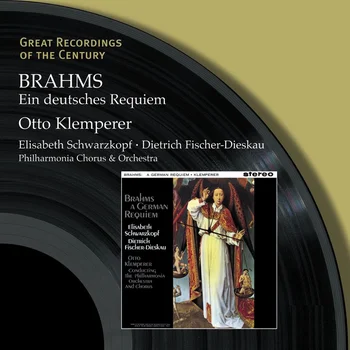
Philharmonia Orchestra, Otto Klemperer (1961)
For decades, the stereo studio recording executed by Otto Klemperer and the Philharmonia Orchestra in 1961 has served as a touchstone and standard benchmark for the work. Klemperer’s reading is characterized by an unyielding, unsentimental architectural integrity. Monumental in scale yet entirely devoid of ponderousness, his steady pacing ensures that each movement maintains structural cohesion from its inception to its final cadence. Vocalists Elisabeth Schwarzkopf and Dietrich Fischer-Dieskau deliver an authoritative, deeply communicative partnership. While the Philharmonia Chorus lacks the pristine blend of modern professional ensembles, it compensates with raw, unwavering emotional conviction.
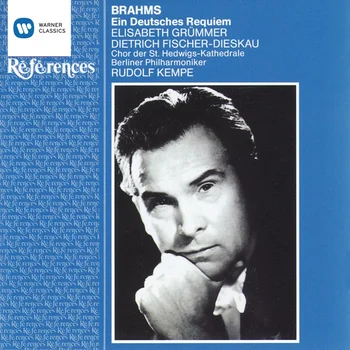
Berlin Philharmonic Orchestra, Rudolf Kempe (1955)
Recorded four years prior to Klemperer’s definitive statement, Rudolf Kempe’s 1955 Berlin Philharmonic account prioritizes spiritual consolation over dramatic force. Clocking in at approximately 76 minutes—roughly seven minutes longer than Klemperer’s interpretation—Kempe utilizes flexible, highly sensitive pacing that prevents the expansive runtime from dragging. The St. Hedwig’s Cathedral Choir provides a fresh, well-blended vocal texture. Despite the inherent limitations and tape hiss of the archival mono sound engineering, no essential details of the score are obscured. The zenith of the performance arrives in the fifth movement, where soprano Elisabeth Grümmer sings with a radiantly warm, consoling tone.
Vienna Philharmonic, Herbert von Karajan (1947)
Emerging from the physical and cultural wreckage of post-war Europe, Herbert von Karajan captured the first-ever complete studio recording of the Requiem in Vienna in 1947. This early interpretation is notably more intense and searching than Karajan’s subsequent stereo and digital remakes. Characterized by exceptionally patient flows and expansive tempos, the performance treats the long second movement with profound breadth, while the fourth movement radiates peaceful reverence. Baritone Hans Hotter delivers his solos with a dark, resonant timbre and meticulous textual articulation. Although the acoustic profile is clouded by constricted mono balances—where the orchestra sits blurred behind sharply defined vocal lines—the performance burns with a palpable sense of historic hope and moral conviction.
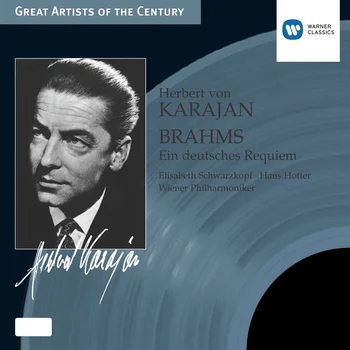
Bavarian Radio Symphony Orchestra, Wolfgang Sawallisch (Mid-1980s)
Captured approximately two decades after his initial recorded exploration of the score, Wolfgang Sawallisch’s mid-1980s Bavarian Radio account is defined by a pair of superlative vocal soloists. Baritone Thomas Allen infuses the third-movement solos with authentic existential gravity, while soprano Margaret Price deploys a resonant, soaring instrument. Supported by the Bavarian Radio Symphony Orchestra and Chorus, Sawallisch crafts an unhurried, texturally natural reading grounded in organic phrasing and profound emotional restraint.
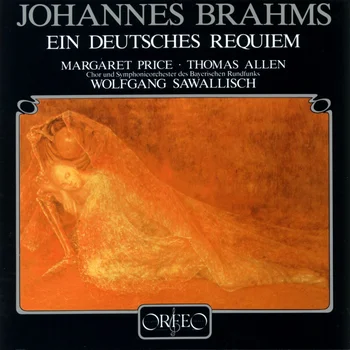
Berlin Philharmonic Orchestra, Claudio Abbado (1992)
Claudio Abbado’s 1992 live recording with the Berlin Philharmonic functions as a masterclass in choral transparency. Collaborating with the Swedish Radio Choir and the Eric Ericson Chamber Choir, Abbado elicits a seamless, pristine vocal line that consistently honors polyphonic clarity. Operating under broad, measured tempos, the conductor ensures that the massive choral forces never overwhelm the orchestra, allowing inner instrumental voices—including rich cello lines, second violins, and a poignant oboe solo—to register with crystalline definition.
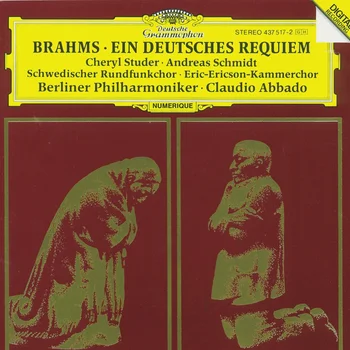
Berlin Philharmonic Orchestra, Simon Rattle (2006)
Sharing stylistic DNA with Abbado’s approach, Sir Simon Rattle’s 2006 live Berlin Philharmonic recording embraces a traditional architecture governed by expansive, highly focused tempos. The pacing proves unerringly convincing across macro and micro structures alike, with climaxes managed via intelligent dynamic architecture. The Rundfunkchor Berlin maintains rigorous attentiveness; even within complex fugal passages, individual vocal lines remain distinct. The fourth movement unfolds with a graceful, dance-like lilt, while the concluding movement dissolves into an ethereal glow. Though certain playback systems may reveal a slightly bass-heavy, muffled orchestral footprint, the performance remains a deeply considered, meticulously played monument.
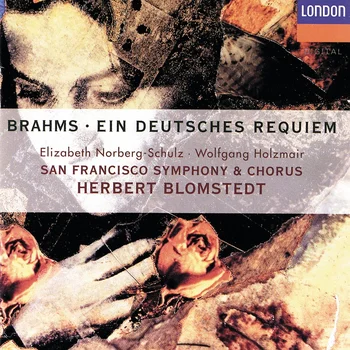
San Francisco Symphony, Herbert Blomstedt (1993)
Among North American interpretations, Herbert Blomstedt’s 1993 reference recording with the San Francisco Symphony remains a formidable achievement. The orchestral playing is muscular, full-bodied, and rich in instrumental detail. While Blomstedt occasionally exercises a degree of formal restraint that reins in the most cataclysmic orchestral peaks, and the vocal soloists employ relatively light, lyric instruments, the San Francisco Symphony Chorus delivers breathtaking dynamic control, particularly in its breathtaking handling of delicate, pianissimo passages.
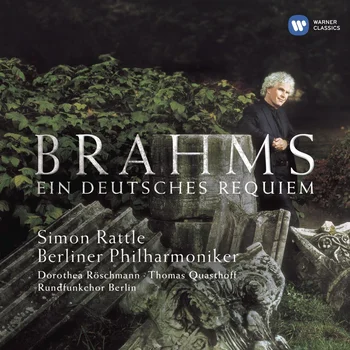
Orchestre Révolutionnaire et Romantique, John Eliot Gardiner (1990)
John Eliot Gardiner’s pioneering 1990 period-instrument recording fundamentally reshaped modern understanding of Brahms’s orchestration and texture. By employing reduced orchestral forces, period-authentic instruments, and a smaller, highly agile choir, Gardiner adopts brisk, forward-moving tempos while adhering strictly to the composer’s dynamic and agogic markings. The performance illuminates Brahms’s profound historical debt to Baroque choral writing. The Monteverdi Choir sings with razor-sharp precision, ensuring every syllable of Luther’s German text cuts through the transparent orchestral fabric.
Orchestre des Champs-Élysées, Philippe Herreweghe (1996)
Building upon the period-performance revolution, Philippe Herreweghe captured a live 1996 account with the Orchestre des Champs-Élysées characterized by a warm, exceptionally balanced acoustic profile. Maintaining brisk tempos and utilizing unvibrated string tone, Herreweghe secures ideal vocal alignment from soloists Christiane Oelze and Gerald Finley. Most notably, his twin-choir formation—comprising Collegium Vocale Gent and La Chapelle Royale—melds into a unified, homogenous vocal entity where no single section exerts dominance.
Bach Collegium Japan, Masaaki Suzuki (2024)
Representing the cutting edge of contemporary Brahms scholarship, Masaaki Suzuki’s 2024 recording with Bach Collegium Japan utilizes a compact choir of just 36 voices, yet achieves an expansive, robust sonic footprint. Suzuki favors moderate tempos and exceptional textural transparency, permitting minute internal details—such as the rustic horn figures in the opening movement—to emerge naturally. Baritone Jochen Kupfer sings with expressive ease, while soprano Miku Yasukawa delivers a tone of crystalline purity. The emotional zenith of the recording arrives in the heart of the final movement, where the textual promise of divine rest is rendered with transcendent intimacy.
The Broader Cultural and Artistic Implications
The enduring vitality of Brahms’s A German Requiem lies in its universal humanism. By stripping away the dogmatic terrors of the Latin Dies Irae and replacing them with scriptural consolations centered on endurance, grief, and eventual peace, Brahms created a secularized sacred space that transcends denominational boundaries.
The divergence between large-scale symphonic recordings (typified by Klemperer, Karajan, and Rattle) and period-informed chamber interpretations (championed by Gardiner, Herreweghe, and Suzuki) underscores a broader musicological shift in the 21st century. Listeners are no longer compelled to choose between monumental emotional catharsis and historical stylistic authenticity; rather, modern classical programming and recorded catalogs embrace both as valid, mutually enriching entries into one of the 19th century’s crowning artistic achievements.