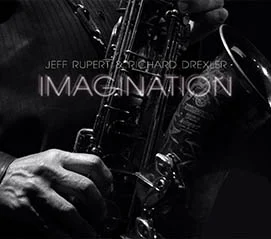
The contemporary jazz landscape frequently celebrates large ensembles, complex arrangements, and high-energy sonic experimentation. Yet, within this broader genre, the intimate dialogue of a stripped-down duo often reveals the purest distillation of improvisational artistry. Such is the case with Imagination, a critically acclaimed recording that pairs saxophonist Jeff Rupert with pianist Richard Drexler. Recorded live and released to capture the unvarnished immediacy of their musical partnership, the album showcases a masterclass in subtlety, mutual respect, and spontaneous composition.
Stripped of the safety nets provided by drums, bass, or larger horn sections, Rupert and Drexler operate in a exposed acoustic space. The resulting album is not merely a collection of standards and original compositions, but a comprehensive study in dynamic balance, conversational interplay, and the sophisticated exploitation of musical space. Through a careful selection of repertoire spanning the Great American Songbook, Latin jazz, and modern idioms, the duo achieves a rare textural cohesion that defies the limitations of a two-piece ensemble.
Main Facts and Musical Architecture
At its core, Imagination is built upon the seamless integration of Rupert’s tenor saxophone and Drexler’s piano. The album features a lean, highly focused tracklist that prioritizes melodic clarity and harmonic exploration. The complete track listing includes enduring standards and thoughtfully crafted originals: "Without a Song," "I Can’t Help It," "Snowfall," "Dave Brubeck’s "Strange Meadowlark," the title track "Imagination," Tom Jobim’s bossa nova masterpiece "A Felicidade," Rupert’s original composition "My Mistress’ Eyes," and Mal Waldron’s moody classic "Soul Eyes."
The structural foundation of the album relies heavily on what musicologists and critics describe as an invisible passing of the torch. Rather than engaging in traditional, cut-and-dry exchanges where one instrument strictly accompanies while the other solos, Rupert and Drexler fluidly trade roles. The saxophone glides into the spotlight with rounded edges and hushed tones that evoke the lineage of Lester Young and Stan Getz, while the piano recedes into a supportive, harmonically rich backdrop. Moments later, by subtle acoustic magic, the roles reverse. Drexler steps forward to adorn simple melodies with ebullient arpeggios and gilded glissandi, establishing himself as a true equal partner in the exposition of each theme.
Furthermore, the rhythmic framework of the album is maintained without the traditional percussion section. Both musicians utilize their instruments to establish a strong, pulsing undercurrent, ensuring that the momentum never lags. The interplay is characterized by a distinct lack of crowding; neither player treads on the other’s harmonic or sonic turf. This spatial awareness allows the listener to appreciate not only the notes played, but the deliberate silences embedded within the arrangements.
Background Context and Chronological Evolution
The collaboration between Jeff Rupert and Richard Drexler did not emerge in a vacuum; it is the product of decades of shared professional experience within the American jazz ecosystem. Jeff Rupert, a prominent saxophonist, educator, and recording artist based in Florida, has long maintained a reputation for his lyrical approach to the tenor saxophone. His career includes extensive performance credits with major jazz figures and ensembles, alongside his academic leadership roles, which have kept him at the forefront of straight-ahead and contemporary jazz performance.
Richard Drexler, equally accomplished on piano and bass, brings a vast palette of harmonic knowledge and stylistic versatility to the collaboration. Drexler’s background encompasses work across a wide spectrum of jazz subgenres, enabling him to navigate complex chord progressions and subtle modal shifts with equal facility.
The decision to record Imagination as a live duo project represents a deliberate artistic choice to strip away post-production artifice in favor of authentic, in-the-moment communication. Live recording in a minimalist setting introduces significant technical and artistic challenges. Without isolation booths or the ability to easily punch in corrections during mixing, the musicians were forced to rely entirely on their real-time rapport, listening acumen, and technical mastery. The resulting tracks preserve the minor imperfections and soaring triumphs of a single performance, offering listeners a documentary-style window into the creative minds of two seasoned professionals.
Repertoire Analysis and Highlight Performances
The thematic depth of Imagination is heavily influenced by the repertoire chosen by the duo. Each selection serves as a vehicle for distinct stylistic explorations, testing the limits of how much texture a piano-and-saxophone pairing can generate.
A prime example of this dynamic is found in their interpretation of Claude Thornhill’s "Snowfall." Rupert’s playing on this track is characterized by a flowing tempo and a delicate articulation of phrase after phrase. The subtlety of his saxophone lines gently nudges Drexler into a rarefied harmonic realm, where the piano responds with crystalline chord voicings that complement the wintry atmosphere of the composition.
The stylistic range of the album is further demonstrated on Tom Jobim’s "A Felicidade." Here, the duo adapts the rhythmic buoyancy of Brazilian bossa nova to the intimate chamber-jazz format. Without drums to drive the syncopated rhythms, Drexler’s left hand and Rupert’s phrasing establish an implicit groove that captures the joyous yet melancholic spirit of the original work.
Original and modern compositions also feature prominently, adding a contemporary layer to the traditional jazz ethos. Rupert’s Shakespearean-inspired original piece, "My Mistress’ Eyes," showcases a sophisticated compositional framework that bridges poetry and instrumental jazz. The melodic contour of the saxophone mimics the cadence of spoken verse, while the piano provides a supportive, contemplative harmonic structure.
Similarly, the inclusion of Mal Waldron’s "Soul Eyes" allows the duo to explore a darker, more introspective mood. The performance is defined by its unhurried pace, deep emotional resonance, and an acute attention to harmonic color. The spaciousness of the arrangement gives each note maximum impact, reinforcing the album’s overarching thesis that restraint is often more powerful than technical inundation.
Industry Reception and Aesthetic Implications
Upon its release, Imagination garnered attention from jazz critics and connoisseurs for its refreshing adherence to melody, tone, and conversational interplay. In an era where commercial jazz sometimes leans toward dense arrangements and high-decibel pyrotechnics, Rupert and Drexler’s project stands as a reminder of the power of intimacy in improvised music.
Industry analysts and jazz educators have pointed to albums like Imagination as vital pedagogical tools for understanding the mechanics of small-group interaction. The clear division of labor, the mutual listening skills demonstrated, and the sophisticated use of register and dynamics provide a blueprint for aspiring jazz musicians. Furthermore, the album highlights the viability of the saxophone-piano duo format in modern programming, proving that commercial and artistic success can be achieved without expanding the rhythm section.
The broader implications for the artists involve an elevated profile within the international jazz community. By delivering a masterclass in subtlety and execution, Rupert and Drexler have positioned themselves as torchbearers of a classic, chamber-jazz sensibility. The recording serves not only as a career milestone for both musicians, but also as an enduring contribution to the recorded catalog of contemporary acoustic jazz.
Conclusion
Imagination transcends the standard categorization of a routine jazz duo recording, emerging instead as a meticulously crafted dialogue between two master instrumentalists. Through a judicious selection of repertoire, an unwavering commitment to melodic clarity, and a profound respect for musical space, Jeff Rupert and Richard Drexler have created a timeless artistic statement. The album remains a definitive example of how technical mastery, when paired with emotional restraint and deep listening, can yield a sonic experience of extraordinary richness and enduring appeal.