Album Review: Astrig Siranossian and François-Xavier Roth Deliver a Passionate Reading of Elgar’s Cello Concerto on Alpha Classics

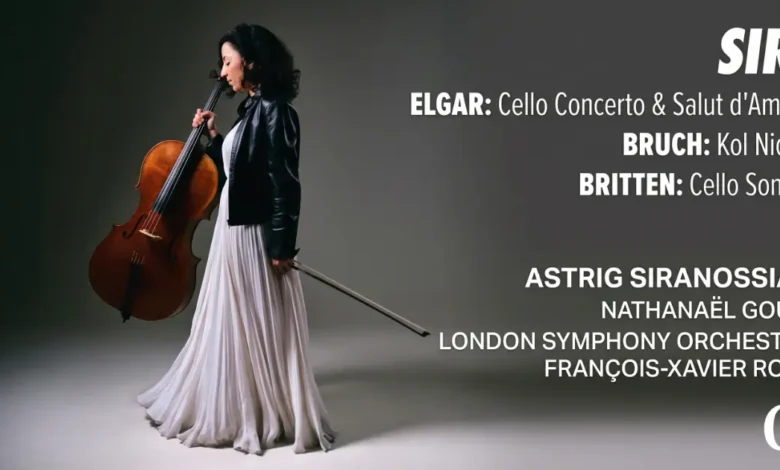
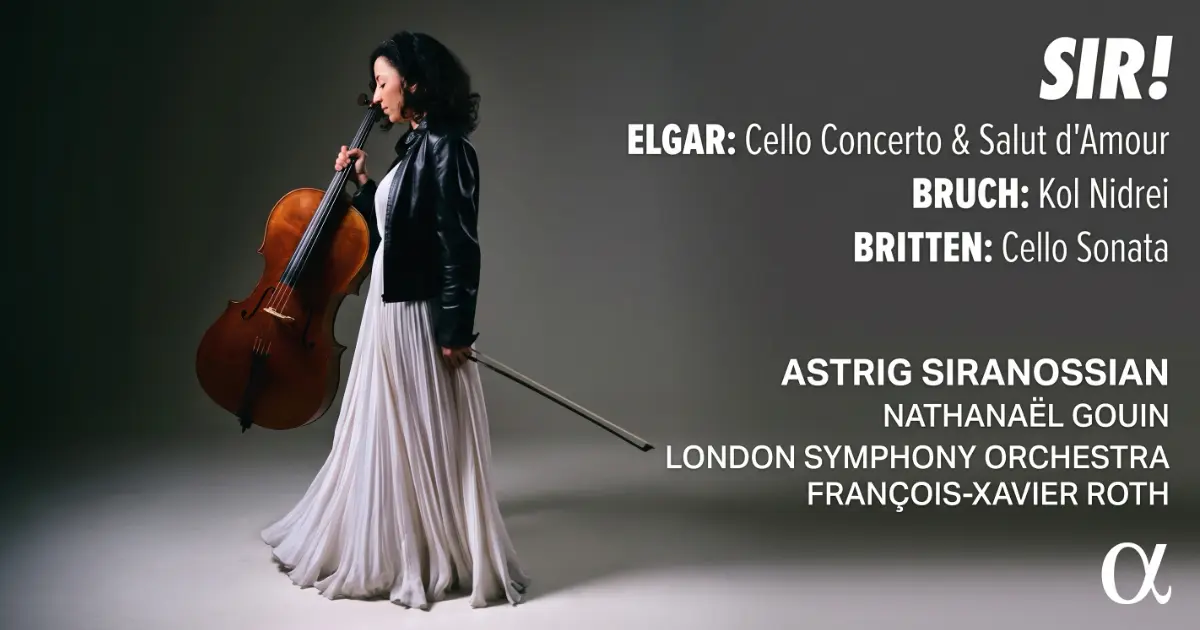
French cellist Astrig Siranossian has released her fifth album on the Alpha Classics label, presenting a diverse program anchored by Edward Elgar’s monumental Cello Concerto in E minor, Op. 85. Recorded with the London Symphony Orchestra under the baton of conductor François-Xavier Roth, the release also features Benjamin Britten’s Cello Sonata, Op. 65, Max Bruch’s Kol Nidrei, Op. 47, and a tender reading of Elgar’s short parlor piece, Salut d’amour, Op. 12. This latest project places Siranossian within a densely populated and historically rich recorded canon, testing her interpretative mettle against nearly a century of benchmark recordings.
Background Context and Recording Landscape
Entering the recorded legacy of the Elgar Cello Concerto presents a distinct challenge for any contemporary soloist. With approximately ninety commercially available recordings, every new interpretation is invariably measured against towering historical benchmarks. Foremost among these is Jacqueline du Pré’s legendary 1965 recording with Sir John Barbirolli and the London Symphony Orchestra for Warner Classics. Du Pré’s performance remains a touchstone for its overwhelmingly personal, emotionally raw expression, matched by Barbirolli’s deeply involving orchestral accompaniment.
Conversely, historians frequently turn to the composer’s own 1928 recording featuring Beatrice Harrison as soloist, with Elgar leading the New Symphony Orchestra. That account, characterized by a less overtly demonstrative, more classically restrained leadership, offers an entirely different yet potent emotional gravity.
In the decades following, modern performances of the concerto have largely bifurcated into two distinct interpretive schools. The first camp favors a gentler, more emotionally internalized approach. Notable examples include recordings by Paul Watkins with the BBC Philharmonic under Andrew Davis (Chandos), Gautier Capuçon with the London Symphony Orchestra under Antonio Pappano (Erato), and Daniel Müller-Schott with the Oslo Philharmonic under André Previn (Orfeo).
The second camp embraces a more extroverted, highly personalized narrative arc akin to du Pré’s philosophy, though distinctly tailored by each artist. Proponents of this style include Pieter Wispelwey with the Netherlands Radio Philharmonic under Ed Spanjaard, Steven Isserlis with the Philharmonia Orchestra under Paavo Järvi, and Johannes Moser with the Orchestre de la Suisse Romande under Jonathan Manze. Siranossian’s newly released interpretation firmly aligns with this latter, more outward-looking and expressive tradition.
Interpretive Analysis of the Elgar Concerto
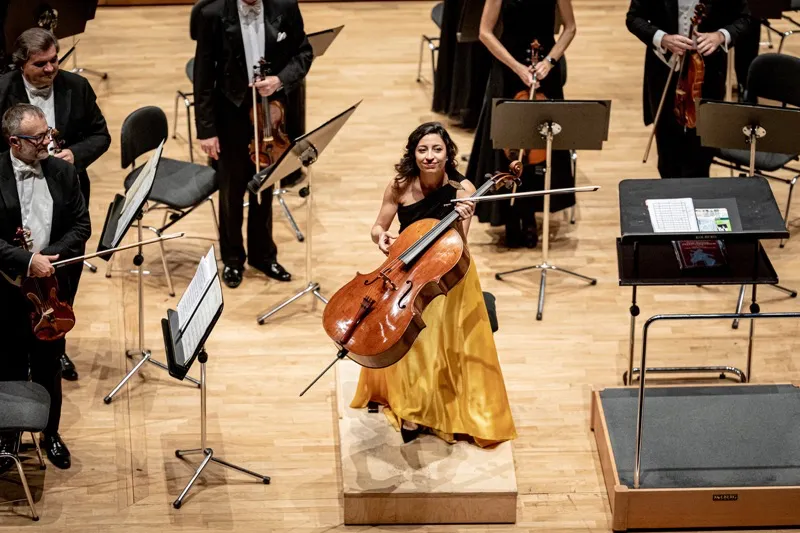
Siranossian’s performance is captured in close microphone placement by Alpha’s engineering team, highlighting a brilliant array of tonal colors drawn from her 1756 Gennaro Gagliano cello—an instrument with historical resonance, having once been owned by Sir John Barbirolli.
The soloist’s artistic intent is declared immediately in the opening recitative. Marked fortissimo and nobilmente, Siranossian delivers a ferocious and emotionally unvarnished initial attack. Her interpretation honors the marking of nobilmente through sheer weight of tone and dynamic color rather than through a stiff-upper-lip aesthetic of British reticence. Her first statement of the primary thematic material is luminous and agile, while subsequent restatements expand into full-toned, deeply impassioned utterances.
The second movement, marked Lento — Allegro molto, introduces a delicate, mercurial lightening of texture, which is subsequently counterbalanced by an Adagio of heightened inward intensity. In these slower sections, Siranossian deliberately blanches her tone to evoke a sense of exhaustion and profound vulnerability. The finale returns to an unreserved, fiery mode, navigating the darker emotional corners of the score that are occasionally glossed over in more conventional readings.
The London Symphony Orchestra, an ensemble intimately familiar with Elgar’s score, strives to match the soloist’s intense momentum. However, conductor François-Xavier Roth occasionally applies a more objective, transparent framework. While this structural clarity occasionally tempers the overt romanticism of the phrasing, it grants listeners an unprecedented appreciation of Elgar’s intricate orchestration and compositional craftsmanship. Furthermore, the recording sessions—housed at LSO St Luke’s rather than the acoustically demanding Barbican Hall—afford the recording a pristine, dry acoustic profile that benefits both soloist and orchestra.
Complementary Repertoire: Britten, Bruch, and Elgar
Beyond the headline concerto, the album features substantial chamber and concertante works that broaden the stylistic scope of the release. The inclusion of Benjamin Britten’s Cello Sonata highlights Siranossian’s established musical partnership with French pianist Nathanaël Gouin.
Composed in 1961 for Mstislav Rostropovich, the Britten sonata is a work of severe modernist architecture and psychological tension. Siranossian and Gouin lean directly into this stark modernity. While some contemporary interpretations, such as Sheku Kanneh-Mason’s 2025 Decca recording with pianist Isata Kanneh-Mason, discover flashes of playfulness within the second-movement Scherzo, Siranossian and Gouin prioritize the desolate, nocturnal musings of the third-movement Elegia, executing it at a brisk, unrelenting tempo. Although the Marcia lacks the specific menacing bite achieved by Johannes Moser alongside pianist Paul Rivinius, the concluding Moto perpetuo drives forward with ferocious momentum, recalling the unique bravado of the historic Rostropovich and Britten collaboration.
Max Bruch’s Kol Nidrei shifts the tonal landscape toward a deeply spiritual and elegiac paradigm. Based on two traditional Hebrew melodies—the first described by Bruch as an ancient song of atonement and the second drawing upon Lord Byron’s poem "O weep for those that wept on Babel’s stream"—the piece demands profound lyricism. Compared to classic benchmark recordings such as János Starker’s reading with the London Symphony Orchestra under Antal Doráti, Siranossian adopts a slightly broader tempo, resulting in a sweeter, more openly poignant vocalization on the cello.
The program concludes with Elgar’s ubiquitous Salut d’amour, functioning effectively as a brief, lyrical encore that rounds out the physical release.
Production, Packaging, and Critical Implications
Alpha Classics has ensured high production standards for the physical and digital release, catalogued as Alpha 1217. The accompanying liner notes feature an extended interview conducted in January 2026, wherein Siranossian discusses the profound personal connection between her historical Gagliano instrument—historically linked to Barbirolli—and the musical lineage of the Elgar concerto.
From a critical standpoint, this release enriches a saturated performance tradition by offering a distinctly uninhibited, coloristically adventurous take on core twentieth-century repertoire. While purists of the restrained, traditional English school of Elgar interpretation may find the overt emotionalism and Roth’s transparent orchestral direction unconventional, the technical mastery, interpretive conviction, and acoustic fidelity make this release a noteworthy addition to the contemporary classical catalog. Listeners seeking a fresh, highly personalized perspective on the Elgar Cello Concerto, paired with a gripping traversal of Britten’s chamber writing, will find substantial artistic reward in Siranossian’s latest project.