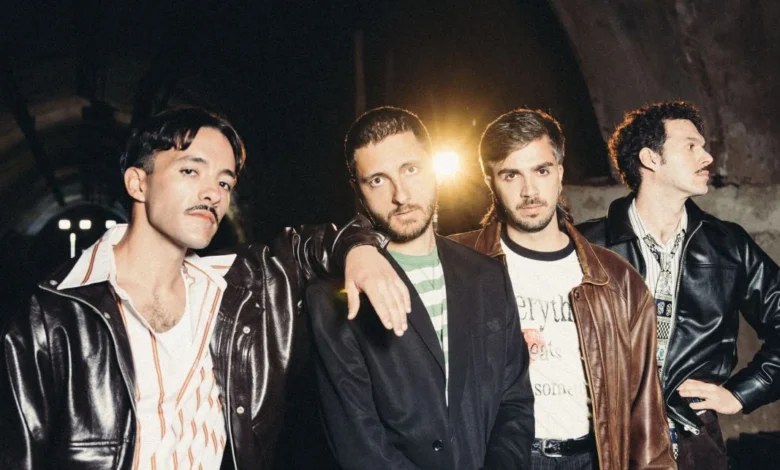
For many international musical acts, the path to global recognition follows a well-trodden blueprint: refine a sound, achieve domestic success, and then pivot toward the United States by recording with high-profile American producers to broaden one’s sonic palette. Yet, for the Spanish rock quartet Arde Bogotá, the trajectory has been characterized by a deliberate commitment to their own cultural vernacular. Rather than attempting to dilute their sound for a broader, English-speaking audience, the band recently traveled to Los Angeles to collaborate with renowned producer Joe Chiccarelli—known for his work with The Strokes, My Morning Jacket, and Beck—with the specific, paradoxical intent of creating their most deeply Spanish record to date.
The resulting album, Manufacturas del Club de la Gente Sola, marks the group’s third studio effort. It follows the immense success of 2023’s Cowboys de la A3, an album that solidified their status as the preeminent force in Spanish rock, earning double-platinum certifications and filling massive venues, including the iconic Movistar Arena in Madrid. While their stature in Spain is firmly established, the band’s decision to cross the Atlantic for production reflects a calculated strategy: to have their work evaluated by an industry professional who possesses no prior bias regarding their standing in the Spanish music scene.
A Quest for Artistic Autonomy
The choice of Joe Chiccarelli was not driven by a desire to adopt a Californian aesthetic, but rather to gain an objective, external perspective on their established identity. Frontman Antonio García has articulated that the collaboration served as a mirror for the band’s own evolution. By working with a producer unfamiliar with the local nuances of the Spanish music industry, the band was forced to articulate their musical goals through raw performance rather than established genre tropes.
“Our ambition was to work with someone who didn’t know our environment or our circumstances,” García explains. By removing the context of their regional popularity, the band was able to focus on the essential qualities of their sound. Interestingly, this objective lens led to the discovery of deep-seated influences within the group’s composition that had previously been overlooked, including echoes of flamenco and traditional pasodoble. According to the band, the experience was not about adopting a foreign sound, but rather excavating the inherent, often subconscious, Spanish elements of their own musical DNA.
The Chronology of an Ascent
The rise of Arde Bogotá has been remarkably swift. Formed in Cartagena, the band emerged during a period of transition for the Spanish rock scene, which had been dominated by long-standing acts for nearly two decades. Their rapid ascent is documented through a series of key milestones:
- 2021: The band releases their debut album, La Noche, introducing a visceral, high-energy sound that immediately resonates with a younger generation of listeners.
- 2023: The release of Cowboys de la A3 acts as a watershed moment. The album captures the zeitgeist of modern Spain, focusing on themes of highway travel, existential malaise, and the search for belonging. It earns the band two Latin Grammy nominations and reaches the top of the Spanish charts.
- 2024: The band completes a series of sold-out arena tours across Spain, establishing a logistical and professional standard for their live performances that rivals international touring acts.
- 2026: The group pivots toward international expansion, beginning with the sessions for Manufacturas del Club de la Gente Sola in Los Angeles and a string of intimate U.S. club dates.
The Reality of International Expansion
Despite their massive success in Spain, Arde Bogotá is currently navigating the realities of entering a new, significantly more competitive market. Their upcoming U.S. tour—featuring stops at The Hall at Elsewhere in Brooklyn, Pacific Electric in Los Angeles, and ZeyZey in Miami—marks a return to smaller, more intimate venues. For a band accustomed to the high-production spectacle of arenas, this transition is both a tactical necessity and a creative "fantasy."
Drummer José Ángel “Jota” Mercader notes that the shift in scale allows for a level of intimacy that is often lost in large-scale stadium shows. However, the move is not without its operational challenges. The band must now reconcile the professional standards they have built in Europe with the logistical constraints of performing in nascent markets. As bassist Pepe Martínez Esteban observes, this process is akin to “starting over.” The band’s experiences in Latin America, particularly in Mexico, have provided a blueprint for this expansion, where they have observed a steady, organic growth in audience size and engagement over multiple visits.

Language and Artistic Integrity
A central question facing any non-English-speaking artist attempting to penetrate the U.S. market is whether a transition to English is required for commercial viability. Arde Bogotá has taken a firm, almost philosophical stance on this matter. For García, the act of singing is fundamentally an act of vulnerability. He maintains that singing in one’s native language allows for a level of emotional honesty that is compromised when performing in a second language, which he describes as creating a "distance" or a "magic trick" that obscures the songwriter’s intent.
Data suggests that the market for non-English music is indeed expanding. The success of Latin music globally, driven by streaming platforms, has lowered the barrier to entry for international artists. However, Arde Bogotá’s refusal to pivot to English serves a specific artistic purpose: it reinforces their identity as a band that is not seeking to mimic the American rock canon, but to contribute to it from a distinct cultural position.
Broader Implications and Industry Impact
The strategy employed by Arde Bogotá reflects a broader shift in how international artists approach the global music market. Rather than aiming for immediate, broad-based mainstream success through assimilation, the band is prioritizing the authenticity of their craft. This "adventure-based" approach, as García describes it, prioritizes long-term sustainability over short-term market saturation.
From a music industry perspective, their trajectory provides a compelling case study. By maintaining high production values and a rigorous touring ethic while refusing to compromise their linguistic identity, the band is building a loyal, international following that values the uniqueness of their sound. Whether this strategy will lead to significant market share in the United States remains to be seen, but the band’s commitment to their own narrative—one that is both rooted in the Spanish experience and global in its ambition—is a testament to the changing nature of 21st-century rock music.
As the band continues its 2026/2027 tour, which spans from Brooklyn to the major stages of Spain, they are effectively bridging the gap between their origins and their future. They have already proven they can conquer the domestic market; the current challenge is to prove that a rock band with a distinctly Spanish essence can find a permanent home on the global stage.
Tour Schedule Summary
The upcoming tour dates demonstrate the band’s dual-market focus. In late 2026, the group will balance their U.S. club dates with a rigorous run of shows in major Spanish cities, including back-to-back nights at La Riviera in Madrid. The 2027 calendar highlights their continued dominance at home, with appearances at major Spanish festivals and venues, including the Estadi Ciutat de València and the Bilbao San Mamés Stadium, underscoring that their international expansion is an addition to, rather than a replacement for, their strong European foundation.
By meticulously managing this dual schedule, Arde Bogotá is attempting to maintain the momentum of their career while exploring the limits of their appeal. Whether they become the "next big thing" in the U.S. or simply find a dedicated, niche audience, their journey remains a clear indication that for modern rock, the path to the center is increasingly found by embracing the fringes.