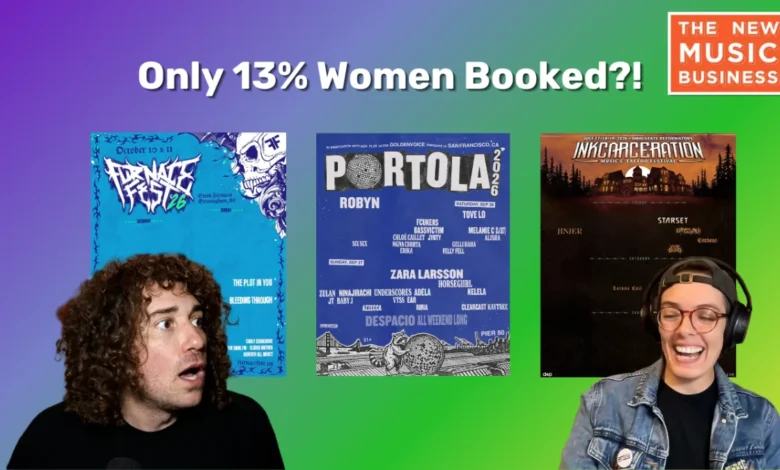
The modern music industry continues to grapple with deep-seated systemic inequalities, most visibly illustrated by the persistent gender imbalance across major music festival lineups. Despite years of public critique, increased awareness, and advocacy from artists and fans alike, festival stages around the globe remain heavily male-dominated. This ongoing disparity has sparked a broader movement aimed at reshaping industry standards, fostering accountability, and demanding transparency from promoters and talent buyers.
A central voice in this crusade for systemic change is Abbey Carbonneau, the founder of Book More Women, a nonprofit organization dedicated to driving gender equity and transparent business practices across the music business. In a recent episode of The New Music Business podcast, hosted by author and musician Ari Herstand, Carbonneau sat down to dissect the root causes of underrepresentation, the persistent myths used to justify skewed festival bills, and the actionable solutions required to build a more inclusive live music ecosystem.
The Genesis of Book More Women
The journey of Book More Women began not as a formal corporate initiative, but as a direct observation of a glaring industry-wide blind spot. Like many avid music fans and industry professionals, Carbonneau noticed a recurring trend while scanning the promotional posters for major music festivals: year after year, regardless of genre, women were conspicuously absent from the upper tiers of the lineups—and frequently missing from the lower tiers as well.
What started as critical observations shared within professional circles quickly evolved into a dedicated mission to hold the music industry accountable. Carbonneau realized that passive complaints would not shift the dial. Promoters, booking agencies, and festival organizers operate within legacy networks that often rely on unconscious bias, lazy booking habits, and outdated metrics of commercial viability. By turning her observations into an organized nonprofit entity, Carbonneau established a framework to monitor, measure, and challenge how festival lineups are curated.
The inception of Book More Women aligns with a broader cultural awakening within the entertainment sector, where stakeholders are increasingly demanding data-driven accountability. Rather than simply calling out festivals for poor representation, the organization seeks to provide constructive pathways toward equity, helping industry decision-makers recognize that diversity is not just a moral imperative, but a commercial asset.
Unpacking the Data: The Reality of Festival Lineups
To understand the scope of the problem, one must examine the broader data surrounding festival curation. Multiple independent studies conducted over the past decade—including analyses by organizations like USC Annenberg’s Inclusion Initiative—have consistently highlighted the stark gender gap in live entertainment. Women and non-binary artists represent a fraction of headliners, top-line billings, and overall festival rosters, despite producing commercially successful and critically acclaimed music across virtually every genre, from electronic dance music and hip-hop to indie rock and country.
During their discussion on The New Music Business podcast, Herstand and Carbonneau explored why this underrepresentation persists across diverse genres. While electronic music and hip-hop present unique subcultural barriers, rock and indie festivals have historically struggled with deeply entrenched boys’ club mentalities. Talent buyers frequently point to the top of the streaming charts or historical headliner pools to justify their booking choices, creating a self-fulfilling prophecy: because women are historically under-booked, they lack the massive festival-headlining credentials that promoters claim to require.
This circular logic forms the bedrock of the business arguments often deployed against booking more women. Promoters frequently hide behind claims of risk aversion, arguing that festival investments are too precarious to gamble on artists who lack proven headlining history. However, industry analysts and advocacy groups like Book More Women argue that this risk-averse mindset is fueled by unconscious bias. When decision-makers rely solely on legacy booking networks and historical rosters, they inherently exclude emerging and mid-tier female talent from building the exact resumés required to headline major stages in the future.
Beyond the Stage: The Intersection of Gender Inequality and Artist Pay
The gender imbalance in the music industry extends far beyond the visual optics of a festival poster; it directly impacts the financial livelihoods of artists. Pay transparency—or the historical lack thereof—remains one of the most significant hurdles in achieving true equity within the live music sector.
Historically, the music business has operated under a shroud of confidentiality regarding performance fees. Artists are rarely privy to what their peers are earning for the same slot on a festival bill. This opacity disproportionately harms women and marginalized artists, who frequently lack the institutional leverage or negotiation data required to command fair compensation. When festivals allocate the vast majority of their talent budgets to a handful of male headliners, the remaining budget is distributed across an underpaid undercard, widening the gender wealth gap within the creative community.
Carbonneau and Herstand delved into the mechanics of how pay inequity thrives in the shadows of the live music business. Without standardized pay transparency, female artists often accept lower guarantees out of fear of losing booking opportunities altogether. Book More Women advocates for radical transparency as a foundational tool to dismantle these disparities. When promoters are forced to justify their budgeting practices and open their books to scrutiny, the systemic underpayment of women becomes much harder to sustain.
Turning Awareness Into Action: The Festival Accountability Program
Moving past mere awareness, Book More Women has developed practical initiatives designed to create measurable change. A cornerstone of this strategy is the organization’s newly launched festival accountability program, which establishes cooperative partnerships with forward-thinking live music events.
A notable milestone in this initiative is Book More Women’s partnership with Lightning in a Bottle, a renowned immersive arts and music festival. By collaborating with festivals willing to submit their lineups and booking practices to external review, Book More Women demonstrates that transformation is entirely achievable when organizers commit to intentional curation. These partnerships serve as case studies for the rest of the industry, proving that inclusive lineups do not detract from the cultural or financial success of an event—in fact, they frequently enhance the attendee experience by offering fresher, more diverse musical perspectives.
The accountability program operates through a combination of data tracking, advisory support, and public recognition. Rather than relying solely on punitive measures, Book More Women works collaboratively with talent buyers to audit their booking pipelines, identify blind spots, and connect them with a vast, diverse roster of talent that they may have otherwise overlooked.
Broader Impact and Industry Implications
The implications of the work being done by Book More Women extend far beyond individual festival weekends. As fans, artists, and industry professionals increasingly factor social responsibility and ethical practices into their purchasing and career decisions, festivals that fail to modernize risk facing reputational and financial consequences.
The modern music consumer is younger, more diverse, and more socially conscious than previous generations. Audiences notice when a festival lineup looks homogenous, and they are increasingly vocal in their criticism. Conversely, events that champion equity and representation are capturing the loyalty of fans who view live music as a community space that should reflect the diversity of the world around them.
Furthermore, industry professionals—including agents, managers, and independent promoters—are recognizing that sustainable growth requires dismantling old gatekeeping structures. Organizations like Book More Women provide the necessary infrastructure to guide this transition, offering resources for volunteers, advocates, and industry insiders who want to actively participate in reforming the business.
A Blueprint for the New Music Business
As the music industry continues to navigate rapid technological, economic, and cultural shifts, the definition of what it means to "make it" is evolving. As discussed in the concluding segments of Herstand’s podcast, success in the contemporary music business is no longer measured solely by legacy metrics of commercial dominance, but by an artist’s or organization’s ability to build sustainable, ethical, and community-driven careers and businesses.
The ongoing efforts of Abbey Carbonneau and Book More Women serve as a vital blueprint for this new era. By combining data-driven accountability, pay transparency, and collaborative industry partnerships, the organization is proving that equity is not an unattainable ideal, but a practical necessity for a thriving, modern music ecosystem. For festivals, artists, and fans alike, the message is clear: the future of live music depends on a commitment to booking, paying, and celebrating women on every stage.