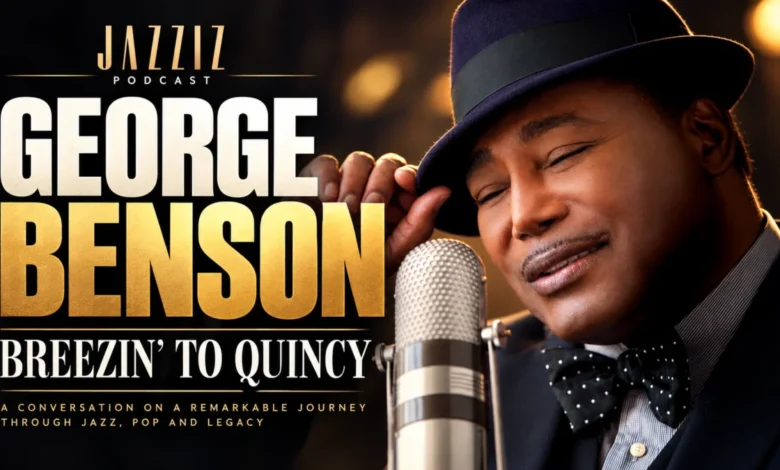
The jazz world recently turned its focus toward one of its most enduring icons as guitarist and vocalist George Benson sat down with JAZZIZ Magazine for a comprehensive retrospective on a career that has spanned over six decades. Featured as the cover artist for the Fall 2026 issue, titled "Let Them Hear It," Benson offers an intimate look at the pivotal moments, transformative collaborations, and philosophical underpinnings that have defined his trajectory from a Pittsburgh prodigy to a global musical phenomenon. Through this dialogue with interviewer Michael Fagien, Benson underscores a career-long commitment to the belief that the artist’s primary duty is to bridge the gap between their own internal creative landscape and the receptive ears of the audience.
The Architect of a Crossover Legacy
To understand the weight of George Benson’s reflections, one must examine the timeline of his ascent. Born in 1943, Benson began his professional journey as a guitar virtuoso, heavily influenced by the bebop tradition and the work of Charlie Christian. However, his career is most notably characterized by his successful navigation of the delicate boundary between jazz, R&B, and pop.
The mid-1970s served as the crucible for this evolution. In 1976, the release of the album Breezin’ marked a tectonic shift in the jazz industry. At a time when jazz was often relegated to niche markets, Breezin’ became the first jazz record to be certified platinum, eventually reaching triple-platinum status. The album’s success was not merely a commercial outlier; it fundamentally altered the expectations for jazz instrumentalists, proving that sophisticated improvisational skill could coexist with mainstream radio appeal. Benson notes that the path to Breezin’ was anything but calculated, describing it as an organic progression of his desire to explore melodic textures that resonated beyond the traditional jazz club setting.
The Quincy Jones Connection and the Sound of Success
Perhaps no single professional relationship captures the magnitude of Benson’s mid-career pivot better than his collaboration with legendary producer Quincy Jones. During the 1980s, the partnership resulted in the landmark album Give Me the Night (1980). By this point, Benson had already established himself as a crossover artist, but Jones helped refine that identity, polishing the production to create a sophisticated, dance-oriented R&B sound that solidified Benson’s status as a top-tier pop star.
Benson recalls the meticulous nature of working with Jones, whose ability to curate soundscapes was unparalleled. The success of Give Me the Night was not just in its chart performance—it peaked at number one on the Billboard R&B Albums chart—but in how it expanded the vocabulary of the jazz guitarist. Under Jones’s guidance, Benson’s guitar playing became a rhythmic anchor, a lead instrument, and a melodic complement to his increasingly prominent vocal performances.
The Symbiosis of Guitar and Voice
A central theme of the JAZZIZ interview is the inextricable link between Benson’s guitar and his voice. Often, critics have compartmentalized these two facets of his artistry, but Benson insists they are two sides of the same coin. This vocal-instrumental hybridity has become his signature, most notably seen in his ability to "scat" along with his guitar lines in perfect unison—a technique that requires extreme technical precision and an acute ear for pitch.
This style was heavily influenced by his early exposure to jazz giants like Louis Armstrong and Nat King Cole. From Armstrong, Benson learned the importance of stage presence and the "humanization" of the musical performance; he learned that the audience is not just hearing notes, but observing a personality. From Cole, he absorbed the art of the sophisticated pop vocal, learning how to deliver a melody with clarity and emotional resonance. These influences, combined with his deep respect for pianist McCoy Tyner’s harmonic complexity, provided the foundation for the unique, liquid-smooth style that defines the "Benson sound."
A Musical Reimagining: The Abbey Road Sessions
Benson’s penchant for breaking genre barriers was perhaps best exemplified by his decision to record an interpretation of The Beatles’ Abbey Road. While jazz musicians frequently cover popular standards, taking on an entire canonical rock album as a guitar-centric project was a bold artistic choice. Benson views this not as a departure from his jazz roots, but as an expansion of them. By stripping away the rock arrangements and infusing the songs with jazz phrasing and improvised solos, Benson demonstrated that high-level musicianship could elevate popular songwriting, further cementing his reputation as an artist who refuses to be confined by labels.
Philosophical Foundations: "Let Them Hear It"
The title of the JAZZIZ cover story, "Let Them Hear It," is drawn from a mantra Benson has carried throughout his life: "You don’t know what’s going on in people’s minds until you let them hear it." This phrase encapsulates his entire approach to communication. For Benson, the music is a psychological bridge. He argues that artists often suffer from a fear of rejection or a lack of confidence in the reception of their creative impulses, but that true artistic growth only occurs when the musician is willing to be vulnerable and share their internal vision with the public.
This philosophy has guided his interactions with both collaborators and fans. Whether he is working with high-profile producers like Quincy Jones or drawing inspiration from unexpected sources like Peter Frampton—whose use of the "talk box" and innovative guitar textures piqued Benson’s interest in the possibilities of guitar technology—Benson remains a student of sound.
Broader Implications and Legacy
The enduring nature of George Benson’s career provides a fascinating case study for the music industry. In an era where genres are becoming increasingly fluid, Benson’s history acts as a blueprint for artistic longevity. By maintaining his technical jazz foundations while embracing the accessibility of pop, he has managed to maintain a multi-generational audience.
Industry analysts note that Benson’s ability to remain relevant for over 60 years is a rarity, often attributed to his refusal to stop experimenting. Even as he enters the later stages of his career, his focus remains on the "conversation" between the performer and the listener. The impact of his influence can be heard in the work of countless contemporary artists who utilize jazz-fusion techniques in modern R&B and pop production.
Chronology of Key Milestones
- 1943: George Benson is born in Pittsburgh, Pennsylvania.
- 1964: Releases his debut album, The New Boss Guitar of George Benson.
- 1976: Releases Breezin’, which becomes the first jazz album to be certified platinum by the RIAA.
- 1977: Wins the Grammy Award for Record of the Year for "This Masquerade," establishing his prominence in pop music.
- 1980: Collaborates with Quincy Jones on Give Me the Night, further bridging jazz and R&B.
- 2026: Featured as the cover artist for the Fall issue of JAZZIZ Magazine, reflecting on six decades of innovation.
Conclusion
The JAZZIZ interview serves as more than just a promotional piece; it is an archival record of a man who changed the landscape of American music. As Benson continues to perform and record, his reflections offer a masterclass in professional resilience and creative integrity. His career stands as a testament to the idea that music, at its core, is a dialogue—a conversation that, if handled with honesty and skill, can transcend time, culture, and genre. By continuing to "let them hear it," George Benson ensures that his voice and his guitar remain as vital today as they were when he first picked up the instrument in the jazz clubs of Pittsburgh.