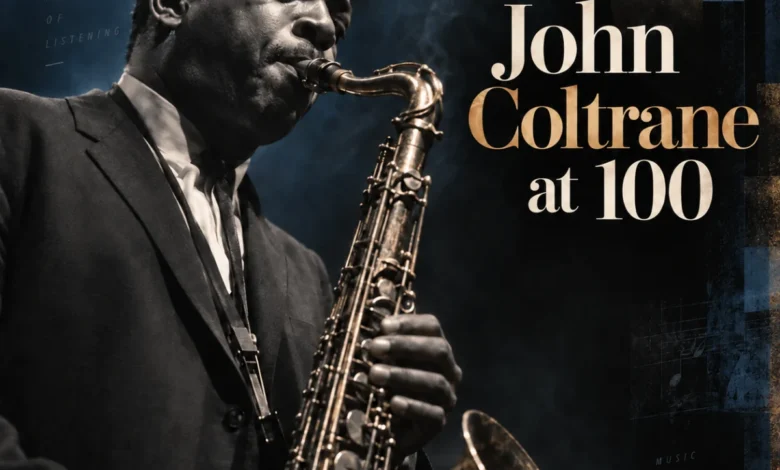
One hundred years after his birth, John Coltrane’s music remains less a historical artifact than a living language—one that musicians are still studying, questioning, and expanding today. Born on September 23, 1926, in Hamlet, North Carolina, Coltrane emerged from the crucible of the mid-20th-century jazz scene to become a seismic force in the evolution of modern music. As the global jazz community marks his centennial this September 2026, the occasion serves as a profound opportunity to reassess a life that, while tragically abbreviated, altered the trajectory of musical expression forever.
The Architect of Modern Sound: A Biographical Chronology
John William Coltrane’s journey was defined by an unrelenting drive for self-improvement and technical mastery. His early career saw him navigating the competitive landscape of the 1940s and 50s, honing his craft in the big bands of Dizzy Gillespie and later under the transformative mentorship of Miles Davis and Thelonious Monk.
The chronology of his output is staggering:
- 1957: The release of Blue Train, which solidified his status as a formidable leader and composer within the hard-bop idiom.
- 1959: The recording of Giant Steps, an album that introduced complex harmonic progressions that remain the ultimate litmus test for jazz improvisation today.
- 1961–1964: The formation of the "Classic Quartet" featuring pianist McCoy Tyner, bassist Jimmy Garrison, and drummer Elvin Jones. This unit redefined the elasticity of time and space in jazz.
- 1965: The recording of A Love Supreme, a four-part suite that fused avant-garde jazz with deeply personal spiritual conviction.
- 1967: Coltrane’s passing at the age of 40 in Huntington, New York, leaving behind a legacy that was simultaneously finished and unfinished.
The Evolution of a Virtuoso
Few artists have undergone as radical a transformation in the public eye as Coltrane. His trajectory is often categorized by musicologists into distinct phases: the formative hard-bop years, the "sheets of sound" period characterized by dense, rapid-fire improvisational lines, and his final, free-jazz era. In this final stage, Coltrane dismantled the traditional constraints of melody and harmony, opting instead for a raw, ecstatic, and often confrontational sound that challenged listeners to perceive music as a medium for metaphysical exploration.
His work on My Favorite Things (1961) serves as a bridge between his earlier, structured compositions and his later improvisational freedom. By taking a Broadway standard and reinterpreting it through the lens of modal jazz, Coltrane demonstrated that a melody was merely a point of departure—an idea that has influenced generations of improvisers, from fusion pioneers to contemporary experimentalists.
Data and Cultural Significance
The enduring impact of Coltrane’s work is reflected in both critical acclaim and institutional recognition. In 2015, the Library of Congress enshrined A Love Supreme into the National Recording Registry, citing its profound influence on both the jazz tradition and the broader American cultural consciousness.
Beyond the prestige of archives, the "Coltrane effect" is measurable through pedagogical and commercial metrics. Every year, thousands of music students worldwide utilize the "Coltrane Changes"—the complex, rapidly modulating chord sequences found in Giant Steps—to master functional harmony. Furthermore, his discography consistently ranks among the highest-selling jazz catalog titles, proving that his music possesses a perennial relevance that defies the shifting trends of the music industry.
The Centennial Commemoration: COLTRANE 100
In recognition of the 100th anniversary, the Coltrane Estate has launched COLTRANE 100, an international initiative designed to preserve and disseminate his vast musical archives. This year-long series includes curated performances, educational symposiums, and, most notably, the long-awaited unveiling of the "Tiberi Tapes."
These archival recordings, captured by musician Frank Tiberi during live performances in New York and Philadelphia in the early 1960s, provide a rare, fly-on-the-wall perspective of Coltrane at the height of his powers. For historians, these tapes offer more than just aesthetic enjoyment; they represent critical data points in understanding how Coltrane refined his motifs during live sets, often playing for hours and pushing the physical limits of his instrument.
Representatives from the Coltrane Estate noted in a recent statement: "Celebrating John at 100 is not about freezing him in the past. It is about acknowledging that he provided a roadmap for how to grow as an artist. Every time a musician picks up a saxophone and attempts to find their own voice through the discipline Coltrane modeled, the centennial is being honored."
Analytical Implications: Why Coltrane Still Matters
The question of why Coltrane remains the primary touchstone for jazz musicians in 2026—a century after his birth—is one of technical and philosophical weight. In a modern era characterized by digital precision and hyper-produced audio, Coltrane’s music offers something increasingly rare: human vulnerability.
His work stands as a testament to the belief that rigorous intellectual preparation must eventually give way to emotional honesty. His ability to balance the "harmonic puzzle" of his early work with the "devotional power" of his later years created a unique duality. He appealed to the mathematician, who could deconstruct his complex scales, and the mystic, who could be moved by the sheer intensity of his tone.
The implications for current jazz are clear: the genre is no longer tethered to a single style, a freedom directly inherited from Coltrane’s willingness to abandon commercial success for the sake of his artistic evolution. By moving away from the safe, repeatable structures of the late 1950s, he forced the entire industry to grow.
A Call to Listen
While the scholarly analysis of his work will undoubtedly continue, the most effective way to engage with the legacy of John Coltrane remains the act of listening. Whether it is the bluesy, conversational interplay with Sonny Rollins on "Tenor Madness" or the meditative, expansive cycles of his final records, his music demands active participation.
As the world celebrates this milestone, it is worth noting that while the personnel in the jazz world have changed—the greats of the 1960s have largely passed, and a new generation has risen to take their place—the fundamental challenge remains the same. Musicians are still attempting to reach beyond their current limitations, still seeking to turn the saxophone into a vehicle for the sublime, and still taking those "giant steps."
John Coltrane was a man of his time, yet he managed to craft a sound that felt as if it had existed forever and would continue to exist long after he was gone. On his 100th birthday, that sound continues to reverberate, serving as a reminder that greatness is not merely a destination, but a relentless, lifelong search. The jazz community stands today in the shadow of that search, invited once more to listen, to learn, and to be transformed.
Happy 100th birthday, John Coltrane. Your music remains a living, breathing testament to the human spirit’s capacity for discovery.