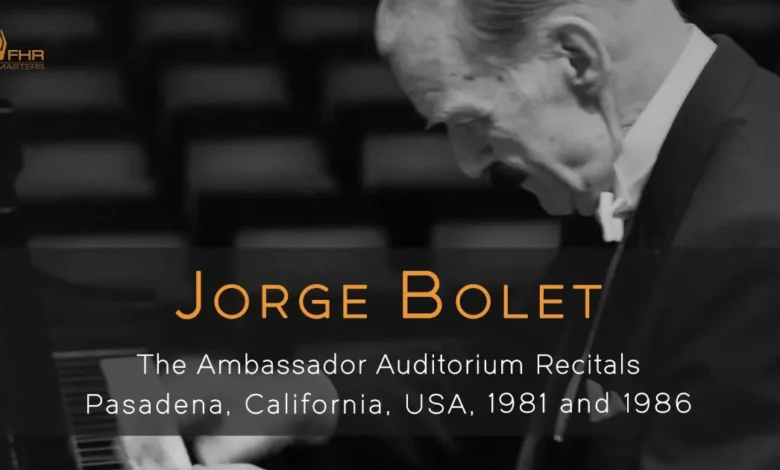
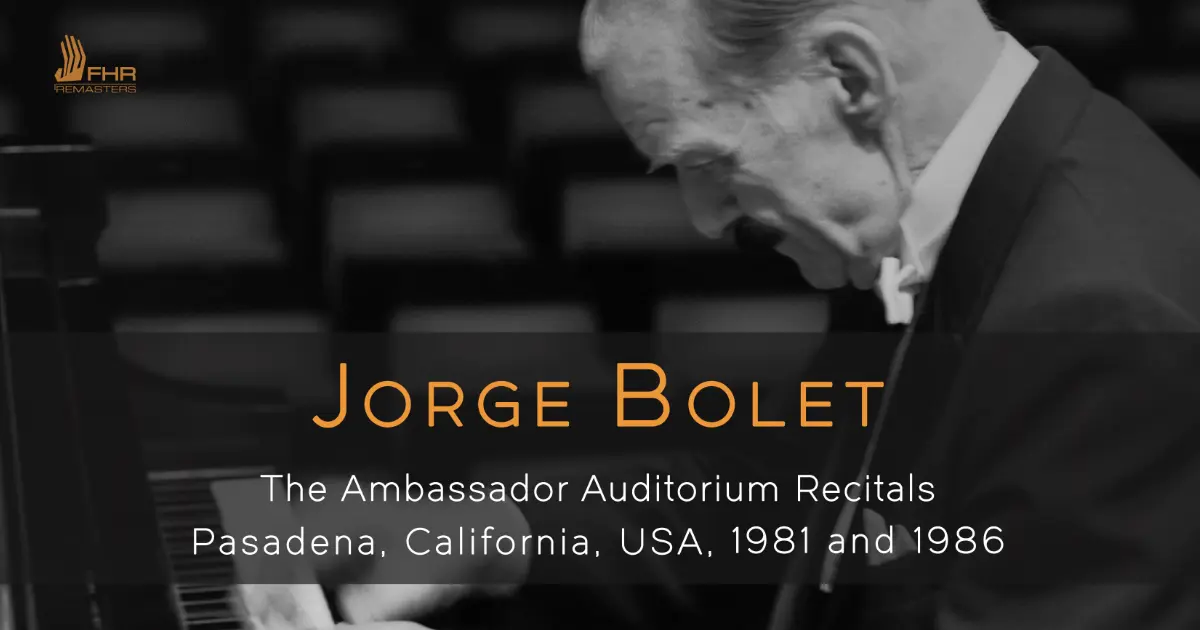
The release of the three-CD box set titled Jorge Bolet: The Ambassador Auditorium Recitals marks a significant archival milestone for enthusiasts of 20th-century pianism and the legacy of the Romantic tradition. Published by First Hand Records (Catalogue No. FHR178), this collection brings to light professionally recorded live performances from 1981 and 1986 that were previously unavailable to the commercial public. These recordings, captured during the final decade of Jorge Bolet’s illustrious career, offer a rare glimpse into the artistry of a performer who often felt most at home on the concert stage rather than in the sterile environment of a recording studio.
Jorge Bolet (1914–1990), a Cuban-born American pianist, was widely regarded as one of the last great representatives of the "Golden Age" of Romantic pianism. His career followed a unique trajectory, characterized by a period of relative obscurity followed by a major international resurgence in the 1970s and 80s. These recitals at the Ambassador Auditorium in Pasadena, California—a venue renowned for its exceptional acoustics and often referred to as the "Carnegie Hall of the West"—represent the height of his late-career mastery. The restoration of these archival open-reel tapes into a high-fidelity 24-bit/96 kHz format provides a vivid sonic document of Bolet’s interpretive philosophy.
Historical Context and the Ambassador Auditorium
The Ambassador Auditorium, which opened in 1974, served as a cultural beacon in Southern California for two decades. Its stage hosted the world’s most prestigious orchestras and soloists, providing a platform where acoustics and architecture met to create an ideal listening environment. For a pianist like Bolet, whose playing was defined by a massive yet transparent tonal palette, such a venue was essential.
During the 1980s, Bolet was under an exclusive contract with Decca/London, producing a series of studio recordings that brought him late-in-life fame. However, critics and aficionados have long debated the merits of his studio output versus his live performances. While his studio albums were praised for their refinement and perfection, some felt they lacked the spontaneous fire and risk-taking present in his concerts. The Ambassador Auditorium recitals bridge this gap, offering the technical polish expected of a master with the visceral energy of a live event.
The 1981 Recital: Romanticism Reimagined
The first major pillar of this collection is the recital from November 11, 1981. A central feature of this performance is Robert Schumann’s Fantasie in C major, Op. 17. Written as a tribute to Beethoven and a coded love letter to Clara Wieck, the Fantasie is a cornerstone of the Romantic repertoire. Bolet’s approach to this work is notably extroverted, contrasting with the more introspective and contemplative interpretations favored by contemporaries such as Sviatoslav Richter or Murray Perahia.
In the first movement, Bolet employs emphatic dotted rhythms and punchy chordal textures that emphasize the work’s "passionate" marking (Durchaus phantastisch und leidenschaftlich vorzutragen). Rather than retreating into purely cerebral territory, he allows the rawness of the music to surface. This is balanced by a profound connection to the audience during the more lyrical, hymn-like passages, where his ability to sustain a melodic line mimics the breath of a singer.
The 1981 program also highlights Bolet’s status as a premier interpreter of Franz Liszt, specifically through Liszt’s transcriptions of Franz Schubert’s Lieder. In Der Müller und der Bach, Bolet demonstrates a sophisticated understanding of voice leading, transforming the piano into a vocal instrument. His rendition of the famous Erlkönig offers a stark contrast to other benchmark recordings. While a young Evgeny Kissin might emphasize the terror of the narrative through sheer speed and aggressive octaves, Bolet’s 1981 performance is more austere. His portrayal of Death is characterized by a chilling sense of inevitability, suggesting a psychological horror that is perhaps more unsettling than overt virtuosity.
The 1986 Recital: A Study in the Ballade Form
The second recital, recorded in 1986, is a thoughtfully curated program centered around the "Ballade"—a narrative musical form that reached its zenith in the 19th century. The program includes Edvard Grieg’s Ballade in G minor, Op. 24, Johannes Brahms’s Four Ballades, Op. 10, and Franz Liszt’s Ballade No. 2 in B minor, S. 171, alongside the complete cycle of Frédéric Chopin’s four Ballades.
Grieg’s Ballade, a work of significant emotional weight and structural complexity based on a Norwegian folk theme, is often overlooked in major recitals. Bolet captures the work’s tonal ambiguity and eclectic spirit, moving seamlessly between whimsy, lyricism, and cataclysmic power. He manages to unify these disparate moods through a pervasive sense of melancholy, which many scholars believe reflected Grieg’s own personal struggles at the time of composition.
The inclusion of Brahms’s Op. 10 Ballades provides an interesting look at the composer’s early period. Although these works lack the dense autumnal profundity of Brahms’s late intermezzos, Bolet finds the "seeds" of that later language within them. His performance of the first Ballade ("Edward") utilizes rapid dynamic surges to heighten the tension of the recurring motifs. In the third Ballade, the Intermezzo, Bolet explores the "off-kilter" melodic material to create a sense of unpredictability, eventually giving way to some of the most tender playing found in the entire box set.
The Chopin Cycle and Technical Virtuosity
The centerpiece of the 1986 recital is undoubtedly the four Chopin Ballades. These works are considered some of the most challenging and aesthetically significant pieces in the piano literature. In this live setting, Bolet engages in what can be described as a "game of opposites."
In the Ballade No. 2 in F major, he juxtaposes the pastoral grace of the opening theme with the sudden, violent fury of the Presto con fuoco sections. This performance is particularly noteworthy for its "recklessness"—a quality rarely associated with Bolet’s typically deliberate and aristocratic style. The Ballade No. 4 in F minor, Op. 52, which many consider the pinnacle of Chopin’s output, is rendered with the ease of a performer who has lived with the music for decades. Bolet’s sensitivity to Chopin’s shifting harmonic colors and his mastery of the bel canto style ensure that the melodic lines remain supple even amidst the work’s dense contrapuntal textures. The concluding Coda is a tour de force of electric energy, providing a thrilling climax to the recital.
Restoration and Technical Specifications
The technical achievement of this release cannot be overstated. The original recordings were made on open-reel tapes, which are subject to degradation over time. The restoration and remastering work conducted by Kabir Hermon and John Croft has resulted in a clarity that is rare for archival live recordings. By utilizing a 24-bit/96 kHz transfer process, the engineers have preserved the specific "ring" of the Ambassador Auditorium’s acoustics and the unique tonal characteristics of the piano Bolet selected for these performances.
This level of fidelity allows the listener to hear the nuance of Bolet’s pedaling and the subtle gradations of his touch, which were often lost in lower-quality bootlegs or older commercial transfers. For piano students and historians, these recordings serve as a masterclass in tone production and architectural pacing.
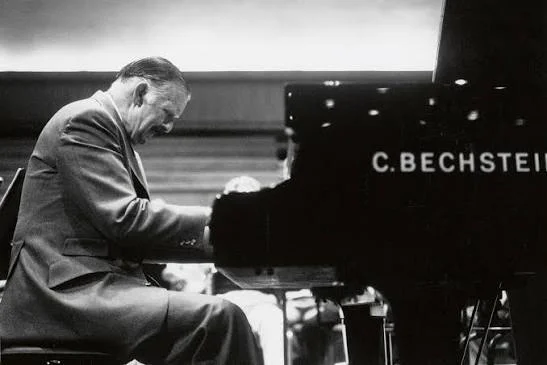
Implications for the Legacy of Jorge Bolet
The release of The Ambassador Auditorium Recitals serves to re-evaluate Jorge Bolet’s place in the pantheon of great pianists. For years, he was pigeonholed as a Liszt specialist, a label that, while accurate, limited the public’s understanding of his range. By presenting major works by Schumann, Grieg, Brahms, and Chopin, this set proves that Bolet’s "Romantic" approach was a versatile philosophy applicable to a wide breadth of 19th-century music.
Furthermore, these recordings highlight the importance of preserving live performance archives. In an era where studio recordings are increasingly edited to the point of clinical perfection, live documents like these remind audiences of the human element in music—the "wrong notes" mentioned by critics in the 1981 Schumann performance do not detract from the experience but rather underscore the joyous, spontaneous energy of the moment.
As the classical music industry continues to look toward its past to inspire its future, Jorge Bolet: The Ambassador Auditorium Recitals stands as a definitive testament to a vanished era of pianism. It is an essential addition to the discography of any serious listener, offering not just a historical record, but a living, breathing encounter with a master at the height of his powers. The set is currently available through First Hand Records and featured on major streaming platforms, ensuring that Bolet’s "vocal" piano and aristocratic fire will continue to reach new generations of listeners.