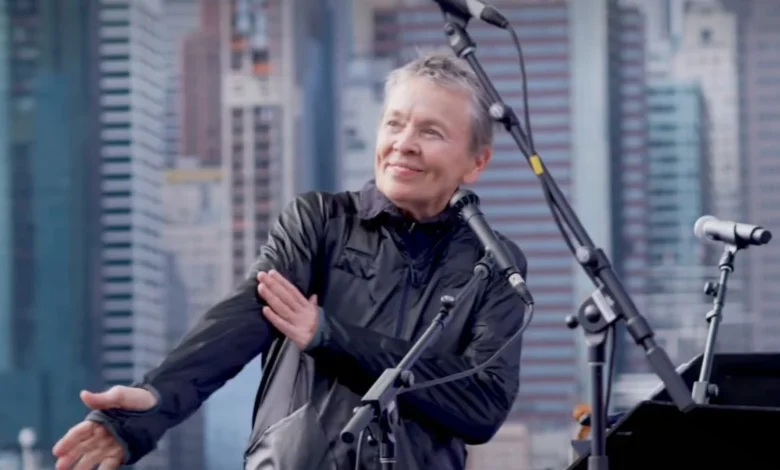
The intersection of avant-garde performance art and profound social commentary was on full display in Brooklyn this September, as legendary artist Laurie Anderson captivated audiences during the public art project Return of the Buffalo: Tatanka Owe Akupi. The event, which traversed Lower Manhattan and Downtown Brooklyn, served as a sprawling canvas for Anderson to deliver a series of life lessons originally cultivated alongside her late husband, the iconic musician Lou Reed. By blending her signature technological experimentation with a poignant message regarding the nature of human anger, Anderson reinforced her status as a cultural polymath capable of bridging the gap between historical trauma and contemporary psychological healing.
The Return of the Buffalo: A Contextual Framework
Return of the Buffalo: Tatanka Owe Akupi was far more than a mere street performance; it was an ambitious, two-day collaborative undertaking designed to symbolize resilience and environmental renewal. Spearheaded by theater director Amir Nizar Zuabi in close partnership with tribal elders from the Lenape and Lakota Nations, the project featured 40 life-size, articulated buffalo puppets. These figures, moving through the dense urban landscape, served as a powerful metaphor for the species’ recovery from the brink of near-extinction in the 19th century.
The logistics of the event were immense, requiring coordination between community groups, actors, poets, and musicians. Notable participants alongside Anderson included cultural figures such as Rhiannon Giddens, Haley Heynderickx, Max García Conover, Sam Waterston, Susan Sarandon, and Rosario Dawson. By grounding the performance in the specific history of the buffalo, the organizers invited participants to reflect on the cyclical nature of destruction and restoration, a theme that resonated deeply with the current socio-political climate.
Chronology of the September 19th Performance
The specific moment that has garnered significant digital attention occurred on September 19th during the procession through Downtown Brooklyn. Anderson, long celebrated for her mastery of multimedia, utilized her own body as a percussive instrument. By tapping her chest and limbs, she triggered sensors embedded in her attire, creating a rhythmic, electronic soundscape that echoed her seminal 1986 "Drum Dance."
This physical display was not merely an aesthetic choice; it was a rhythmic anchor for the philosophical guidance she provided. Anderson revisited the three fundamental rules for life that she and Lou Reed refined during their years together: "Don’t be afraid of anybody," "Get a really good bullshit detector and learn how to use it," and "Be really tender." These tenets, first shared publicly by Anderson during her eulogy for Reed at his 2015 Rock & Roll Hall of Fame induction, have since become part of her essential pedagogical repertoire.
Analyzing the "Three Rules" and Their Cultural Resonance
The endurance of these three rules speaks to their deceptive simplicity. In an era often characterized by information overload and heightened digital anxiety, Anderson’s advice functions as a framework for cognitive and emotional sovereignty.
- Fearlessness: The injunction to not be afraid of anybody suggests a rejection of power dynamics based on intimidation. In the context of her broader performance, it acts as a call to authentic self-expression.
- The Bullshit Detector: This requirement for discernment is increasingly relevant in the age of generative AI, deepfakes, and hyper-partisan media. It encourages an active, skeptical engagement with the world rather than passive consumption.
- Tenderness: Perhaps the most radical of the three, the insistence on being "really tender" provides the necessary counterbalance to the first two rules. It prevents the fearlessness and skepticism from hardening into cynicism, maintaining the human capacity for empathy.
The Anatomy of Contemporary Anger
Following her recitation of these rules, Anderson transitioned into a meditation on the ubiquity of anger in modern society. Drawing from Buddhist philosophy, she encouraged the audience to peer behind the curtain of outward aggression. She posited that if one follows the trajectory of a person’s anger far enough, one will invariably encounter a broken heart.
This observation aligns with psychological theories regarding "secondary emotions." In many therapeutic models, anger is viewed as a protective mechanism—a "secondary" emotion that shields the individual from more vulnerable, "primary" feelings such as shame, rejection, or grief. By urging her audience to "get to the bottom" of this anger rather than reacting to it in kind, Anderson advocated for a de-escalation strategy rooted in communal compassion.
Technical Evolution: From 1986 to the Present
Laurie Anderson’s use of sensor-based instrumentation has been a hallmark of her career since the mid-1980s. Her original "Drum Dance" utilized a custom-built suit that mapped specific audio samples to different zones of her body. This innovation effectively collapsed the distance between the performer and the tool, making the body itself the generative source of the art.
By revisiting this technique in 2026, Anderson demonstrated the continued utility of the human body as a site of technological mediation. The performance served as a bridge between the analog history of her career and the digital future, proving that the effectiveness of the message is intrinsically linked to the intimacy of its delivery. Unlike a recorded lecture, the physical exertion required to produce the sounds emphasized the labor and presence required to cultivate a "tender" life.
Broader Impact and Social Implications
The inclusion of diverse participants—from tribal elders to Hollywood actors—in the Return of the Buffalo project highlights a shift toward collaborative, site-specific art as a form of social activism. By moving away from the "ivory tower" of traditional galleries and into the streets, the organizers successfully forced an intersection between urban daily life and the deeper, often ignored, histories of the land upon which these cities are built.
Analysts of performance art note that the power of this project lies in its "embodied history." When an artist of Anderson’s stature uses her platform to address the collective emotional health of a crowd, it creates a momentary community. The reaction to the viral clips of her performance suggests a widespread public appetite for wisdom that acknowledges the difficulty of modern life while offering tangible tools for resilience.
Fact-Based Analysis: The Role of Public Art in Urban Healing
Public art projects like Return of the Buffalo provide measurable benefits to urban centers. According to various urban planning studies, the introduction of large-scale, interactive art installations often leads to:
- Increased Civic Engagement: By occupying public squares, these projects encourage residents to reclaim shared spaces.
- Psychological De-stressing: Studies have shown that immersive artistic experiences can lower cortisol levels in participants, providing a brief respite from the "anger" Anderson identified.
- Cross-Cultural Dialogue: By centering Lenape and Lakota perspectives, the project facilitated a necessary conversation regarding land stewardship and indigenous history that might not otherwise occur in a standard municipal setting.
Future Outlook
As Anderson continues to integrate these life lessons into her performances, the implications for her work remain significant. She is not merely an artist documenting the present; she is a curator of human experience. Her ability to synthesize the teachings of Lou Reed with Buddhist philosophy and cutting-edge sound design creates a unique pedagogical space.
The success of the Brooklyn performances suggests that there is a growing movement toward "intentional living" that seeks to reconcile personal ethics with the broader, often chaotic, public sphere. Whether through the lens of a 40-foot buffalo puppet or the simple, rhythmic tapping of a chest, Laurie Anderson continues to demonstrate that the most complex societal problems—anger, fear, and dishonesty—are often best addressed through a return to fundamental, human-centric values.
As the digital echoes of this performance continue to circulate, the takeaway for observers is clear: the path to navigating a fractured world is not found in the escalation of conflict, but in the deliberate cultivation of a functioning "bullshit detector," the shedding of unnecessary fear, and the radical, intentional choice to remain tender in the face of widespread heartbreak. This synthesis of art, philosophy, and technology remains a vital contribution to the cultural landscape of the 21st century.