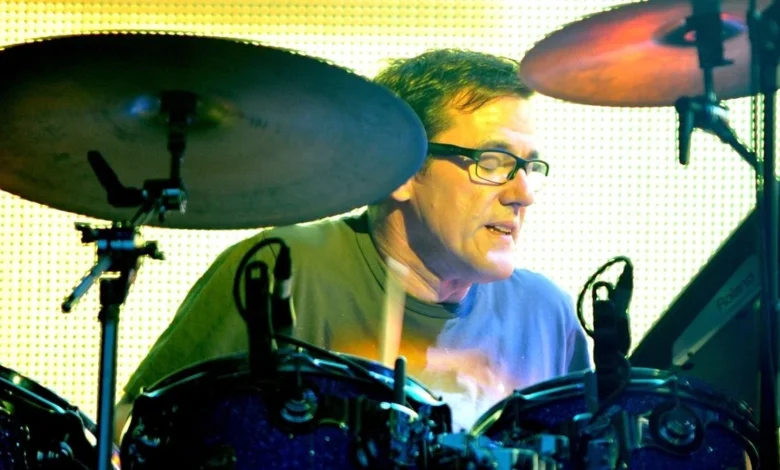
The landscape of post-punk and electronic music history faces a period of profound uncertainty as Stephen Morris, the foundational drummer for both Joy Division and New Order, has publicly acknowledged that his return to live touring is highly unlikely. Dealing with an undisclosed, chronic health condition that he has characterized as “pretty serious,” Morris’s admission marks a significant shift in the trajectory of one of the most influential bands in modern music. This development follows the collective decision made by Morris and his wife, longtime New Order keyboardist Gillian Gilbert, to withdraw from the group’s touring schedule indefinitely earlier this summer.
The revelation emerged during a candid interview with Rolling Stone, providing the first substantive update on the couple’s status since the band’s official announcement in June. As the industry and fanbase process the news, the implications for the future of New Order’s live operations—and the broader legacy of the Manchester-based collective—are becoming increasingly clear.
A Chronology of Withdrawal
The timeline of this transition began in earnest this past June, when New Order management confirmed that both Morris and Gilbert would be stepping away from the road for the “foreseeable future.” At the time, the reasons cited were strictly personal health-related, though the vague nature of the announcement left many fans concerned about the long-term prospects of the band’s touring viability.
Following that announcement, the couple attempted to test the feasibility of travel with a brief visit to New York City. The trip was intended to coincide with an exhibition featuring the lyrics of the late Joy Division frontman Ian Curtis. By all accounts, the attempt was unsuccessful. Morris described the excursion as a “disaster,” noting that the physical demands of international travel were incompatible with his current condition. This experience appears to have cemented his realization that the lifestyle required for global touring is no longer sustainable for him.
The immediate consequence of this health situation is Morris’s absence from New Order’s upcoming South American tour. The trek is scheduled to commence on November 23rd in São Paulo, Brazil, with a follow-up show on November 25th, before moving through major markets in Chile, Argentina, Peru, and Colombia. The band will be forced to move forward without two of its most essential members, highlighting the difficulty of replacing the specific musical chemistry that Morris and Gilbert have provided for decades.
The Rock & Roll Hall of Fame Induction
Adding a layer of emotional complexity to these circumstances is the impending induction of Joy Division and New Order into the Rock & Roll Hall of Fame. The ceremony, scheduled for November 14th in Los Angeles, was meant to be a celebratory moment of reconciliation and recognition for the band’s storied history. However, it now seems highly improbable that Morris will be in attendance.
The induction honors the combined legacy of both bands, acknowledging the transition from the bleak, atmospheric intensity of Joy Division to the pioneering synth-pop sound of New Order. The class of inductees includes the surviving members of the original lineup—Bernard Sumner, Peter Hook, and Stephen Morris—alongside Gillian Gilbert and the late Ian Curtis. While the event is designed to honor their collective contribution to the canon of rock music, the absence of key members due to health challenges underscores the physical and temporal distance between the bands’ origins and the present day.
The Nature of the Condition and Musical Continuity
When pressed on whether he harbors hope for a return to the stage, Morris was pragmatically somber. “I don’t know. I really don’t want to dwell on what this illness is, but it’s pretty serious. It’s not something that someone’s going to come up with a cure for,” he stated. The finality of his tone—acknowledging that this is not a temporary setback but a permanent change in his physiological capacity—serves as a sober reminder of the fragility of even the most iconic musicians.
Despite the clinical limitations, Morris is adamant that his creative life is far from over. He emphasized in his recent comments that his passion for drumming remains undiminished. While the rigors of international travel, jet lag, and the physical toll of a multi-month tour are no longer viable, he continues to play in a capacity that his health allows. He remains in close contact with his bandmates—Bernard Sumner, Phil Cunningham, and Tom Chapman—and has suggested that he is not entirely opposed to live performance if the logistics were simplified. “If it was a gig down the road, I’m sure we’d be all right,” he noted, suggesting that while the global touring machine is closed to him, the creative spirit of the band persists in more localized forms.
Historical Context and Musical Legacy
To understand the weight of Morris’s potential permanent departure from the stage, one must consider the historical gravity of his contributions. As a drummer, Morris was integral to the “Manchester sound,” bridging the gap between the raw, post-punk urgency of the late 1970s and the electronic precision of the 1980s. His drumming style, often described as metronomic and mechanically precise, became the backbone of New Order’s signature sound.
The upcoming release of the Eternal (Live) box set, slated for September 25th, serves as a timely retrospective of this legacy. Comprising 14 CDs and two DVDs, the collection features 16 concert recordings and over two and a half hours of rare footage. It acts as a definitive document of the band’s live prowess, perhaps arriving at a moment when the band’s live performance era is undergoing its most significant transition to date.
Analysis: The Implications for New Order
From an industry perspective, the situation facing New Order is reflective of a larger trend in the music business: the aging of legacy acts and the logistical challenges of maintaining high-octane touring schedules in the face of chronic health issues. For a band that has survived the tragic dissolution of Joy Division, the departure of Peter Hook, and multiple decades of internal friction, the absence of Morris and Gilbert represents an existential challenge.
The band’s ability to function as a live entity relies heavily on its core rhythm section. While session musicians can replicate parts, the interplay between Morris’s drumming and the band’s programming is a nuanced skill that is difficult to replicate. Furthermore, the loss of Gillian Gilbert—a vital architect of the band’s synthesizer-led sound—creates a significant vacuum in the live performance experience.
However, the fact that Morris remains committed to the creative process suggests that New Order may evolve rather than expire. If the band shifts away from the demands of global touring toward more sporadic or geographically limited engagements, it could establish a new model for how veteran acts sustain their creative output without the necessity of exhaustive road work.
Conclusion
Stephen Morris’s recent disclosures represent a poignant chapter in the history of Manchester’s most famous musical exports. While his health issues have necessitated a retreat from the demanding life of a touring musician, his dedication to the music itself remains a constant. As the music community looks toward the Rock & Roll Hall of Fame ceremony and the release of the Eternal (Live) collection, the focus shifts from the uncertainty of the future to the enduring impact of the past.
Whether or not the public sees Stephen Morris behind a drum kit in a stadium again, his influence on the architecture of modern music is firmly established. The band he helped forge continues to navigate the complexities of its own evolution, proving that while members may come and go—or be sidelined by the realities of life—the music continues to resonate with a global audience. For now, the priority remains the health and well-being of a musician whose rhythm has defined the sound of several generations.