Historic Turnout Marks Mexican Independence Day Celebrations Across New York and Chicago Amid Cultural Pride and Political Discourse

Mexican Independence Day celebrations transformed the urban landscapes of New York and Chicago into vibrant displays of cultural heritage, music, dance, and community solidarity. The annual festivities, which commemorate the historic Grito de Dolores of 1810 that initiated Mexico’s war of independence from Spanish colonial rule, drew hundreds of thousands of participants to the streets. While the atmosphere was largely defined by traditional attire, elaborate floats, and a profound sense of shared identity, the 2026 commemorations also featured significant milestones in local governance and sparked notable political discourse regarding immigration policies and national leadership.
In the boroughs of New York City and the neighborhoods of the American Midwest, the celebrations underscored the vast demographic and cultural footprint of the Mexican diaspora. From the historic thoroughfares of Brooklyn to the heart of the Midwest’s Mexican-American community in Chicago, civic leaders, activists, and families united to honor a legacy of resilience and self-determination. However, the juxtaposition of traditional pageantry with contemporary political statements highlighted the complex socio-political realities navigating the lives of Mexican immigrants and Mexican-Americans in the United States today.
A Milestone in New York City Politics
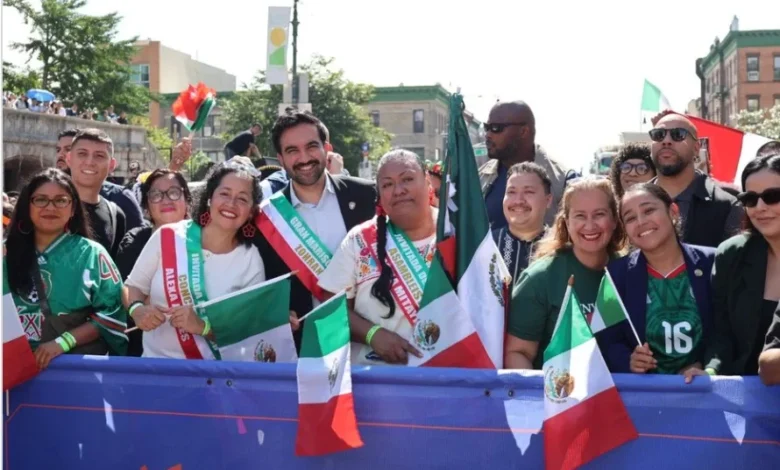
The festivities in New York City achieved a historic precedent in the borough of Brooklyn, specifically within the culturally rich neighborhood of Sunset Park. According to announcements from the mayor’s office, Mayor Zohran Kwame Mamdani made history by becoming the first sitting chief executive of New York City to actively participate in and march along the route of the neighborhood’s annual Mexican Independence Day Parade.
Draped in the celebratory energy of the crowd, Mayor Mamdani walked alongside local residents, community organizers, and participants adorned in traditional Mexican attire, while spectators lined the sidewalks waving green, white, and red flags. The appearance was widely interpreted by political analysts as a strategic and meaningful acknowledgment of the burgeoning political and economic influence wielded by Mexican New Yorkers.
Following the conclusion of the march, Mayor Mamdani utilized social media and official communication channels to articulate a message emphasizing the indispensable contributions made by the Mexican community to the fabric of New York City. His statement underscored that Mexico’s enduring fight for independence serves as a testament to the triumph of a people determined to shape their own futures—a sentiment he mapped onto the daily lived experiences of immigrants striving for progress in the metropolitan area.
Local representatives also echoed this sense of neighborhood pride. City Council Member Alexa Avilés shared her enthusiasm online, noting the emotional significance of showing up bravely to celebrate community vibrancy during times that demand cultural solidarity. The integration of high-level municipal presence with grassroots neighborhood celebration marked a watershed moment for Hispanic representation in New York City governance.
Chicago’s 55th Annual 26th Street Parade: Resilience and Recovery
Meanwhile, in the Midwest, Chicago hosted its landmark 55th annual 26th Street Mexican Independence Day Parade in the historic neighborhood of Little Village, widely recognized as the cultural capital of the city’s Mexican-American population. The thoroughfare was transformed into a sweeping sea of motion and color, featuring elaborate community floats, traditional marching bands, intricate Aztec dance troupes, and a ceaseless wave of Mexican flags.
The magnitude of the turnout was visually and statistically staggering compared to previous years. High-ranking elected officials, including Chicago Mayor Brandon Johnson and Illinois Governor JB Pritzker, joined the procession, signaling robust institutional backing for the community. The overwhelming participation served as a definitive rebound from the considerably subdued celebrations observed in 2025.
During the previous year’s festivities, widespread anxiety and heightened concerns surrounding federal immigration enforcement operations kept numerous families confined to their homes, casting a temporary pall over what is traditionally a joyous public holiday. The ripple effects of these enforcement fears had disrupted multiple cultural events across the broader Chicagoland area throughout 2025.
Consequently, the organizers of the 2026 parade selected the resonant theme “United We Ride: Stronger Than Ever.” This guiding motto provided a cohesive narrative for the event, channeling themes of collective perseverance and community strength. The formidable turnout along 26th Street acted as a powerful collective statement, illustrating that community resilience and pride could eclipse systemic anxieties surrounding immigration enforcement.
Intersection of Cultural Festivity and Political Expression
Despite the overwhelming atmosphere of joy, cultural pride, and historical remembrance, the Chicago parade also became a focal point for contemporary political discourse. The visual landscape of the procession featured various forms of political expression, reflecting the deeply intertwined relationship between cultural identity and current events in the United States.
Among the marching groups and vehicles, observers documented visual displays that included what appeared to be a Trump-inspired effigy, alongside prominent signage and flags carrying explicit messaging directed at federal authorities, most notably a banner reading "FUCK ICE," referencing U.S. Immigration and Customs Enforcement. These images rapidly circulated across digital media platforms, generating a bifurcated reaction from the public and political commentators alike.
Critics of the partisan displays argued that such provocative imagery detracted from the core cultural mission of Mexican Independence Day, contending that national holidays should serve as inclusive spaces for unity rather than platforms for polarizing political attacks. Conversely, supporters and community advocates asserted that immigration policy, border security, and federal enforcement actions are inextricably linked to the daily realities, safety, and psychological well-being of Chicago’s Mexican families. For many attendees, utilizing a prominent public platform to voice dissent against immigration policies is viewed as a modern extension of the very spirit of resistance and autonomy celebrated during the historical struggles for Mexican independence.
Historical Context and Background of Mexican Independence
To fully contextualize the weight of these modern celebrations, it is essential to examine the historical genesis of the holiday. Mexican Independence Day traces its origins to the early morning hours of September 16, 1810, in the small town of Dolores, Guanajuato. It was there that a Roman Catholic priest, Miguel Hidalgo y Costilla, rang the church bell and delivered the historic Grito de Dolores (Cry of Dolores).
Father Hidalgo’s passionate call rallied the indigenous and mestizo population to rise up against three centuries of harsh Spanish colonial rule, demanding social equality, land reform, and political self-determination. Although Hidalgo was captured and executed the following year, the revolutionary momentum he catalyzed persisted through a grueling, decade-long war led by figures like José María Morelos and Vicente Guerrero. Independence was finally achieved in 1821 with the entry of the Trigarante Army into Mexico City.
Today, the spirit of September 16 transcends the borders of the Mexican nation-state, serving as a unifying anchor for the global diaspora. In major metropolitan centers across the United States, these celebrations function as both a retrospective honoring of historical heroes and a living assertion of contemporary presence, cultural contribution, and civil rights.
Socio-Economic Impact and Demographic Significance
The massive mobilization of crowds in both New York and Chicago highlights the enduring demographic and economic weight of Mexican populations within the United States. According to demographic data, Mexican-Americans and Mexican nationals constitute the largest Hispanic subgroup in the country, driving significant economic activity, labor force participation, and cultural enrichment in urban centers.
In New York City, the Mexican-American community has expanded significantly over the past three decades, establishing deep-rooted enclaves in boroughs such as Brooklyn, Queens, and Staten Island. Their labor forms a vital component of the city’s hospitality, service, construction, and small business sectors. Similarly, Chicago’s Mexican community has historical roots that stretch back generations, anchoring neighborhoods like Little Village, Pilsen, and various suburban corridors with robust commercial districts, community organizations, and educational institutions.
The willingness of civic leaders—such as New York Mayor Mamdani, Chicago Mayor Johnson, and Illinois Governor Pritzker—to actively participate in these high-visibility events reflects a recognition of this constituency’s growing electoral and social influence. Engaging with the Mexican diaspora during its most sacred cultural holiday has transformed from a symbolic gesture into a political necessity for urban and state leadership aiming to build multi-ethnic coalitions.
Implications for the Future of Immigrant Communities in Urban Centers
The events surrounding the 2026 Mexican Independence Day celebrations offer a clear window into the current state of immigrant communities in major American cities. The striking contrast between the subdued, fear-driven atmosphere of 2025 and the triumphant, record-breaking turnout of 2026 demonstrates the cyclical nature of political climate impacts on immigrant populations.
When systemic pressures, such as aggressive immigration enforcement rhetoric or policy threats, recede or are actively countered by municipal sanctuary policies and community organizing, civic engagement and cultural expression rebound with heightened intensity. The deliberate choice of themes like "United We Ride: Stronger Than Ever" points to an organized, intentional effort by community leaders to foster psychological safety and collective empowerment.
At the same time, the inclusion of sharp political critique within the celebrations indicates that immigrant communities refuse to compartmentalize their cultural identity from their political struggles. As debates surrounding immigration reform, federal enforcement jurisdiction, and civil liberties continue to dominate the national legislative agenda, cultural parades will likely remain dual-purpose spaces: arenas for joyful heritage preservation and platforms for urgent political assertion.
Conclusion: A Definitive Statement of Belonging
Ultimately, the collective resonance of the celebrations in New York City and Chicago delivered an unequivocal message to the broader American public. Through music, dance, historic reenactments, and vocal civic participation, millions of individuals asserted that Mexican identity, history, and cultural influence are permanent, foundational components of the modern American mosaic.
From the historic first steps of a New York City mayor in Sunset Park to the roaring, flag-draped streets of Little Village in Chicago, the 2026 Mexican Independence Day will be remembered as a milestone of resilience. It bridged the gap between historical memory and modern civic struggle, proving that despite shifting political tides and socio-economic challenges, the cultural vitality of the Mexican diaspora remains unbreakable.