Morphoice Unleashes EightyTen: A Dual Vintage Roland Synth Emulation Hits Beta, Offering a Taste of Iconic Sounds for Free

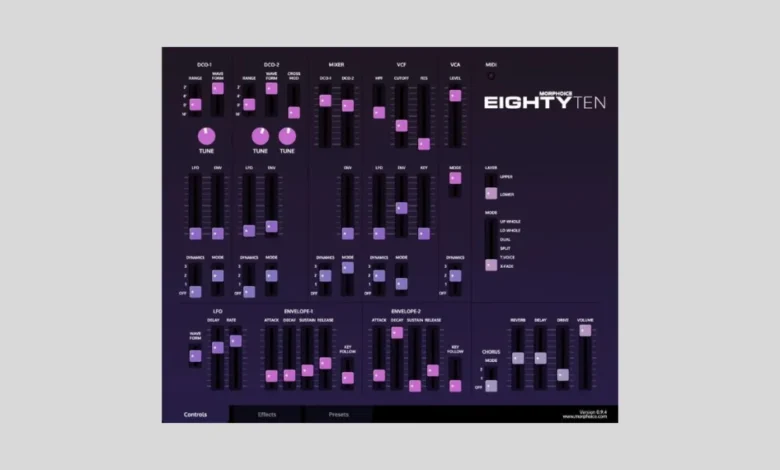
Developer Morphoice has unveiled its latest virtual instrument, EightyTen, a free beta plugin that masterfully emulates two legendary Roland synthesizers: the JX-8P and the SuperJX-10 (also known as the MKS-70 rackmount unit). This release continues Morphoice’s impressive trajectory of bringing sought-after vintage hardware sounds to the digital realm, solidifying its reputation as a key player in accessible software synthesis. EightyTen arrives as an early beta, with the developer employing a model where continued free access is contingent on future paid versions, offering a generous window for users to explore its sonic capabilities.
A Legacy of Emulation: Morphoice’s Growing Portfolio
Morphoice has rapidly established a niche by focusing on emulating iconic synthesizers, often with a distinctive approach that combines fidelity with modern usability. Their previous releases include the highly regarded Unstable, a faithful recreation of the Yamaha CS-80, and EightySix, which captures the essence of the Roland Juno-6. More recently, EightyEight delved into the rich sonic palette of the Roland Jupiter-8. EightyTen represents a natural progression, delving into the robust and versatile JX series. This consistent output suggests a clear strategy from Morphoice: to democratize access to the sounds that shaped decades of music production.
The developer’s release strategy for EightyTen mirrors that of its predecessors. It is presented as an early beta, emphasizing its developmental stage. While currently available without charge, Morphoice has indicated that users who contribute $10 or more will receive a lifetime license for the eventual, fully released version. This "pay-what-you-want" model for early adopters, coupled with the promise of future paid updates, fosters a community of engaged testers and supporters, ensuring the plugin’s development is guided by user feedback and financial sustainability.
EightyTen is accessible across major operating systems, including macOS, Windows, and Linux, and is available in AU, VST, and VST3 plugin formats. This broad compatibility ensures that a wide range of producers and musicians can integrate it into their existing workflows.
Unpacking the EightyTen: The JX-8P and SuperJX-10 Duo
At its core, EightyTen merges the sonic characteristics of two influential Roland instruments. The JX-8P, released in 1985, was a polyphonic analog synthesizer known for its warm pads, expressive leads, and distinctive digital chorus. Its successor, the SuperJX-10 (released in 1986), expanded upon the JX-8P’s foundation. The SuperJX-10 was notable for featuring two JX-8P "engines" within a single unit, effectively doubling its polyphony to twelve voices. This architecture allowed for the layering of two six-voice patches, enabling the creation of incredibly rich and complex sonic textures. The MKS-70 is the rackmount variant of the SuperJX-10, offering the same powerful synthesis capabilities in a more compact form factor.
The appeal of these Roland instruments lies not only in their individual sonic qualities but also in their architectural design. The ability to stack two independent patches on the SuperJX-10 and MKS-70 was a significant innovation, allowing for the creation of layered sounds that were both deep and broad. This dual-voice architecture offered a level of sonic depth and complexity that was a step up from many contemporary synths. EightyTen aims to capture this nuanced layering capability, providing users with the tools to recreate those sought-after stacked sounds.
While the SuperJX-10 offered this advanced layering, the JX-8P maintained a simpler, more direct approach that many users still appreciate. EightyTen’s design appears to accommodate both preferences, offering a comprehensive emulation that bridges the gap between the two.
Key Features: A Blend of Vintage Authenticity and Modern Enhancement
EightyTen distinguishes itself through a host of features that are faithful to the original hardware while also incorporating enhancements for contemporary production.
-
Cross Modulation: This is a particularly exciting feature, allowing the pitch of one Digital Controlled Oscillator (DCO) to be modulated by the output of another. This capability opens the door to FM-like timbres, enabling users to explore synthesized sounds that were traditionally the domain of instruments like the Yamaha DX7. The potential for creating unique, metallic, or bell-like tones, or even gritty industrial textures, is immense. This feature is a testament to Morphoice’s understanding that modern producers often seek the sonic flexibility to recreate or approximate sounds from various eras and instrument types.
-
Dual Filter Configuration: The plugin features a robust filtering section. This includes a 24 dB/octave low-pass filter, a staple for shaping analog synth tones, and a non-resonant high-pass filter, which can be used to clean up low-end frequencies or add brightness. The combination of these filters provides a versatile palette for sculpting the timbre of the synthesized sounds.
-
Dual ADSR Envelope Generators: Each voice within EightyTen is equipped with two Attack-Decay-Sustain-Release (ADSR) envelope generators. This allows for complex shaping of amplitude and filter cutoff over time, crucial for creating dynamic and evolving sounds, from percussive plucks to swelling pads.
-
Roland’s Signature Stereo Chorus: No emulation of these Roland synths would be complete without their iconic stereo chorus effect. EightyTen faithfully recreates this effect, offering both fast and slow settings. This effect is renowned for its ability to add width, depth, and a shimmering quality to synth patches, a sound that has been a hallmark of countless hit records across various genres.
-
Expressive Control: The plugin is designed to respond to velocity and aftertouch, mirroring the expressive capabilities of the original hardware. This ensures that players can impart nuance and emotion into their performances, making the virtual instrument feel more alive and responsive. Furthermore, EightyTen provides a PG-800-style interface, offering a more convenient and intuitive way to control the synth’s parameters compared to the often-complex editing of the original hardware.
Beyond Emulation: Modern Additions
In line with its previous releases, Morphoice has infused EightyTen with contemporary sonic tools that extend its creative potential beyond the limitations of the vintage hardware it emulates. These additions are not mere afterthoughts but carefully integrated effects that can elevate the synthesized sounds into modern production contexts.
-
DarkStar Reverb: Inspired by the acclaimed Strymon BigSky reverb unit, this addition offers a suite of high-quality digital reverb algorithms. This allows users to place their EightyTen sounds in a variety of spatial environments, from intimate rooms to vast halls and beyond, without needing an external reverb plugin.
-
Lo-fi Tape Delay: A classic effect in its own right, a tape delay emulation brings vintage character and warmth to the sound. This effect can add subtle imperfections, saturation, and a sense of analog decay, perfect for creating nostalgic or gritty textures.
-
HeatBurn Drive and Distortion: This integrated effect provides users with the ability to add grit, saturation, and aggressive distortion to their sounds. Whether seeking subtle warmth or outright sonic mayhem, the HeatBurn effect offers a direct route to pushing the EightyTen’s analog-inspired tones into more aggressive territories.
These modern additions underscore Morphoice’s understanding of current production demands. By integrating these effects, EightyTen becomes a more self-contained and powerful creative tool, reducing the need for external processing and streamlining the workflow.
Historical Context: The Rise of the Digital Synthesizer and Roland’s Dominance
The mid-1980s were a pivotal era in music technology. Analog synthesizers, which had dominated the sonic landscape of the 1970s and early 1980s, began to face competition from emerging digital synthesis technologies. Roland, a Japanese manufacturer with a rich history in electronic musical instruments, was at the forefront of this evolution.
The JX-8P, released in 1985, was part of Roland’s push into hybrid synthesis, combining digital control with analog sound generation. While it retained some analog warmth, it also embraced digital programmability and memory storage, a significant departure from earlier analog synths that often relied on tactile knobs and limited patch recall. The JX-8P was designed to offer a more accessible and user-friendly experience than some of its more complex predecessors, aiming to appeal to a broader range of musicians. Its distinctive chorus effect became a signature sound, widely used in pop, new wave, and electronic music of the era.
The SuperJX-10 and its rackmount counterpart, the MKS-70, represented a refinement and expansion of the JX-8P’s architecture. By incorporating two JX-8P "engines," Roland significantly increased the polyphony and layering capabilities, offering a more powerful and versatile instrument. This move towards increased polyphony and layering was a trend across the synthesizer industry at the time, as manufacturers sought to provide the sonic complexity required for more elaborate arrangements and productions. These instruments were particularly adept at creating lush pads, sweeping strings, and rich, evolving textures that became synonymous with the sound of the late 1980s.
The introduction of the PG-800 programmer, a dedicated hardware controller for the JX-8P and SuperJX-10/MKS-70, was a crucial development. The original synthesizers’ interfaces were somewhat menu-driven, making deep sound design a more involved process. The PG-800 provided a hands-on approach, with dedicated sliders and buttons for most parameters, allowing for much quicker and more intuitive sound editing. EightyTen’s inclusion of a PG-800-style interface directly addresses this user experience, making the power of these synths more accessible to modern users.
The Significance of Free Beta Releases
Morphoice’s decision to release EightyTen as a free beta is a common strategy in the software development world, particularly within the music technology sector. This approach offers several benefits:
-
Community Building and Feedback: Early beta releases allow developers to gather invaluable feedback from a large user base. Testers can identify bugs, suggest usability improvements, and highlight features that resonate most with producers. This collaborative process can lead to a more polished and user-centric final product.
-
Market Penetration and Awareness: Offering a free beta version serves as a powerful marketing tool. It allows potential customers to experience the plugin’s capabilities firsthand, generating buzz and word-of-mouth promotion. This is particularly effective for emulations of sought-after vintage synths, where the allure of authentic sound is a strong draw.
-
Financial Sustainability Model: The "pay-what-you-want" model for a lifetime license, as implemented by Morphoice, offers a unique way to fund ongoing development. It allows users who value the plugin to contribute financially, while those with limited budgets can still access the core functionality. This democratizes access while providing a pathway to revenue for the developer. The $10 threshold is a modest investment for a lifetime license, making it an attractive proposition for many users.
-
Ethical Considerations in Software Development: In a digital landscape where software can be easily pirated, this model encourages a more ethical approach to acquiring software. It incentivizes users to support developers directly, fostering a healthier ecosystem for independent creators.
The Broader Impact: Democratizing Iconic Sounds
The release of EightyTen by Morphoice has significant implications for music producers, especially those who may not have access to the original hardware or the financial means to acquire expensive vintage emulations.
-
Accessibility for Emerging Producers: For aspiring musicians and producers, the cost of acquiring classic hardware or even high-end software emulations can be prohibitive. Free beta releases like EightyTen lower the barrier to entry, allowing a new generation of artists to experiment with and learn from the sounds that have shaped popular music. This can foster creativity and innovation by providing access to a rich sonic palette.
-
Preservation of Musical Heritage: By faithfully emulating vintage synthesizers, developers like Morphoice play a role in preserving musical heritage. They ensure that the unique sonic characteristics of these instruments remain accessible and relevant for future generations of musicians, even as the original hardware becomes rarer and more expensive.
-
Creative Exploration and Hybrid Workflows: EightyTen, with its blend of authentic emulation and modern effects, encourages creative exploration. Producers can combine the warmth and character of the Roland synths with contemporary effects like DarkStar Reverb or HeatBurn Drive, leading to unique hybrid sounds that are both vintage-inspired and distinctly modern. This flexibility allows for a wider range of sonic possibilities within a single plugin.
-
Competitive Landscape in Software Synthesis: The continued release of high-quality, accessible emulations by developers like Morphoice contributes to a competitive and vibrant software synthesizer market. This competition often drives innovation and affordability, benefiting consumers by offering more choices and better value.
Looking Ahead: The Future of EightyTen
As an early beta, EightyTen is a work in progress. Users who download and test the plugin are encouraged to provide feedback to Morphoice. The success of this beta phase and the subsequent paid release will depend on the plugin’s stability, its sonic accuracy, and the developer’s responsiveness to user input.
The promise of a lifetime license for a modest contribution is a compelling offer for anyone interested in the distinctive sounds of the Roland JX-8P and SuperJX-10. EightyTen represents an exciting opportunity to explore a significant chapter in synthesizer history, brought to life through the dedication and skill of Morphoice. The plugin’s availability across multiple platforms and formats ensures its reach, making it a valuable addition to any producer’s toolkit. As the beta period progresses, the anticipation for the final release of EightyTen will undoubtedly grow, fueled by the promise of accessible, iconic vintage synth sounds.
Download Information:
EightyTen is currently available as a FREE beta on Gumroad. A lifetime license for the final version can be obtained by donating $10 or more to the developer.
- Download Link: https://www.morphoice.com/eightyten
The last update to this article was on July 17, 2026, by Tomislav Zlatic.