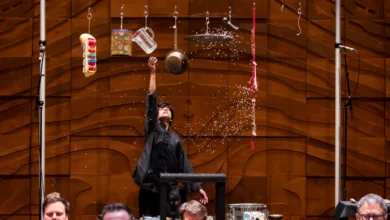
The Berlin Philharmonic and conductor Iván Fischer part ways over artistic disagreement on orchestral seating arrangements


The Berlin Philharmonic, one of the world’s most prestigious musical institutions, announced a significant disruption to its concert schedule this week, citing an irreconcilable artistic disagreement between the orchestra and guest conductor Iván Fischer. The concerts, originally scheduled to take place from November 5 to November 7, have been canceled following a breakdown in negotiations regarding the seating configuration for Gustav Mahler’s Symphony No. 5. While the orchestra’s official FAQ page asserts that the power to dictate seating arrangements rests entirely with the conductor to ensure the "best possible presentation of the music," this incident highlights the complex power dynamics and collaborative friction that exist behind the scenes in high-stakes classical performance.
A breakdown in the collaborative process
The cancellation was confirmed on Thursday via a formal press release, which characterized the split as a "mutual agreement." The statement underscored a degree of professional respect between the parties, noting that while both the conductor and the orchestra regretted the outcome, neither side was willing to compromise on their respective positions.
Iván Fischer, a conductor known for his innovative approach to orchestral sound and spatial dynamics, has long been a proponent of experimenting with traditional seating charts to alter the sonic texture of a performance. In the context of Mahler’s Fifth—a dense, emotionally complex work that requires precise instrumental layering—Fischer’s vision for the ensemble’s physical layout evidently clashed with the established preferences or technical requirements of the Berlin Philharmonic’s members.

In the wake of the withdrawal, the Berlin Philharmonic has moved quickly to minimize the impact on its subscribers and ticket holders. Conductor Andrés Orozco-Estrada has been tapped to replace Fischer for the November dates, ensuring that the performances of the Mahler cycle—a cornerstone of the orchestra’s current season—will proceed under new leadership.
Chronology of the dispute
The conflict appears to have developed during the pre-rehearsal planning stages. In professional orchestral environments, the conductor typically submits a seating plan to the orchestra’s management and lead musicians weeks in advance.
- Pre-season planning: The program for November 5–7 was finalized, featuring Mahler’s Fifth Symphony as the primary work.
- Seating negotiations: Discussions regarding the spatial arrangement of the sections—specifically the placement of strings, brass, and percussion—reached a stalemate.
- The decision: Realizing that a consensus on the stage layout could not be achieved without compromising the integrity of the performance, both Fischer and the orchestra leadership elected to terminate their collaboration for these specific dates.
- Public announcement: The Berlin Philharmonic issued its statement on Thursday, notifying the public of the cancellation and the immediate appointment of a substitute conductor.
The significance of seating in orchestral acoustics
For the layperson, the seating of an orchestra might appear to be a static tradition. However, for conductors of Fischer’s caliber, the physical arrangement of musicians is a critical tool for "sculpting" sound.
Historically, the "German" layout (violins on the left, celli and basses on the right) has been the standard. Yet, throughout the 20th and 21st centuries, many conductors have returned to the "antiphonal" or "divided" layout (first violins on the left, second violins on the right), which allows for a more distinct dialogue between the two violin sections.

Fischer, in particular, has frequently championed unconventional seating, such as spreading the brass section across the back or clustering woodwinds in a way that emphasizes the counterpoint in complex scores. Mahler’s music, which often utilizes extreme dynamic ranges and unusual instrumental groupings, serves as a frequent battleground for such experiments. The Berlin Philharmonic, an orchestra that prides itself on its "Karajan-era" sound—a lush, blended, and uniform aesthetic—often maintains rigorous standards for how it achieves that sound, which can lead to friction when a guest conductor proposes a radical spatial departure.
Institutional implications and the power of the soloist-conductor
The Berlin Philharmonic is a self-governing orchestra, meaning the musicians themselves hold a significant share of institutional power compared to orchestras in the United States, where management often holds final authority. This unique governance structure means that when a conductor clashes with the orchestra, they are effectively clashing with the collective will of some of the world’s most experienced and opinionated instrumentalists.
The fact that this disagreement reached the point of cancellation suggests a fundamental disconnect in artistic philosophy. When an orchestra of this caliber refuses to accommodate a conductor’s request, it usually signals that the musicians feel the requested arrangement would jeopardize the clarity or tonal quality of the work. For a piece as demanding as Mahler’s Fifth, the risk of a "failed" performance—one that does not meet the orchestra’s high standard—is deemed too high by both the players and the conductor.
Reaction and future outlook
Industry analysts view this incident as a rare, albeit transparent, window into the high-pressure world of international conducting. It is unusual for such a dispute to result in a total cancellation rather than a compromise; however, both Fischer and the Berlin Philharmonic possess high public profiles, and neither is likely to accept a performance environment that they believe serves the music poorly.

Iván Fischer, who has maintained a long-standing and generally positive relationship with the Berlin Philharmonic, is expected to address his vision for orchestral seating in forthcoming interviews. His ability to return to the podium in Berlin will likely depend on whether this disagreement is viewed as a singular event related to the specific demands of Mahler’s writing or a wider divergence in artistic vision.
As for the Berlin Philharmonic, the swift transition to Andrés Orozco-Estrada signals a desire to maintain continuity and professionalism. The incident serves as a reminder that even at the pinnacle of classical music, the "simple" question of where a musician sits remains a profound, contentious, and essential component of the art form itself. The management of the orchestra has emphasized that they remain committed to the highest standards of artistic excellence, and they appear to have calculated that a change in conductor was the most effective way to uphold those standards under the current circumstances.
As the season progresses, the focus will undoubtedly shift back to the music, but the conversation surrounding the autonomy of conductors versus the collective expertise of orchestral musicians is likely to persist within the industry. For the Berlin Philharmonic, the priority remains the successful delivery of their Mahler series, proving that the institution’s reputation for resilience and excellence remains intact despite the recent personnel shift.