Jeff Rupert and Richard Drexler Redefine the Intimacy of Chamber Jazz on New Duet Album Imagination

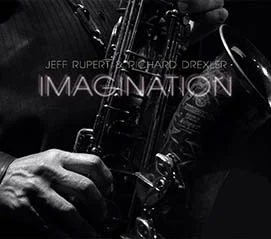
The contemporary jazz landscape often tends toward maximalism, with expansive big bands, densely layered fusion ensembles, and heavily produced studio recordings dominating the commercial airwaves. However, a profound counter-movement has continually prized the acoustic purity and exposed vulnerability of the stripped-down duet. Entering this storied tradition with a masterclass in modern chamber jazz, saxophonist Jeff Rupert and pianist Richard Drexler have delivered a landmark recording titled Imagination. Released to critical acclaim, this eight-track collection strips away the safety net of a rhythm section, leaving only two seasoned virtuosos to navigate the harmonic, melodic, and rhythmic architecture of some of the genre’s most enduring compositions. Recorded live to capture the unedited breath and kinetic energy of an immediate performance, the album showcases a rare telepathic interplay that bridges the historical lineage of classic jazz with contemporary sophistication.
Main Facts of the Release and Instrumentation
At its core, Imagination is an exercise in dynamic balance and mutual respect. The album features Jeff Rupert on tenor saxophone and Richard Drexler exclusively on acoustic piano. Without the percussion of a drum kit or the grounding low-end of a double bass, the two musicians must independently and cooperatively imply groove, time, and harmonic progression.
The resulting sound is both remarkably full and refreshingly spacious. Rupert’s approach to the tenor saxophone avoids the aggressive, overdriven tone common in post-bop idioms, instead favoring a warm, rounded aesthetic that immediately evokes the breathy lyricism and relaxed phrasing of jazz icons Lester Young and Stan Getz. His melodic lines are characterized by ebullient arpeggios and meticulously gilded glissandi that mimic the expressive phrasing of a human vocalist.
Complementing this melodic grace is the pianism of Richard Drexler. Operating as an equal partner rather than a mere accompanist, Drexler brings an impulse to adorn simple melodies with sophisticated harmonic voicings and counter-melodies. His ability to fill the sonic gaps without crowding Rupert’s register creates a seamless conversational dialogue. The dynamic range achieved across the recording is striking; the artists effortlessly trade the spotlight, moving from foreground soloing to supportive background textures with a sleight of hand that feels almost magical.
Chronology and Background of the Collaboration
The artistic partnership between Jeff Rupert and Richard Drexler is not a sudden studio pairing, but rather the culmination of years of professional collaboration, shared stages, and mutual admiration within the academic and professional jazz communities. Both artists have built formidable individual careers before converging on this intimate configuration.
Jeff Rupert, a renowned saxophonist, composer, and educator based in Florida, has spent decades performing alongside jazz royalty, including Maynard Ferguson, Sam Rivers, and Benny Golson, while also leading his own large and small ensembles. His deep understanding of the jazz canon informs every note he plays, allowing him to honor historical traditions while speaking in a distinct, contemporary voice.
Richard Drexler brings an equally impressive pedigree to the piano bench. Known for his versatility on both piano and acoustic bass, Drexler has performed with jazz greats such as Woody Herman, Randy Brecker, and Nat Adderley. His comprehensive understanding of the rhythm section—having spent significant time holding down the bass role in various ensembles—uniquely equips him to provide harmonic grounding and rhythmic propulsion from the piano, even in the absence of a traditional bassist.
The decision to record Imagination as a pure duet was born from a desire to strip away artifice and test the boundaries of their musical communication. The recording sessions were approached with a live-performance ethos, emphasizing spontaneity, real-time decision-making, and emotional authenticity. By capturing the performances live, Rupert and Drexler ensured that the kinetic spark of their initial inspiration remained preserved on the master tapes.
Repertoire Analysis: From Standards to Original Compositions
The structural integrity of Imagination relies heavily on its thoughtfully curated repertoire. The tracklist is a masterclass in song selection, blending beloved standards with inventive original compositions that highlight the duo’s compositional and improvisational breadth.
The album opens with a confident statement before moving through a diverse landscape of tempos and emotional tonalities. One of the standout moments occurs with the interpretation of Claude Thornhill’s flowing standard, “Snowfall.” On this track, Rupert’s playing is particularly exquisite, sending up phrase after phrase of delicate notes that drift effortlessly above Drexler’s cascading chordal accompaniment. The tempo remains fluid, creating a sense of suspended time that gently nudges Drexler into a rarefied harmonic realm of his own.
Rhythmic vitality and harmonic sophistication are further demonstrated on Tom Jobim’s immortal bossa nova classic, “A Felicidade.” Here, the duo avoids the cliché tropical trappings often associated with the genre, opting instead for a nuanced, harmonically rich exploration that emphasizes the underlying melancholia and melodic beauty of Jobim’s writing.
Original compositions also take a prominent place on the album, proving that Rupert and Drexler are as adept at writing new material as they are at reinterpreting the canon. A prime example is Jeff Rupert’s Shakespearean-inspired sonnet, “My Mistress’ Eyes.” Translated into musical terms, the composition serves as a vehicle for poetic phrasing, where the curved edges of the saxophone and piano interplay to create a narrative arc reminiscent of Elizabethan verse.
Rounding out the core highlights is a stirring rendition of Mal Waldron’s classic “Soul Eyes.” Waldron, known for his sparse, hypnotic phrasing and association with John Coltrane, provides a blueprint that Rupert and Drexler execute with reverence. They understand that in a Waldron composition, the spaces between the notes are just as important as the notes themselves. The duo masterfully exploits these silences, allowing the music to breathe and creating a palpable tension that holds the listener in breathless anticipation.
Other notable tracks on the eight-song journey include “Without a Song,” “I Can’t Help It,” “Strange Meadowlark,” and the title track, “Imagination,” each offering a unique perspective on the conversational capacity of the saxophone and piano pairing.
Technical Brilliance and Spatial Awareness in Recording
Achieving a professional, commercial-grade sound with a saxophone and piano duet presents distinct acoustic challenges. Without the cushion of drums and bass, every imperfection in intonation, touch, or microphone placement is laid bare.
The engineering on Imagination rises to this challenge by maintaining a pristine sonic balance. The recording captures the natural resonance of the instruments, preserving the woody timbre of the tenor saxophone and the warm, percussive hammers of the piano. The stereo imaging places the listener directly in front of the performers, creating an immersive, room-like atmosphere.
Crucially, the album succeeds because of its profound respect for space. Modern masterclasses in audio engineering often suffer from over-compression, which strips acoustic music of its natural dynamic peaks and valleys. Imagination avoids this pitfall by utilizing a wide dynamic range. The artists and engineers recognize that silence and restraint are powerful rhetorical devices in music. By leaving empty space in the arrangement, Rupert and Drexler allow the harmonic resonance of previous chords to linger in the air, creating an ethereal, almost haunting beauty.
Critical Reception and Industry Implications
Since its release, Imagination has drawn praise from jazz critics, purists, and educators alike for its uncompromising commitment to acoustic authenticity. In an era where many jazz releases lean toward high-concept fusion, vocal crossovers, or heavily digitized production, Rupert and Drexler’s stripped-down approach serves as a reminder of the core tenets of the art form: listening, reacting, and storytelling.
Industry analysts note that albums of this caliber play a vital role in preserving the intimacy of jazz. While large-scale festival performances and high-energy club sets are essential to the culture, the quiet intensity of a chamber jazz duet offers a different kind of cultural value. It demonstrates the highest tier of technical mastery, where neither player can hide behind volume or complex arrangements. Every melodic choice, every harmonic substitution, and every rhythmic push-and-pull is exposed to the listener.
Furthermore, the album highlights the viability of independent, artist-driven projects that prioritize artistic integrity over commercial trends. By focusing on the pure dialogue between two master musicians, Rupert and Drexler have created a timeless document that will likely serve as a study piece for aspiring jazz instrumentalists in academic settings.
Broader Impact on the Contemporary Jazz Canon
The release of Imagination arrives at a time when listeners are increasingly seeking authenticity and emotional depth in recorded music. The psychological fatigue associated with heavily produced, algorithm-driven media has sparked a renewed interest in organic, human-made art forms where performance errors and spontaneous decisions are celebrated rather than scrubbed away by digital editing software.
By executing a live-recorded duet album with such seamless telepathy, Jeff Rupert and Richard Drexler have contributed a significant work to the modern jazz lexicon. The album proves that a well-crafted melody, executed with technical brilliance and deep emotional resonance, requires no amplification, electronic manipulation, or massive ensemble to captivate an audience.
As the jazz community continues to balance its rich historical traditions with the demands of the modern era, recordings like Imagination provide a vital anchor. They remind us that at its foundation, jazz is a conversation—an intimate exchange of ideas between human beings translating the human experience into sound. Through their radiant creativity, immaculate phrasing, and fearless vulnerability, Rupert and Drexler have not only honored this tradition but elevated it for a new generation of listeners.