Komische Oper Berlin Triumphs with a Monumental, Immersive Production of Aribert Reimann’s Masterpiece Lear at Tempelhof Airport

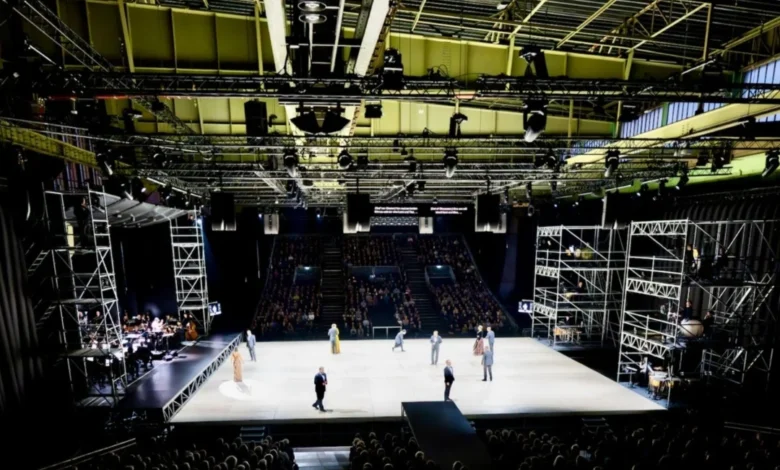
The Komische Oper Berlin has officially launched its new season with a high-stakes, deeply immersive staging of Aribert Reimann’s twentieth-century masterpiece, Lear. Eschewing traditional proscenium arch theaters entirely, the company transported its opening-night production to the cavernous, history-laden confines of Hangar 4 at the former Tempelhof Airport. Nearly half a century after its triumphant 1978 world premiere at the Bavarian State Opera in Munich, Reimann’s monumental score—paired with Claus H. Henneberg’s tightly condensed libretto—demonstrated once again that it has firmly graduated from contemporary curiosity to core operatic repertoire.
Directed by Barrie Kosky and designed by Rebecca Ringst, this bold staging utilized the vast proportions of Tempelhof’s architectural footprint to mirror the psychological disintegration of the titular monarch. By positioning three thousand spectators across grandstands facing one another over a central white square, the production transformed an operatic performance into a stark, communal public tribunal. The acoustic and visual choices made within the hangar successfully turned a potentially hostile, non-traditional performance space into an expressive theatrical instrument, cementing the venue as a vital asset for forward-thinking European opera direction.
The Architecture of Annihilation: Staging Lear at Tempelhof Airport
Staging opera in an aircraft hangar presents formidable logistical and acoustic obstacles. Hangar 4 requires the complete construction of temporary theatrical infrastructure from the ground up, including grandstands, staging platforms, extensive lighting rigs, and specialized amplification systems to carry sound across the immense space. Yet, rather than fighting the monolithic environment, director Barrie Kosky and set designer Rebecca Ringst leaned directly into its industrial geometry.
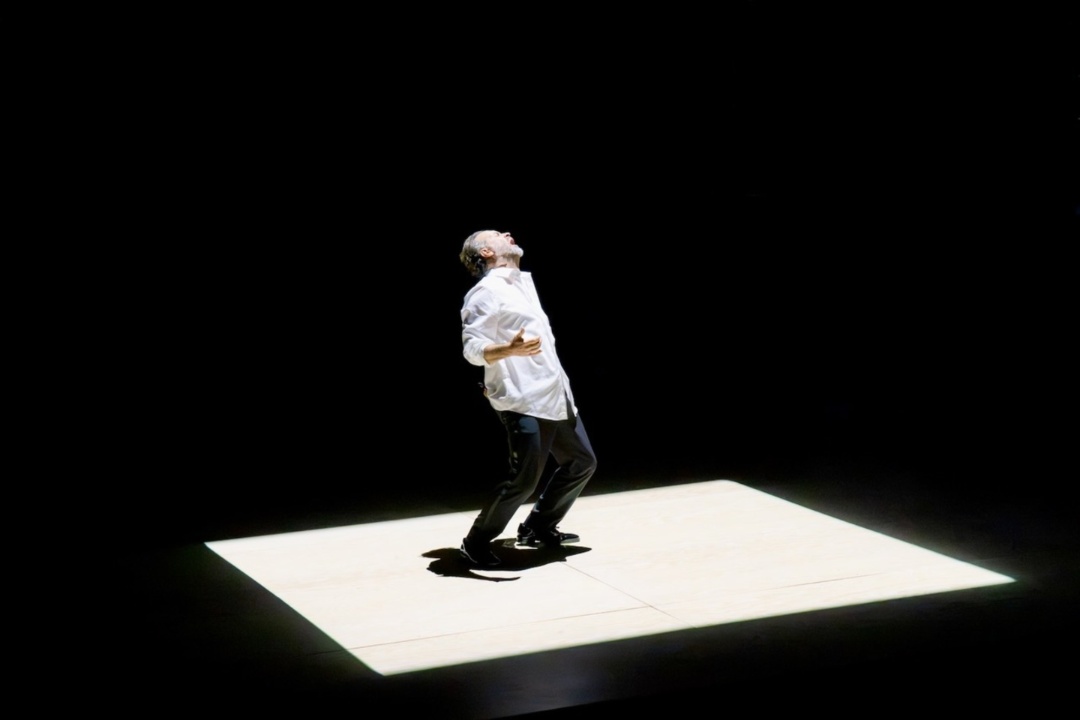
At the heart of the hangar lay a massive white square, flanked on opposite sides by towering audience grandstands. The orchestra occupied one end of the space, while two towering scaffolding structures at the opposite end housed Reimann’s formidable percussion battery. This physical layout forced the audience into a unique vantage point, making them silent witnesses to an unfolding public and private catastrophe.
Ringst kept set additions to an absolute minimum, relying instead on modular chairs and movable catwalks that doubled as tables, pathways, barriers, and pedestals as the drama dictated. Costume designer Klaus Bruns bridged the historical gap by anchoring the narrative firmly in the modern day. The royal family’s initial appearance in polished, high-end black-tie attire visually coded them as members of contemporary corporate and political privilege. As the tragedy accelerated, these immaculate garments devolved into military fatigues, perfectly charting the descent from organized power to violent chaos. Lear himself underwent the inverse physical and sartorial trajectory, shedding his initial aura of authority to end his days exposed, clad in filthy rags, and reduced to near-nakedness.
A Corporate Tycoon’s Hubris: Redefining the Monarch
In this modern interpretation, Scott Hendricks’s portrayal of Lear broke away from the traditional trope of the frail, elderly patriarch staggering toward his final days. Instead, Hendricks entered the space as a vigorous, confident corporate tycoon in his fifties or sixties—a man accustomed to absolute control, presiding over what felt less like an ancient kingdom and more like a high-stakes shareholders’ meeting.
This conceptual framing fundamentally altered the dramatic engine of the tragedy. Lear’s fatal error was not initially diagnosed as senility or failing cognitive faculties, but rather as sheer corporate and personal arrogance: the belief that executive power could be cleanly divested on paper while retaining all of its underlying privileges, social deference, and emotional leverage.
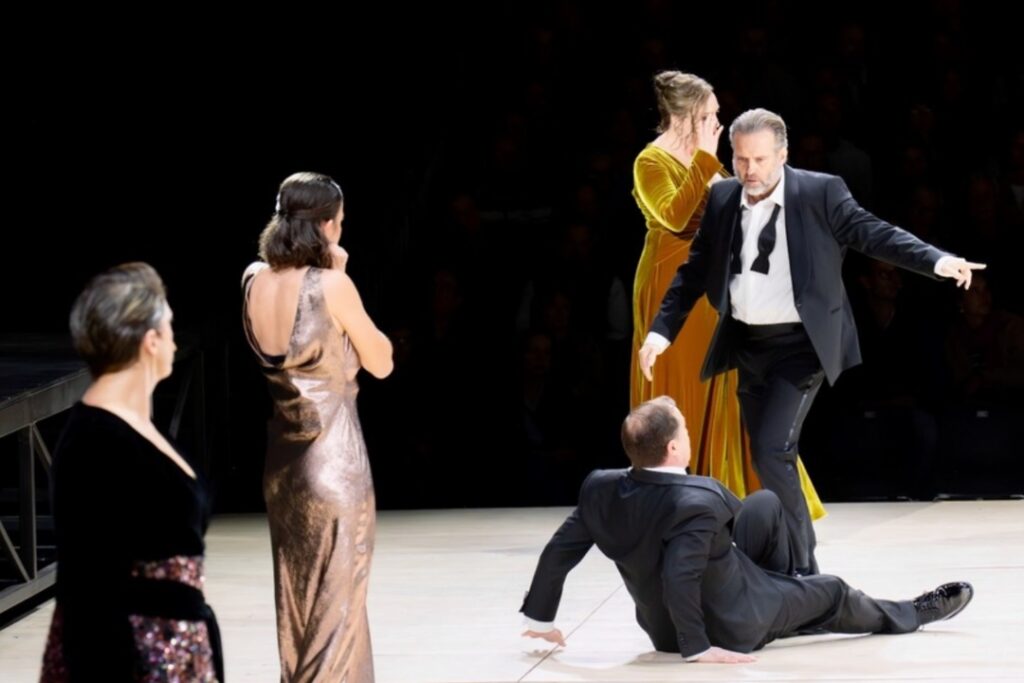
The production was anchored by a stellar ensemble. Dagmar Manzel delivered a brilliant performance as the Court Fool, whose physicalized movements and sardonic body language threw Lear’s grand, inflated gestures into stark relief. Rosie Aldridge as Goneril and Nicole Chevalier as Regan eschewed one-dimensional fairy-tale villainy in favor of differentiated cruelty. Aldridge portrayed Goneril as the calculating, controlled inheritor of the corporate state, while Chevalier brought a volatile, sadistic edge to Regan. Penny Sofroniadou offered a formidable counterweight as Cordelia. Rejecting empty performative flattery, Sofroniadou played Cordelia with profound sensitivity that was matched by unbreakable moral steel, turning her refusal to participate in her father’s public auction of affection into the fissure that shatters the entire domestic and political order.
The male supporting cast proved equally vital to the dramatic architecture. Aryeh Nussbaum Cohen brought searing intensity and vocal agility to the role of Edgar, effortlessly negotiating Reimann’s notoriously exposed writing as he transformed into the wretched "Poor Tom." Brenton Ryan injected febrile energy and calculating danger into Edmund, utilizing an incisive tenor and commanding stage presence to drive the sub-plot’s ruthless ambition. Meanwhile, Günter Papendell imbued Gloster with growing emotional weight, transitioning from commanding baritone authority to devastating vulnerability following the character’s blinding, grounding the production’s more apocalyptic flights in profound human suffering.
Reimann’s Orchestra as a Protagonist of Nature and Mind
Musically, Reimann’s adaptation of Shakespeare remains a towering achievement. By compressing the original play into eleven distinct scenes, the composer and librettist stripped away narrative fat while leaving the emotional architecture entirely intact. Reimann’s idiom is famously abrasive, dense, and uncompromisingly modern, utilizing jagged vocal lines to translate raw psychological states—such as fury, humiliation, vengeance, and terror—directly into musical gesture.
However, it is the orchestral writing that truly dominates the work. Under the meticulous musical direction of conductor Nicholas Carter, the enormous instrumental apparatus functioned not merely as accompaniment, but as an active, hostile environment closing in on the characters. Carter maintained masterly control over the forces, successfully navigating the considerable physical distances between the orchestra, the dispersed singers, and the elevated percussion towers.
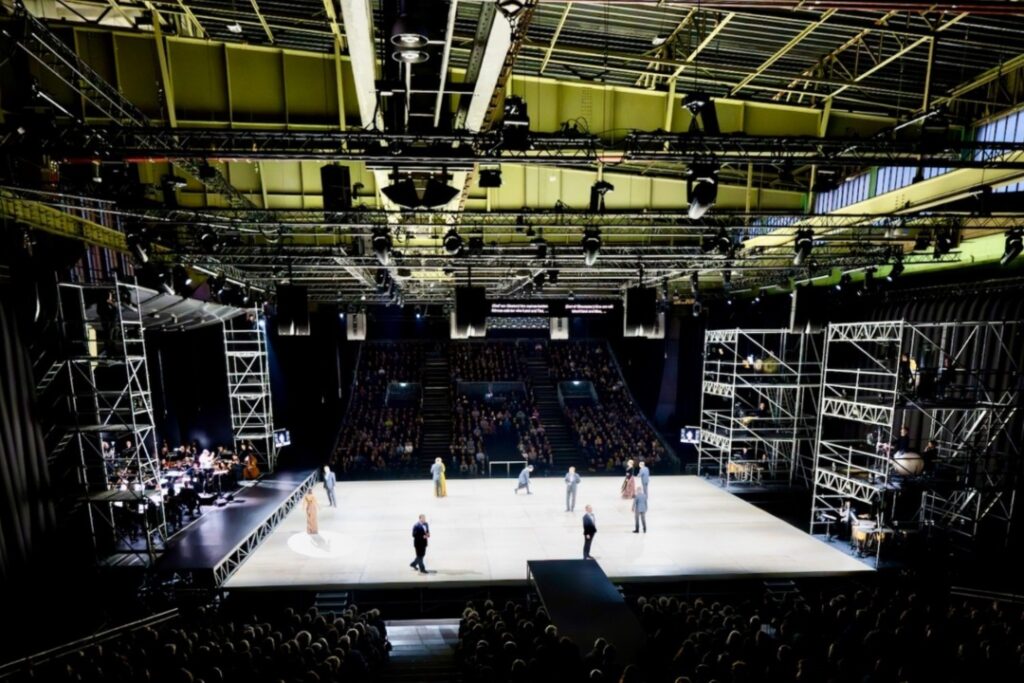
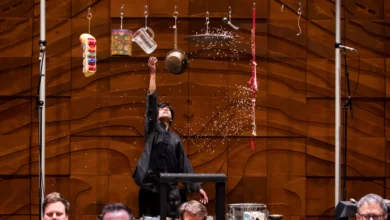
The percussion section itself—comprising bongos, tom-toms, wood and temple blocks, slit drums, gongs, tam-tams, bronze plates, metal foil, and an array of heavy bass drums—served as an independent theatrical arsenal. During the iconic storm scene, this instrumental battery ceased to function as mere atmospheric color. As Reimann built the passage into a massive, relentless crescendo, the boundary between external meteorological destruction and Lear’s internal mental collapse dissolved completely. Enhanced by Hangar 4’s acoustics and rolling clouds of stage fog that enveloped both performers and spectators, the audience did not simply listen to the storm; they sat directly inside its destructive epicenter, justifying the high-risk choice of Tempelhof Airport as a venue.
Broader Implications: From Contemporary Experiment to Permanent Repertoire
The critical and public reception of the Komische Oper’s new production of Lear marks a significant milestone in the work’s performance history. Written during an era when contemporary opera struggled to find a permanent foothold outside specialized festival circuits, Reimann’s score has steadily shed the defensive label of "new music" to claim a secure, enduring place in the international standard repertoire.
The implications of this production extend far beyond Berlin’s seasonal programming. By proving that complex, aggressive late-twentieth-century scores can successfully inhabit non-traditional, industrial spaces without sacrificing musical precision or dramatic nuance, the Komische Oper has provided a blueprint for regional and international houses seeking to engage new audiences. Furthermore, Kosky’s framing of Lear as a study in corporate hubris and the casual relinquishment of power resonates powerfully within current socio-political climates, proving that Shakespearean tragedy—when filtered through Reimann’s uncompromising sonic lens—remains an urgent mirror for contemporary anxieties.
As the final notes of the score ebbed away into a devastating pianissimo, leaving the aged monarch to dissolve into silence rather than conclude with a grand resolution, Hangar 4 fell into a profound stillness. Forty-eight years after its Munich premiere, Lear no longer fights for its place on the stage; it commands it, offering a terrifying and beautiful meditation on the insurmountable distance between absolute power and the human cost of love recognized too late.