Contextualizing the Brecker Evolution
To understand the significance of Tales From The Hudson, one must look at the preceding decade of Brecker’s career. Before the mid-1990s, Michael Brecker was perhaps the most in-demand session musician in the world. Having cut his teeth with the Brecker Brothers alongside his sibling, trumpeter Randy Brecker, he became the defining sound of the fusion era. His ability to navigate complex harmonic structures with an EWI (Electronic Wind Instrument) or a tenor saxophone made him a staple on hundreds of records, ranging from pop hits by Paul Simon and James Taylor to jazz-fusion staples.
However, his first two solo albums—Michael Brecker (1987) and Don’t Try This at Home (1988)—were often criticized by traditionalists for their heavy reliance on synthesizers and high-production-value electronic arrangements. While technically flawless, these records were perceived by some as "studio-bound," prioritizing technical precision over the raw, spontaneous interaction that defined the jazz canon of the 1960s. Tales From The Hudson represents the antithesis of this approach, favoring the acoustic interplay of a world-class ensemble over the rigid structures of electronic production.
The Personnel: An All-Star Configuration
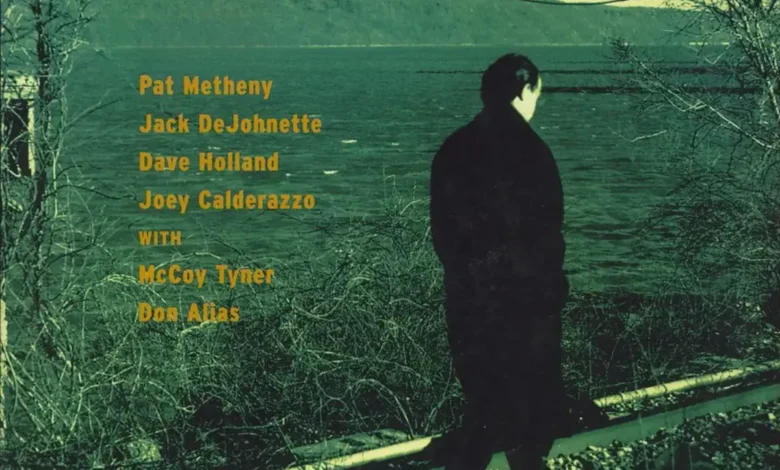
The artistic success of the album is largely attributable to the caliber of musicians assembled in the New York City studio. The lineup features a "who’s who" of modern jazz, providing a rich sonic tapestry that allows Brecker to explore his full expressive range.
- Michael Brecker: Tenor Saxophone
- Pat Metheny: Guitar and Guitar Synthesizer
- Joey Calderazzo: Piano
- McCoy Tyner: Piano
- Dave Holland: Bass
- Jack DeJohnette: Drums
- Don Alias: Percussion
The inclusion of McCoy Tyner—a legendary pianist known for his foundational work with John Coltrane—is particularly symbolic. By inviting a direct link to the 1960s "tonal saxophone masters," Brecker signaled an intentional homage to the giants who inspired his own phrasing. Simultaneously, the inclusion of Pat Metheny adds a contemporary texture, particularly on his composition "Song for Bilbao," where he utilizes a guitar synth that contrasts with the acoustic purity of the rest of the record.
A Track-by-Track Examination of Stylistic Shifts
The composition of the album is varied, balancing original works with pieces that demand a high degree of interpretative skill. The opening track, "Slings and Arrows," serves as an immediate manifesto of intent: it is sharp, rhythmically driving, and centers entirely on the interplay between the rhythm section and Brecker’s muscular tone.
Perhaps the most compelling moment on the record is the interpretation of Joey Calderazzo’s "Midnight Voyage." Here, Brecker moves away from the rapid-fire, multi-tonic substitutions that defined his earlier "Brecker-esque" style. Instead, he opts for a more lyrical, open-ended delivery. Critics have noted that his phrasing on this track evokes a synthesis of Dexter Gordon’s cool, rolling elegance and Wayne Shorter’s enigmatic, non-linear melodic sensibility.
Conversely, tracks like "Naked Soul" offer a glimpse into the more contemplative, ballad-heavy side of the artist. While some critics have described the track as "grey" or less dynamic than the up-tempo numbers, it serves a functional purpose in the album’s sequencing, providing a necessary breath of air between the intense, rhythmically dense compositions like "African Skies" and "Cabin Fever."
Chronology of Production and Release
The sessions for Tales From The Hudson took place in New York City in 1996. The recording process was characterized by a move toward live-room capture, minimizing the overdubbing that defined Brecker’s late 80s work.
- Early 1996: Pre-production meetings between Brecker and the Impulse! A&R team to determine the stylistic direction of the third album.
- Mid-1996: Studio sessions at The Power Station in NYC. The ensemble is recorded in a way that emphasizes the "live" feel of the jazz quartet/quintet format.
- Late 1996: Album release, followed by widespread critical acclaim.
- 1997: The album achieves significant commercial success, further validated by a Grammy Award for Best Jazz Instrumental Solo and Best Jazz Instrumental Album, Individual or Group.
The "Studio Automaton" Myth
A recurring theme in the discourse surrounding Brecker’s career was the dismissive label of "studio automaton." Because of his extreme technical facility, some critics argued that he was more of a "machine" than a "soulful" artist—a common critique for musicians who master their instrument to a degree that renders the act of playing seemingly effortless.
Tales From The Hudson effectively dismantled this narrative. By engaging with the nuances of McCoy Tyner’s harmonic world and the reactive drumming of Jack DeJohnette, Brecker proved that his facility was not a barrier to emotion but rather a conduit for it. The album demonstrates a vulnerability that had previously been obscured by the heavy layering of electronic textures. The improvisational risk-taking on this record is evident; Brecker is not merely executing patterns, he is engaging in a dialogue.
Broader Implications for the Jazz Genre
The release of Tales From The Hudson occurred at a time when jazz was experiencing a significant "neoclassical" revival. Wynton Marsalis and the Lincoln Center Jazz Orchestra were pushing for a return to traditional acoustic jazz, often criticizing the fusion experiments of the 70s and 80s. Brecker’s album acted as a bridge between these two worlds. He did not reject his fusion roots entirely—his choice of Pat Metheny and the inclusion of specific arrangements proves that—but he successfully integrated them into a lineage that honored the history of the tenor saxophone.
Furthermore, the success of the album paved the way for a new generation of saxophonists to embrace technical complexity without being labeled as "fusion-only" artists. It demonstrated that one could be a master of the instrument—capable of playing at blistering speeds—while remaining firmly grounded in the tradition of the jazz ballad and the blues.
Official Reception and Critical Legacy
Upon its debut, the album received praise from major jazz publications for its focus and structural unity. The consensus was that Impulse! had finally captured the "real" Michael Brecker. The sensitivity of the accompanists—particularly Dave Holland’s bass lines, which provide a flexible foundation for Brecker’s long, flowing lines—was frequently cited as a highlight.
From an analytical standpoint, the album remains a pedagogical gold standard for jazz students. The way Brecker constructs his solos—beginning with simple melodic motifs and gradually increasing the harmonic density before resolving back to the theme—is a masterclass in improvisational architecture. As of the current era, Tales From The Hudson remains a top-tier recommendation for listeners seeking to understand the transition of jazz from the high-production 80s to the more reflective, tradition-conscious 90s.
Conclusion
Tales From The Hudson stands as a testament to Michael Brecker’s growth as an artist. By stripping away the electronic artifice and focusing on the raw interaction between world-class improvisers, Brecker managed to create a record that is both technically awe-inspiring and deeply personal. It serves as a rebuttal to those who questioned his ability to lead a group without the safety net of studio gimmicks, and it remains a vital piece of the jazz discography that continues to influence modern saxophone performance. Through this work, Brecker proved that the true "Tales" worth telling in jazz are not found in the machines, but in the breath, the fingers, and the collective spirit of the ensemble.