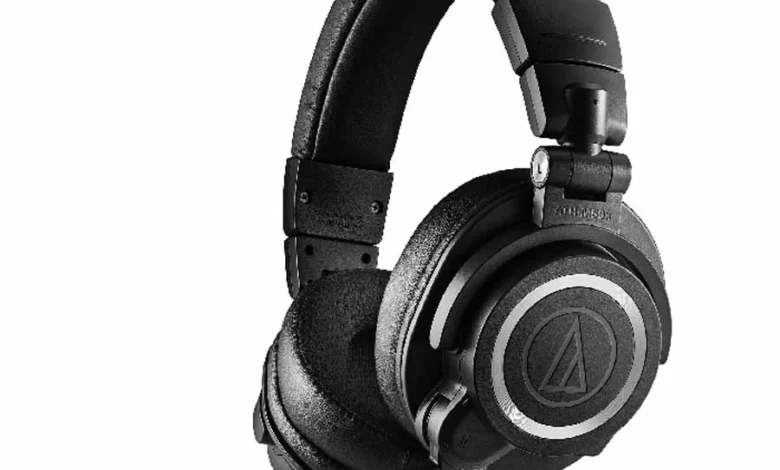
Audio-Technica, a globally recognized leader in professional and consumer audio technology, has officially announced the expansion of its popular StreamSet product line with the introduction of the ATH-M50xSTS-WL wireless headset. Priced at $299 USD, this new peripheral bridges the gap between high-fidelity music monitoring and professional-grade content creation. Designed specifically for desktop users who frequently engage in live streaming, podcasting, online conferencing, and high-resolution media consumption, the headset aims to eliminate the need for separate dedicated headphones and standalone broadcast microphones. By leveraging the acoustic architecture of its legendary ATH-M50x studio monitor headphones, Audio-Technica seeks to capture a growing market of creators who refuse to compromise on sound fidelity for the sake of communication convenience.

The launch of the ATH-M50xSTS-WL arrives at a time when the convergence of remote work, digital content creation, and high-performance gaming has fundamentally shifted consumer audio demands. Over the past decade, the original ATH-M50x has cemented its status as an industry standard in recording studios and mixing suites worldwide, praised for its flat, accurate frequency response and durable design. However, as the creator economy matured during the early 2020s, users increasingly demanded products that could effortlessly transition from critical listening environments to interactive communication platforms. Audio-Technica initially responded to this demand by releasing the wired ATH-M50xSTS and ATH-M50xSTS-USB models. While successful, the wired iterations left a distinct gap for users seeking cable-free mobility at their desks without sacrificing audio performance. The newly unveiled wireless model directly addresses this requirement, combining the untethered freedom of 2.4GHz radio frequency transmission with studio-proven acoustic transducers.
Unlike conventional consumer headsets that rely heavily on standard Bluetooth connectivity—which often introduces noticeable audio delay and data compression—Audio-Technica has opted for a dedicated 2.4GHz USB wireless transceiver. This architectural choice is critical for applications involving real-time audio and video synchronization, ensuring that what a creator hears on screen matches the audio output without perceptible latency. The low-latency connection establishes a stable, point-to-point link between the headset and the host computer or gaming console. However, potential buyers are advised to verify compatibility with their specific operating systems or hardware ecosystems before making a purchase. Furthermore, recognizing the operational demands of marathon streaming or recording sessions, the manufacturer has engineered the headset to support wired USB operation simultaneously while the internal battery is charging. This dual-functionality guarantees that running out of battery power will not prematurely terminate an ongoing broadcast or professional meeting.

Comfort and long-term wearability have also been prioritized in the design of the ATH-M50xSTS-WL. Audio-Technica includes two distinct sets of interchangeable earpads in the retail package, allowing users to customize their physical experience based on personal preference and environmental conditions. The first set comprises traditional leatherette pads optimized for maximum sound isolation and low-end bass retention, which is characteristic of the closed-back M50x design. The second set features a breathable mesh fabric, designed to improve ventilation and reduce heat buildup during extended listening or speaking sessions. This thoughtful inclusion acknowledges that content creators often wear their gear for hours at a time, making ergonomic adaptability just as important as sonic accuracy.
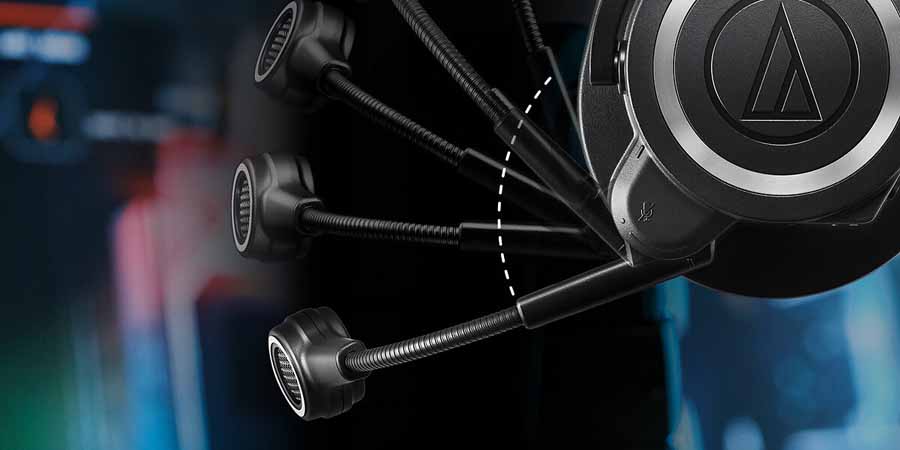
At the core of the headset’s communication capabilities is a professional-grade boom microphone, adapted directly from Audio-Technica’s acclaimed 20-series studio condenser microphones. Featuring a cardioid pickup pattern, the microphone is engineered to focus specifically on the user’s voice while actively rejecting off-axis ambient noise originating from computer fans, mechanical keyboards, or room reflections. To enhance usability during live broadcasts, the flexible boom arm incorporates a convenient flip-to-mute mechanism; simply raising the boom arm vertically automatically cuts the microphone signal. Additionally, the device features adjustable microphone noise reduction technology, designed to clean up outgoing vocal transmissions in acoustically untreated rooms. It is important to distinguish this feature from active noise cancellation (ANC), as the noise reduction applies exclusively to the outgoing microphone signal rather than filtering environmental sounds for the listener.
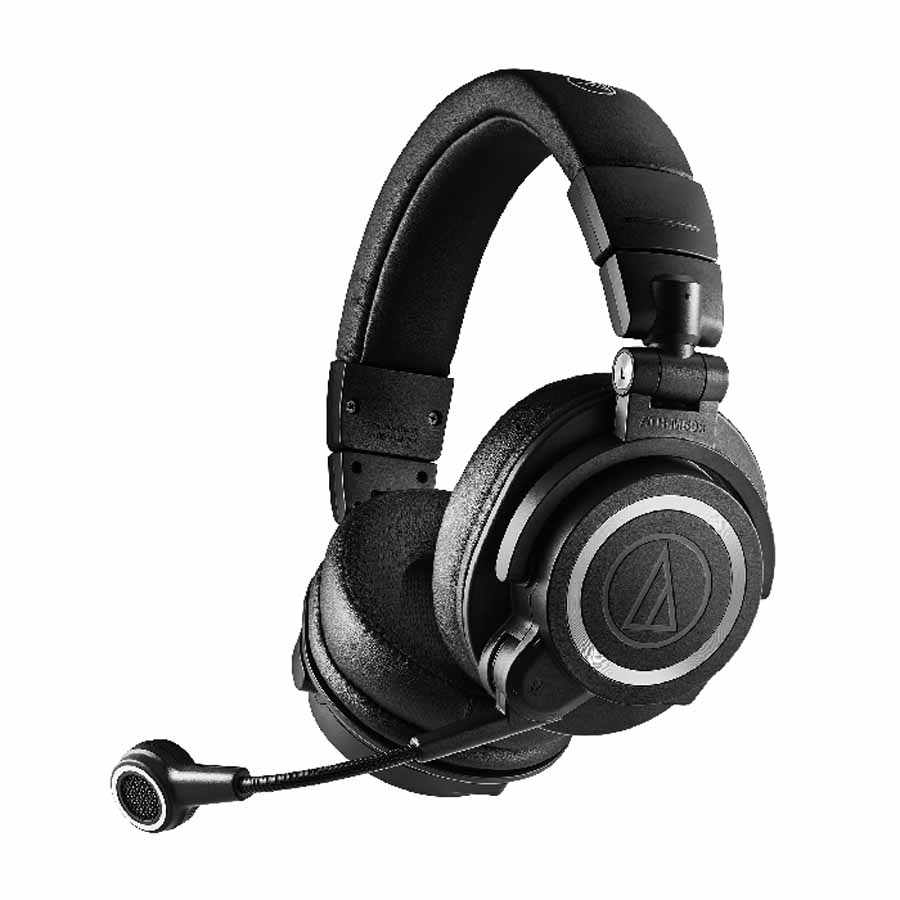
To further refine the user experience during prolonged speaking engagements, Audio-Technica has integrated a sidetone circuit into the headset. Sidetone feeds a controlled amount of the user’s own voice back into the earcups, counteracting the natural isolation provided by the closed-back earcups. For many speakers, wearing closed-back headphones creates an unnatural occlusion effect, making their own voice sound muffled or disconnected. By introducing adjustable sidetone, the ATH-M50xSTS-WL allows creators to speak at a natural volume and maintain vocal control without straining their vocal cords. These integrated professional features underscore the device’s positioning as a serious tool for media production rather than a generic multimedia accessory.
From a technical standpoint, understanding the core terminology associated with the ATH-M50xSTS-WL helps contextualize its market value. In electroacoustics, a "driver" refers to the electromagnetic transducer element inside each earcup that converts electrical audio signals into audible sound waves. "Closed-back" earcups feature a solid, sealed outer shell designed to prevent sound leakage into the room while blocking external ambient noise from reaching the user’s ears. The "cardioid" polar pattern describes a directional microphone’s sensitivity profile, which is most sensitive to sound arriving from the front while exhibiting a wide null point directly behind it. "Latency" measures the time elapsed between the initiation of an audio event within a computer system and its physical reproduction by the headphone drivers. Finally, "sidetone" is the acoustic feedback loop that routes the microphone’s input signal back into the monitoring headphones, facilitating natural speech patterns.
The release of the ATH-M50xSTS-WL at a retail price point of $299 USD places it firmly in the upper tier of desktop communication headsets, well above mainstream entry-level options. Industry analysts note that this pricing strategy reflects Audio-Technica’s intention to target prosumers, semi-professional broadcasters, and high-end remote professionals who prioritize acoustic fidelity over cost-saving measures. While budget-oriented gaming headsets frequently compromise on music reproduction quality by emphasizing exaggerated bass profiles and proprietary software suites, the ATH-M50xSTS-WL relies on its heritage of flat, uncolored studio monitoring. This makes it an attractive proposition for musicians who also stream, video editors who require accurate sound staging, and audiophiles who demand a reliable microphone without cluttering their desks with standalone equipment.
As the boundary between entertainment, remote collaboration, and professional media production continues to blur, hardware manufacturers are increasingly forced to innovate at the intersection of consumer convenience and professional performance. Audio-Technica’s latest offering demonstrates a clear understanding of these shifting paradigms. By removing the physical constraints of a wired connection while retaining the acoustic integrity and broadcast-quality voice transmission that users expect from the brand, the ATH-M50xSTS-WL establishes a robust benchmark for multi-purpose desktop audio gear. Nonetheless, the ultimate success of the headset will depend heavily on real-world evaluations concerning battery longevity, wireless stability in crowded radio frequency environments, and long-term structural durability under daily professional use.