Bayerischer Staatsoper Stages Otto Schenks Hyperrealistic Production of Puccinis La Bohème in Munich

Giacomo Puccini’s timeless masterpiece La Bohème has returned to the esteemed stage of the Bayerische Staatsoper for a month-long run throughout November, drawing opera enthusiasts from across Europe to Munich. This revival of the iconic production, originally directed by veteran stage director Otto Schenk, offers a poignant meditation on the enduring human condition, specifically probing timeless and agonizing questions: How does one endure in the face of crushing poverty, and what solace remains when confronted with the inevitability of mortality? Set against the backdrop of 19th-century Paris, the opera weaves together two distinct yet deeply intertwined love stories, using the stark juxtaposition of youthful optimism and devastating destitution to explore the fragile boundaries of art, survival, and human connection.
Background and Context of the Production
The Bayerische Staatsoper, one of Europe’s premier lyric theaters, has long maintained a reputation for balancing daring, contemporary Regietheater productions with visually opulent, traditional stagings. Otto Schenk’s classic realization of La Bohème firmly belongs to the latter category, championing a philosophy of hyperrealism that meticulously recreates the physical world of Henri Murger’s Scènes de la vie de bohème, the 1851 episodic novel upon which the opera’s libretto by Luigi Illica and Giuseppe Giacosa is based.
In Schenk’s vision, historical fidelity is pursued with staggering devotion. Not a single advertising mural, period-accurate gaiter button, or cobblestone is overlooked in the scenic design. Yet, this exhaustive pursuit of detail creates a fascinating paradox. The Paris presented under the theater’s proscenium arch is enclosed beneath an almost pristine glass dome—clean, highly aestheticized, and remarkably sanitized. The raw locomotive soot, the choking dust kicked up by heavy horse-drawn carriages, and the gritty, visceral grime of urban working-class survival are largely supplanted by a "glossy realism."
This aesthetic choice has historically sparked intense debate among opera critics and audiences alike. While the immaculate visual framing delights traditionalists who appreciate the sweeping romance and picturesque beauty of nineteenth-century theatrical design, it simultaneously alienates purists who argue that the staging sanitizes the ab
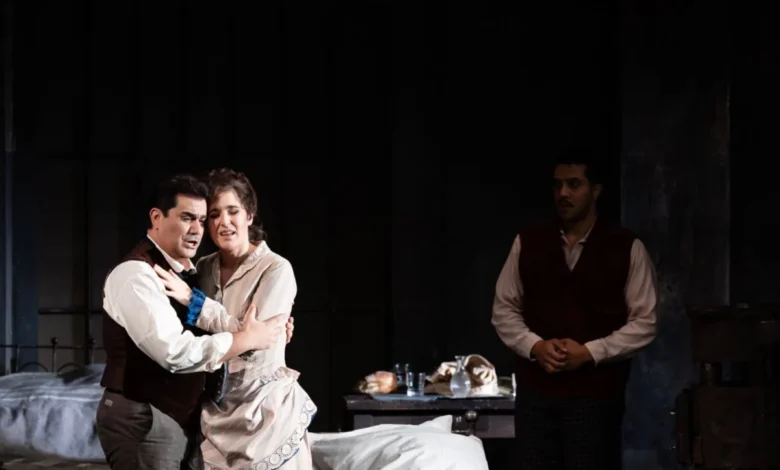
ject misery and systemic poverty that Puccini’s sweeping orchestral and vocal lines so vividly convey. This stylistic dissonance is physically embodied on stage, perhaps most notably in the striking sartorial contrast between Rodolfo—who cuts a dashing, elegant figure in a rich cochineal-red waistcoat and tailored grey silk trousers—and his roommate Marcello, whose attire reflects a genuinely modest, toil-worn working-class existence.
Chronology of the Narrative and Thematic Exploration
Puccini’s four-act structure mirrors a tragic descent from the frantic, bohemian camaraderie of youth into the cold, isolating reality of physical decay and grief. The opera’s narrative progression throughout the Munich run highlights the central motif of sacrifice.
In Act I, set within the freezing, cramped attic shared by the aspiring poet Rodolfo and the painter Marcello, survival demands immediate, tactile compromise. Rodolfo famously sacrifices the handwritten manuscript of his latest drama to feed the meager fireplace and stave off the biting winter cold. Shortly thereafter, the quartet of penniless artists demonstrates their resourcefulness through deception, successfully tricking their bumbling landlord, Benoit, out of collecting overdue rent by feigning indignation and plying him with wine.
As the narrative shifts to Act II, the bohemians descend upon the bustling Latin Quarter, culminating at the vibrant Café Momus. Here, survival is mediated through social performance and financial maneuvering, exemplified by Musetta’s elaborate ruse to manipulate her wealthy, elderly admirer, Alcindoro, into footing an exorbitant bill for the entire group.
The emotional gravity deepens considerably by Act III at the Rue d’Enfer tollgate, where the romantic entanglements of Rodolfo and Mimì begin to fracture under the unbearable weight of her failing health and their shared, inescapable poverty. The final act brings a devastating resolution back in the claustrophobic attic. In a masterclass of tragic pacing, all four friends are forced to sacrifice treasured personal belongings—pawned coats and keepsakes—to procure medicine and comfort for the dying Mimì.
Reflecting on the overarching philosophy of the work, the production channels the spirit of Edmond Rostand’s Cyrano de Bergerac ("It is far more beautiful when it is futile") and the famous adage of playwright Pierre Beaumarchais: one must laugh at the tragedies of life before weeping over them. As the bohemian characters succinctly observe, "We work as hard as we can. But it is all only temporary."
Vocal Performances and Character Analysis
The current Munich run boasts a carefully curated cast of international vocal talents, whose individual interpretations breathe complex psychological life into Schenk’s hyperrealistic framework.
Tenor Saimir Pirgu steps into the role of Rodolfo, delivering a vocal performance defined by a clear, bright, and resonant lyric timbre. Pirgu’s technical precision and sparkling articulation make him a brilliant presence on stage. However, his theatrical approach occasionally leans toward an outward-facing delivery, projecting directly to the auditorium—most notably during his soaring first-act aria, Che gelida manina!. This performance style establishes an engaging, direct rapport with the house, though it stands in stark contrast to the deeply internal artistic choices made by his stage counterpart.
Baritone Davide Luciano offers a masterclass in psychological subtlety as Marcello. Luciano maintains an intensely inward-looking, deeply felt performance throughout the evening, performing with an authentic vulnerability as if entirely unobserved by an audience. His dramatic chemistry with soprano Juliana Grigoryan’s Musetta anchors the production’s secondary romance. Grigoryan navigates the pitfalls of the second act with remarkable restraint, wisely avoiding excessive diva-esque exaggeration and instead grounding Musetta in natural charm, sharp wit, and genuine character development.
As the tragic heroine Mimì, soprano Nicole Car delivers a performance of breathtaking emotional resonance. Beneath her polished, secure vocal technique lies a profound, fragile vulnerability. Her delivery of Sì. Mi chiamano Mimì is handled with exquisite delicacy, drawing palpable emotional gravity from the house.
The supporting cast provides exceptional depth to the tragicomic framework of the opera. Bass Giorgi Manoshvili commands the stage as Colline, anchoring the fourth act with a deeply moving and memorable rendition of Vecchia zimarra, senti, his melancholic farewell to his aging overcoat that elevates the moment to profound tragedy. Meanwhile, baritone Vitor Bispo shines as Schaunard, balancing quick-witted, almost comic spoken-sung delivery during his first-act recounting of the parrot episode with devastating gravity in the final moments of the opera.
Orchestral Execution and Musical Direction
In the pit, the Bayerische Staatsoper Orchestra performs under the baton of conductor Francesco Ivan Ciampa. Ciampa’s musical direction leans toward a bold, powerful dynamic profile. At times, the orchestra’s robust volume risks overwhelming the more delicate, silken instrumental textures that Puccini meticulously wove into the score—particularly during the intimate duets between Rodolfo and Mimì, where the breathless, fragile motifs of Mimì’s theme occasionally struggle to cut through the heavy instrumentation.
However, this assertive approach yields remarkable success elsewhere in the score. During the chaotic ensemble numbers of Act II, Ciampa successfully marshals the immense forces to bring the soaring, unifying melodic line shared by Marcello and Musetta into sharp, triumphant relief against the bustling sonic backdrop of the Latin Quarter.
Broader Impact and Implications
The Bayerische Staatsoper’s November revival of La Bohème underscores the enduring power of standard-repertory staples to provoke contemporary artistic debate. By pairing a traditional, hyperrealistic production concept with a cast of world-class vocalists, the Munich institution provides a fascinating lens through which modern audiences can re-examine 19th-century operatic conventions.
As the run continues to draw capacity crowds, the production reinforces the timeless relevance of Puccini’s music drama: a work that, despite the gloss of theatrical illusion, continues to lay bare the raw, unvarnished realities of human love, loss, and mortality.