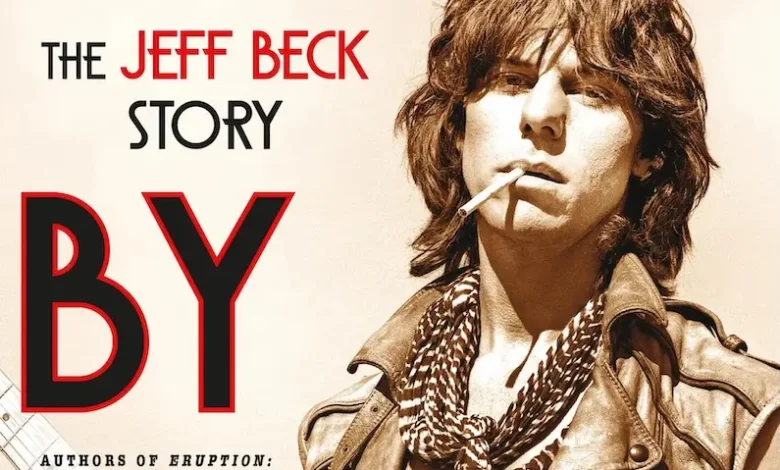
The release of Blow By Blow: The Jeff Beck Story, authored by Brad Tolinski and Chris Gill, arrives as a definitive addition to the canon of literature surrounding one of the most enigmatic figures in rock music. Published in 2026 by Michael Joseph, the 387-page volume serves as a comprehensive chronicle of Jeff Beck’s life, joining previous biographical works such as Annette Carson’s 2001 study, Jeff Beck: Crazy Fingers, and Martin Power’s 2014 account, Hot Wired Guitar: The Life Of Jeff Beck. While the subject has been explored previously, Tolinski and Gill offer a fresh, analytical lens, focusing on the intersection of Beck’s blues-rock foundations and his profound, often under-acknowledged, affinity for jazz.
A Legacy Beyond the Blues-Rock Paradigm
Jeff Beck’s musical identity has long been categorized by his seminal work with the Yardbirds and the subsequent Jeff Beck Group. However, his influence extended far beyond the constraints of traditional rock. Eric Clapton, a lifelong peer who frequently featured Beck at his annual Crossroads Guitar Festival, noted in the documentary Still On The Run: The Jeff Beck Story that Beck possessed a rare, innate understanding of jazz that few of his rock contemporaries could replicate.
While Beck often distanced himself from the label of "jazz musician," describing his output as "elaborated blues with progressive rock overtones," the technical and emotive qualities of his playing suggest otherwise. The new biography meticulously details how Beck’s improvisational poetics mirrored the sensibilities of jazz masters. Tolinski and Gill argue that Beck’s pursuit of "strangest sounds" was not merely an act of rock experimentation but a deliberate move toward the avant-garde aesthetic championed by figures like Eric Dolphy and Roland Kirk.
Chronology of an Iconoclastic Career
The development of Beck’s unique sonic vocabulary can be traced through several distinct eras:
- 1965–1966: The Yardbirds Era. Beck’s tenure with the Yardbirds served as a crucible for his experimentation with feedback and distortion, effectively laying the groundwork for the psychedelic movement.
- 1967–1972: Blues-Rock Innovation. Following his departure from the Yardbirds, Beck navigated through the formation of the Jeff Beck Group and the short-lived but impactful Beck, Bogert & Appice. During this time, his curiosity regarding the burgeoning jazz-fusion movement grew.
- 1975–1976: The Fusion Breakthrough. The release of the George Martin-produced album Blow by Blow (1975) and Wired (1976) marked a decisive pivot. These records solidified his transition toward instrumental fusion.
- 2009: The Ronnie Scott’s Residency. A week-long engagement at the famed London jazz club resulted in the release of Performing This Week: Jeff Beck at Ronnie Scott’s, which many consider the pinnacle of his later career.
- 2022–2023: Final Projects and Passing. Beck’s final collaborative album with Johnny Depp, 18, and his subsequent death in early 2023 brought his long, storied career to a close, prompting a global re-evaluation of his contribution to contemporary music.
Technical Influences and Stylistic Evolution
The biography provides a granular look at the influences that shaped Beck’s trajectory. Tolinski and Gill highlight the 1970s, a period where the music of Billy Cobham—specifically the album Spectrum—and the playing of John McLaughlin on Miles Davis’s Jack Johnson became central to Beck’s creative evolution.
Furthermore, the book explores the latent connection between Beck and jazz guitarist Barney Kessel. This is particularly evident in Beck’s solo on Stevie Wonder’s 1971 track, "Looking For Another Pure Love." The linear grace and intricate chromaticism displayed in that performance suggest that Beck was synthesizing jazz theory long before he was explicitly identified as a fusion artist. His reverence for rhythm sections was equally significant; he frequently attended performances by drummer Elvin Jones at Ronnie Scott’s, mirroring the deep respect Jones commanded from rock icons like Charlie Watts.
The "Pork Pie Hat" Turning Point
Perhaps the most significant analysis in the Tolinski and Gill study concerns Beck’s interpretation of Charles Mingus’s "Goodbye Pork Pie Hat." Originally a threnody for Lester Young on the 1959 Mingus Ah Um album, Beck’s rendition on the 1976 Wired album is cited as a pivotal moment in his artistic development.
The authors characterize this performance as a "dynamic slow burn," asserting that it acted as the bridge between his blues-rock roots and the iconoclastic, expressive style that defined his later years. By successfully reinterpreting a cornerstone of the jazz repertoire, Beck proved that his capacity for melodic sensitivity was as potent as his technical prowess on the fretboard.
Critical Reception and Contextual Analysis
While Blow By Blow: The Jeff Beck Story offers an exhaustive account of Beck’s career, it also invites discussion on which elements of his life warrant further study. The book provides welcome context for Beck’s final project, 18, and leans heavily on the observations of noted music journalist Charles Shaar Murray. However, scholars and aficionados may note that certain aspects of Beck’s 2009 Ronnie Scott’s residency could have benefited from a more rigorous musical analysis. The residency, which Beck himself cited as the happiest period of his professional life, represents a high-water mark for his integration into the jazz-club environment.
Implications for Future Beck Scholarship
The publication of this biography signals a maturation in how Beck is viewed by music historians. By moving past the "guitar hero" archetype and examining the visceral physicality he shared with jazz luminaries like John Coltrane, Tolinski and Gill have provided a framework that legitimizes Beck’s place in the jazz-fusion timeline.
The implications for this scholarship are clear: Beck’s legacy is not confined to the history of rock guitar, but is a vital component of 20th-century music history. His ability to bridge the gap between disparate genres—blues, rock, jazz, and even electronic experimentation—demonstrates a versatility that few artists in the modern era have achieved.
Data Summary and Publication Details
The text is augmented by 20 black-and-white photographs and seven illustrations, providing a visual guide to the biographical narrative. The inclusion of an index and comprehensive discographical references makes the volume a functional reference tool for researchers.
Blow By Blow: The Jeff Beck Story
Authors: Brad Tolinski & Chris Gill
Publisher: Michael Joseph
Publication Date: 2026
Format: Hardback
Page Count: 387
ISBN: 978–0-241-76717-7
List Price: £30
As the music industry continues to archive the contributions of the post-war generation, the work of Tolinski and Gill stands as an essential, if not definitive, account. For the student of "Beckology," this book provides the necessary historical, technical, and emotional context required to fully appreciate the scope of a musician who spent over five decades redefining the possibilities of the electric guitar. Through its detailed narrative and focus on the intellectual underpinnings of Beck’s art, the volume ensures that the guitarist’s influence will continue to be felt by future generations of musicians, regardless of their preferred genre.
Related posts: