Echoes of Time: Exploring the Interplay of Memory, Identity, and Future in Contemporary Jazz

The intersection of temporal perception and musical composition has become a focal point for contemporary jazz, as evidenced by three significant new releases from John Derek Bishop, Samuel Blaser, and the Scandinavian trio Rymden. These artists, representing disparate musical lineages and geographical backgrounds, are currently engaging in a collective exploration of how historical resonance informs modern improvisational practice. By analyzing these works, one observes a shifting landscape in ambient jazz and avant-garde composition, where the boundary between archival preservation and forward-looking synthesis is increasingly fluid.
John Derek Bishop and Khaled Habeeb: The Architecture of Ekkofremtid
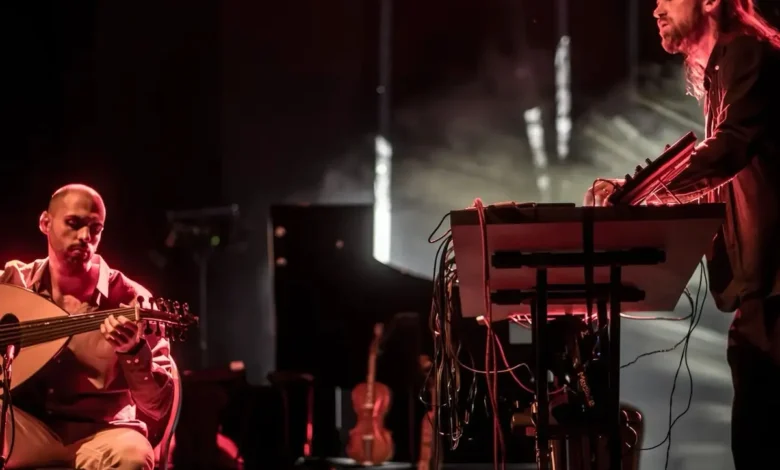
John Derek Bishop, known professionally as Tortusa, has long occupied a space at the forefront of the Nordic ambient jazz scene. His latest collaboration with Syrian oud player Khaled Habeeb, titled Ekkofremtid—translated as "Echo Future"—represents a technical and conceptual departure from his previous work with luminaries such as Nils Petter Molvær and Eivind Aarset.
The album functions as a study in acoustic archaeology. Bishop, a fixture at the annual Punkt Festival in Norway, utilizes his signature live-sampling techniques to dismantle and recontextualize Habeeb’s traditional oud performance. This process is not merely additive; it is transformative. Bishop isolates "rhythmic cells" from the oud’s natural output, reharmonizing them within synthesized soundscapes.
From a technical standpoint, the project bridges the gap between ancient Middle Eastern musical traditions and contemporary electronic production. Field recordings are integrated to provide a cinematic grounding, creating a sense of geographical displacement. On tracks such as "Nordlys Fra Østen," the music sustains a coherent narrative across thirteen minutes, suggesting that even as the digital and the traditional clash, they eventually achieve a unified voice. The implications of this work are significant: it demonstrates that electronic manipulation, when applied with restraint, can serve as a conduit for preserving, rather than erasing, the cultural specificity of traditional instruments.
Samuel Blaser: A Genealogical Journey Through Sound in Rosina
While Bishop’s work explores the theoretical future of sound, Swiss trombonist Samuel Blaser’s latest release, Rosina, is a project rooted in the recovery of lost family history. The album is the culmination of a genealogical investigation that began when Blaser discovered a previously unknown branch of his family in the United States, descendants of Italian emigrants who fled post-World War I financial ruin.
The catalyst for the album was a 1925 photograph of his grandmother, Rosina, taken in Emilia-Romagna. Blaser, a fearless improviser known for his technical prowess, chose to record the project in New Jersey with his long-standing US quartet, including pianist Russ Lossing, bassist Masa Kamaguchi, and drummer Billy Mintz. The recording sessions took place over two days in March 2024, following the completion of another project, allowing the quartet to capture a spontaneous, nostalgic atmosphere.
The repertoire incorporates archival material, including two pieces sourced from Alan Lomax’s 1954-55 Italian field recordings. The track "Boara" serves as a centerpiece, featuring a call-and-response dialogue between Blaser and Lossing that echoes the folk-blues traditions of the region. By juxtaposing these historical motifs with the quartet’s modern improvisational language—notably in the Monk-inflected "Mysteriously"—Blaser creates a bridge between the 1920s Italian diaspora and the modern American jazz scene. The project highlights the capacity for jazz to function as a vessel for personal history, transforming private grief and curiosity into a public, sonic memorial.
Rymden: The Philosophy of Uncertainty in Today May Be Tomorrow
The Scandinavian super-trio Rymden—comprising pianist Bugge Wesseltoft, bassist Dan Berglund, and drummer Magnus Öström—has evolved significantly since their 2019 debut, Reflections and Odysseys. Their latest release, Today May Be Tomorrow, marks a maturation of their sound, characterized by a more nuanced approach to rhythmic tension and conceptual depth.
The trio’s progression is documented through a series of collaborations and stylistic shifts:
- 2019: Reflections and Odysseys established the trio’s foundational "turbo-charged" rhythmic identity.
- 2020: Space Sailors introduced heavy rock-oriented electronics.
- 2023: Rymden + Kork and Valleys and Mountains integrated orchestral arrangements and guest soloists like John Scofield.
- 2026: Today May Be Tomorrow arrives as a self-reflective, mature consolidation of these previous experiments.
The album title poses a sobering question regarding the predictability of the future in an unstable global climate. Musically, this translates into "elastic" compositions that toy with the listener’s perception of time. The group’s reworking of "Valiant Revisited," a composition originally recorded by Berglund, Wesseltoft, and Henrik Schwarz in 2014, serves as a focal point. By stripping away the more pensive qualities of the original, Rymden delivers a definitive, ballad-style performance that showcases their current level of group cohesion.
Comparative Analysis: The Modern Jazz Paradigm
The current movement in jazz, as represented by these three projects, suggests a broader shift in the genre’s relationship with time. For Bishop, time is a loop—a cycle where the past echoes into the future. For Blaser, time is a thread to be traced back to its origin. For Rymden, time is an unstable variable, subject to the pressures of an uncertain present.
Technical and Thematic Parallels
| Artist | Core Theme | Methodology | Primary Goal |
|---|---|---|---|
| John Derek Bishop | Echoing Future | Live sampling & Recomposition | Cultural Synthesis |
| Samuel Blaser | Ancestral Recovery | Archival integration | Personal/Family History |
| Rymden | Temporal Ambiguity | Rhythmic pliancy | Conceptual Reflection |
The economic and logistical realities of these projects also reveal a common trend: the increasing importance of collaboration across borders. Bishop’s work with Habeeb reflects a globalized exchange of sound, while Blaser’s transatlantic family history mirrors the international nature of the modern jazz quartet. Rymden’s recording in Copenhagen, involving members of the Scandinavian jazz elite, reinforces the regional strength of the Nordic scene while acknowledging its global reach.
Implications for the Future of Improvisational Music
The impact of these releases extends beyond their immediate artistic merit. By engaging with concepts of memory and future-casting, these musicians are pushing the genre toward a more philosophical discourse. Industry analysts note that as physical and digital archives become more accessible, musicians are increasingly tasked with curating the past as much as they are with inventing the new.
There is also a notable trend toward "slow revelation" in modern composition. Both Bishop and Rymden have designed their latest works to be intentionally resistant to immediate, superficial consumption. The "uneasy sense of satisfaction" described in reviews of Rymden’s latest work is a testament to an audience that is increasingly willing to engage with music that prioritizes complexity over instant gratification.
In conclusion, the works of Bishop, Blaser, and Rymden indicate a healthy, introspective phase for contemporary jazz. Whether through the digital manipulation of ancient melodies, the re-excavation of family lineage, or the philosophical inquiry into the nature of time, these artists are ensuring that the genre remains a vital, responsive medium. They are not merely performing music; they are documenting the human experience of time in an age where the past, present, and future are increasingly entangled. As the industry moves forward, the success of these projects will likely encourage further experimentation, cementing the role of the improvising artist as both historian and visionary.