Irish Singer Aaron Rowe Defends Ed Sheeran and Directs Focus Toward Zionist Lobbies and Robert Kraft Amid Tour Controversy

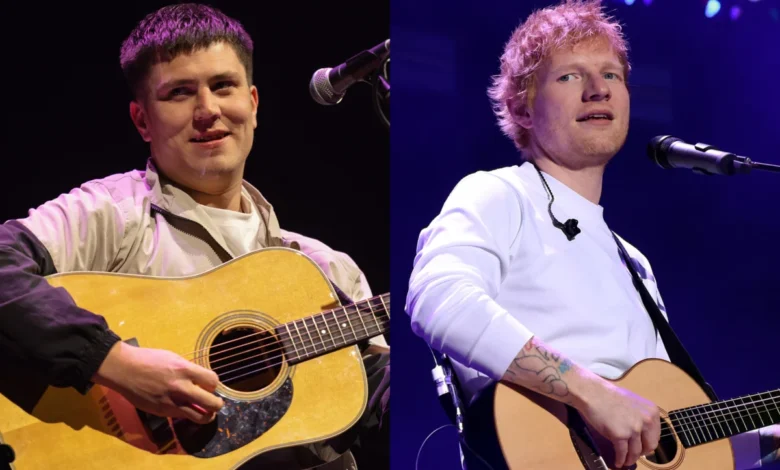
The international music community has found itself at the center of a profound geopolitical debate following a series of high-profile departures and expulsions from Ed Sheeran’s ongoing Loop Tour. Irish singer-songwriter Aaron Rowe, who voluntarily stepped down as an opening act for the tour, has broken his silence to defend the British pop star while aggressively redirecting public criticism toward institutional power structures, Zionist lobbies, and New England Patriots owner Robert Kraft. Rowe’s intervention adds a new layer of complexity to an escalating controversy that has blurred the lines between mainstream commercial entertainment, freedom of expression, and the ongoing humanitarian crisis in Gaza.
The controversy originated when rapper Macklemore was removed from the Loop Tour lineup following impassioned onstage statements expressing solidarity with the Palestinian people and severe criticism of the Israeli military campaign in Gaza. The sudden removal of Macklemore triggered an immediate chain reaction within the tour’s supporting acts. In solidarity with the rapper and in protest of the suppression of pro-Palestinian speech, artists including Finneas and Lukas Graham also elected to leave the tour. Shortly thereafter, Aaron Rowe similarly abandoned his supporting slot, signaling deep internal friction among the touring artists regarding censorship and political expression.
Background Context of the Event and Industry Precedents
The intersection of popular music and Middle Eastern geopolitics has intensified significantly since the escalation of hostilities in Gaza. Artists globally have faced immense pressure to either voice their support for various factions or remain entirely neutral. Live music tours, which rely heavily on corporate sponsorship, venue agreements, international promoters, and local municipal approvals, are particularly vulnerable to political friction.
When performers utilize massive public platforms to condemn state actions or articulate human rights concerns, tour organizers frequently face competing pressures from advocacy groups, venue owners, and financial backers. In the case of Ed Sheeran’s Loop Tour, the decision to remove Macklemore was reportedly executed by the promoter, Messina Touring Group, under substantial pressure from venue stakeholders and external lobbying forces. This dynamic highlights the fragile ecosystem of large-scale international concert tours, where multimillion-dollar commercial interests often collide with artists’ desires to engage in socio-political commentary.
Chronology of the Controversy
The sequence of events unfolded rapidly across a single week, drawing intense scrutiny from music critics, human rights advocates, and fans alike:
- Onstage Statements: Macklemore delivers remarks during a live performance criticizing Israeli military actions in Gaza and calling for Palestinian liberation.
- Tour Removal: Organizers announce that Macklemore has been dropped from Ed Sheeran’s Loop Tour lineup, citing policy violations or commercial disruption concerns.
- Artist Boycott: In response to Macklemore’s expulsion, supporting acts Finneas, Lukas Graham, and Aaron Rowe announce their decisions to exit the tour.
- Ed Sheeran’s Statement: Facing widespread backlash, Ed Sheeran releases a public statement clarifying that the decision to drop Macklemore was made by the Messina Touring Group rather than himself, heavily influenced by external venue pressures and orchestration by Robert Kraft.
- Rowe’s Instagram Address: Aaron Rowe publishes an extended video via Instagram on Friday, defending Sheeran, criticizing the focus on the pop star, and calling out Robert Kraft and Zionist lobbies.
- Financial Pledges and Counter-Statements: Macklemore pledges $1 million to Palestinian support groups and challenges Robert Kraft to match the donation. Kraft responds with a $2 million commitment to humanitarian aid in the region, asserting that the contribution matches a donation made by Ed Sheeran.
Aaron Rowe’s Statements and Defense of Ed Sheeran
In his detailed video statement posted to social media, Aaron Rowe argued that public discourse had mistakenly targeted Ed Sheeran instead of examining the powerful institutional forces orchestrating the censorship. Rowe emphasized that while Sheeran’s initial communication regarding the fallout could have been handled more effectively, the British singer was not personally responsible for Macklemore’s dismissal.
"I’m gonna be honest. I think you are all focusing on the wrong person here," Rowe stated in his Instagram video. "All I keep hearing is Ed Sheeran this, Ed Sheeran that — when you really should be focusing on the likes of Robert Kraft. You really should be focusing on the Zionist lobbies that are trying to silence the voices of people who are shouting about genocide, the genocide that is happening in Palestine right now by Israel."
Rowe further defended Sheeran by noting the deliberate curation of the tour’s lineup, pointing out that multiple supporting artists shared pro-Palestinian sentiments. "Like, if Ed Sheeran was a fucking Zionist, why would he have all these fucking people on the fucking tour?" Rowe questioned. He asserted that panic among promoters and venue stakeholders led to a rushed, reactionary decision to pull Macklemore, and expressed confidence that Sheeran privately recognized the move as a mistake.
Directing Criticism Toward Power Structures and Robert Kraft
Beyond defending his former headliner, Rowe launched a scathing critique of governments, mainstream media outlets, and the wider music industry, accusing them of complicity and inaction. He argued that these entities possess the wealth and influence necessary to suppress dissenting opinions and muzzle public conversations regarding the humanitarian catastrophe in Gaza.
Rowe specifically targeted New England Patriots owner Robert Kraft, whose alleged influence behind the scenes played a pivotal role in venue pressures. Rowe urged his followers and media observers to channel their energy into holding powerful figures accountable for restricting free speech.
"You should be using this opportunity to plaster Robert Kraft’s face everywhere, someone who tried to shut down free speech, someone who tried to silence the voices of people who are shouting out genocide," Rowe urged. "That’s what you should be using your energy on, not fucking Ed Sheeran, for fuck’s sake."
Financial Escalation: Macklemore’s Pledge and Kraft’s Response
The rhetorical battle quickly translated into substantial financial commitments regarding humanitarian aid. Following his removal from the tour, Macklemore doubled down on his advocacy by pledging $1 million to organizations supporting Palestinians. Concurrently, the rapper publicly challenged Robert Kraft to match his donation.
The challenge prompted a formal response from Kraft, who announced a $2 million commitment aimed at alleviating the humanitarian crisis in the region. According to representatives for Kraft, the $2 million allocation served as a matching contribution to a donation previously made by Ed Sheeran. Representatives for Ed Sheeran did not immediately respond to media inquiries from international outlets seeking to verify the details of the financial contributions.
Broader Impact and Implications for the Live Music Industry
The fallout from the Loop Tour cancellations underscores a growing challenge for the global entertainment industry: navigating the political convictions of modern artists against the backdrop of polarized international conflicts. As musicians increasingly utilize their massive platforms to address humanitarian crises, concert promoters, venue owners, and corporate sponsors face difficult decisions regarding freedom of expression versus commercial risk.
Industry analysts suggest that this incident could establish a precedent for how tour management handles political commentary on stage. While some view the suppression of artists as a necessary measure to maintain public order and security at large venues, critics argue that such actions constitute corporate censorship and infringe upon foundational principles of free speech.
Furthermore, the involvement of prominent figures outside the immediate music industry, such as sports franchise owners and high-level donors, signals that cultural boycotts and political activism within entertainment are expanding into broader corporate and philanthropic battlegrounds. As artists continue to leverage their platforms—and personal fortunes—to fund humanitarian relief efforts, the intersection of pop culture and geopolitical advocacy will likely remain a contentious and closely monitored domain.