Donald Trump praises Nicki Minaj’s backside in Michigan while offering his explanation for sizing up Ohio Sen. Jon Husted

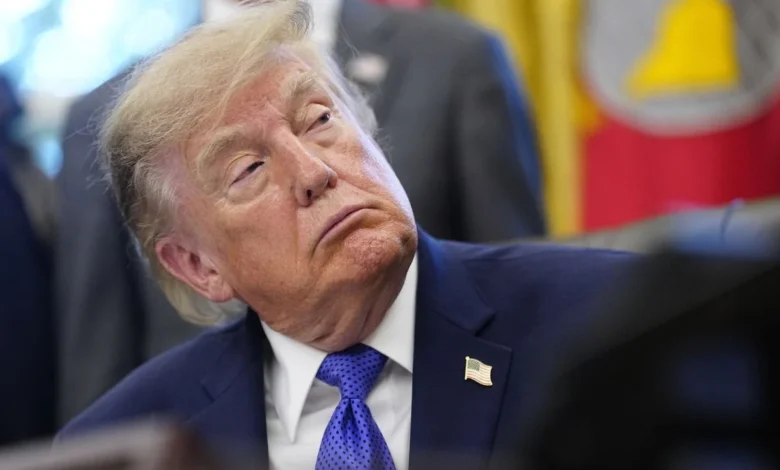
The recent campaign trail appearance of global music icon Nicki Minaj alongside former President Donald Trump in Port Huron, Michigan, took an unexpected turn during a rally speech that blended political rhetoric with unscripted personal commentary. While the visit was intended to bolster support for the Republican ticket in a crucial swing state, the event became the focus of intense media scrutiny following remarks the former president made regarding both the artist and a sitting Ohio senator.
The Context of the Port Huron Rally
The rally, held in the competitive landscape of Michigan, served as a platform for the Republican campaign to consolidate its base ahead of the November 3 election. Nicki Minaj’s presence was a notable development, as she had traveled to the state aboard Air Force One. Reports from the flight indicate that Minaj engaged in substantive discussions with White House communications director Steven Cheung regarding the former president’s business acumen, his approach to international negotiations, and his work ethic.
Minaj’s involvement is part of a broader trend of high-profile entertainment figures engaging with the political apparatus. For the Trump campaign, the endorsement serves as a mechanism to reach younger demographics and urban voters, segments of the electorate that have historically leaned Democratic. The logistical coordination behind such a high-profile visit underscores the campaign’s investment in cultural diplomacy as a means of shifting momentum in Michigan, a state where voters are currently deciding between Republican candidate Mike Rogers and Democrat Abdul El-Sayed for a pivotal open Senate seat.
Chronology of the Remarks
The sequence of events leading to the controversial statements began with a pivot from the former president’s speech. While addressing the crowd in Port Huron, Trump attempted to provide context for earlier, widely reported comments he had made regarding Ohio Sen. Jon Husted.
During a prior event in Youngstown on October 12, Trump had spoken about Husted’s past as a defensive back at the University of Dayton. Trump noted that he had spoken with former NFL coach Jon Gruden—a teammate of Husted’s during their college years—who described the senator as a "violent" player known for his aggressive tackling style. Trump told the crowd that this description of the senator’s physical intensity stood in stark contrast to the humble demeanor he had observed in Husted during his time in office.
In an effort to explain his scrutiny of the senator’s physique, Trump revealed that he had looked over Husted during a rally in Ohio. "I looked at his ass, and I’ve never done that with a man before," Trump stated, adding, "Off the record, women yes, men no."
Following this reflection, Trump transitioned to the presence of Nicki Minaj on stage, drawing a comparison that immediately dominated the news cycle. "By the way, I looked at one hell of a beautiful ass before Nicki Minaj," Trump told the audience. "That’s hard to miss." He quickly pivoted back to his narrative, expressing hope that his comments had not caused offense to the artist, while simultaneously criticizing the media’s coverage of his earlier remarks regarding the Ohio senator.
Fact-Based Analysis of Campaign Rhetoric
Political analysts often examine the use of informal language in campaign settings as a deliberate strategy to foster authenticity and "break the fourth wall" with voters. By addressing the "fake news" narrative—a frequent component of his rally speeches—Trump aimed to frame the resulting media backlash as proof of a biased press corps.
However, the intersection of political commentary and comments on physical appearance presents a complex dynamic for campaign strategists. While supporters often view such remarks as evidence of a candidate’s unfiltered personality, critics argue that such rhetoric detracts from the serious policy discussions necessary for voters to make informed decisions. In the case of the Port Huron rally, the viral nature of the comments regarding Minaj and Husted threatened to overshadow the primary message of the campaign, which centered on economic policy and the Michigan Senate race.
Supporting Data and Demographic Shifts
The Michigan Senate race, which serves as the backdrop for these events, is highly competitive. With the retirement of incumbent leadership, the state has become a laboratory for testing messaging efficacy. Data from recent polls suggests that the race between Mike Rogers and Abdul El-Sayed remains within the margin of error, making every rally and public appearance a high-stakes endeavor.
The inclusion of celebrity surrogates like Minaj is a data-driven tactic intended to influence voter turnout. Studies in political science indicate that endorsements from entertainment figures can significantly increase the visibility of a campaign on social media platforms, even if the direct conversion of celebrity influence into ballots remains a subject of ongoing debate. The "Minaj effect," as some analysts have dubbed it, likely generated millions of impressions across various digital platforms, potentially reaching voters who might not otherwise engage with traditional political reporting.
Official Responses and Public Reaction
To date, official representatives for the Trump campaign have maintained that the remarks were made in a lighthearted, off-the-cuff manner and were not intended to be derogatory. The campaign’s strategy has generally been to dismiss media critiques of the former president’s speaking style as manufactured outrage.
Nicki Minaj, who has previously spoken favorably about the former president’s business philosophy, has not issued a formal statement regarding the specific comments made at the Port Huron rally. Historically, the artist has been protective of her brand and is selective about her public political endorsements. Her silence on the matter suggests a strategic choice to avoid amplifying the controversy, allowing the campaign’s narrative to move forward.
The reaction from the Husted camp and other political figures has been largely muted. Within the internal dynamics of the Republican party, there is an understanding that the former president’s rhetorical style is a fixed variable. Strategists within the party often prioritize campaign unity over public disagreement with the party leader’s specific turns of phrase, particularly when the election cycle is in its final, critical weeks.
Broader Impact and Implications
The long-term implications of these events are twofold. First, they illustrate the increasingly porous boundary between celebrity culture and political discourse. As campaigns continue to integrate high-profile cultural figures, the potential for viral, unscripted moments that divert from the central policy platform increases.
Second, the incident highlights the ongoing tension between traditional media coverage and digital-first communication strategies. By addressing the media directly during his rallies, Trump effectively communicates with his base, creating a feedback loop where the criticism he receives from mainstream outlets is used to reinforce his narrative of being an "outsider" fighting against an established order.
As the November 3 election approaches, the focus in Michigan will inevitably shift back to the concrete issues of the Senate race: inflation, healthcare policy, and regional manufacturing interests. Whether the viral nature of the Port Huron rally helps or hinders the Republican ticket remains to be seen. In the current political environment, where attention is a finite and valuable resource, the ability of a campaign to control the narrative—even through controversial means—remains a central pillar of its success.
The episode serves as a reminder of the volatility inherent in modern campaigning. Every public appearance is a performance, and in the high-pressure environment of a Michigan rally, the line between political messaging and personal observation continues to blur, leaving both voters and the press to parse the difference between policy and personality. As the campaign enters its final phase, the impact of such moments will be measured in the turnout of critical demographics and the final tally of votes in a state that remains essential to the national political balance.