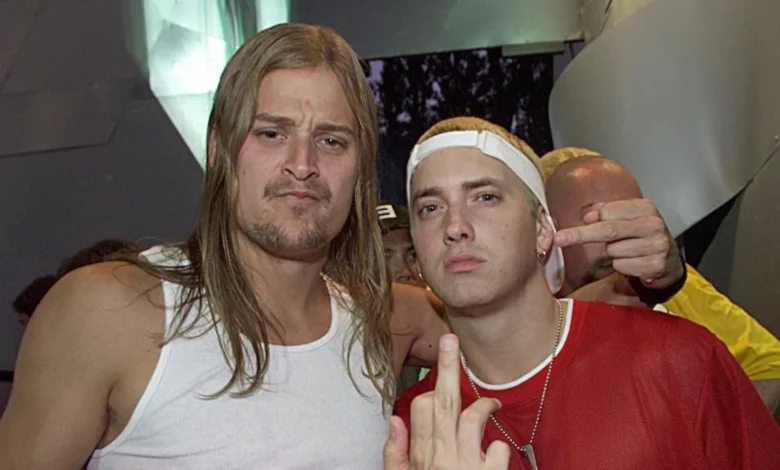
The intersection of traditional music production and emerging generative artificial intelligence has become a focal point of industry debate, a conversation recently amplified by Kid Rock’s admission that he utilized AI technology to synthesize a gospel choir for his latest track, "Heal My Faith." The song, a high-profile collaboration with longtime friend and fellow Michigan native Eminem, appears on Kid Rock’s recently released album, "Halfway 2 Jesus." During a candid appearance on "Real Time with Bill Maher," the musician defended his use of synthetic vocalists, framing the choice as a matter of personal efficiency rather than financial necessity.
The Genesis of the Controversy
The revelation occurred during a broader discussion on the societal impact of artificial intelligence. When host Bill Maher pressed the artist on the ethics of AI, noting that technology is now capable of producing musical outputs indistinguishable from human artists, Kid Rock confirmed he had turned to AI to complete the chorus of "Heal My Faith."
According to Kid Rock, the decision was driven by time constraints. "I’m an impatient guy," he explained during the broadcast. "It’s not about the money of getting a choir. But everything I look at in life now is time. How much time do I have?" He noted that while he had employed a real choir for another track on the same album, "7 Sins," the prompt-based generation of a Southern gospel choir provided the sonic aesthetic he desired without the logistical hurdles of hiring and scheduling a large group of human vocalists.
Historical Context and Technological Evolution
The debate sparked by Kid Rock’s comments mirrors the broader anxiety currently felt across the creative industries. Since the mainstream emergence of generative AI in 2023, musicians, screenwriters, and visual artists have wrestled with the implications of automation. The tension centers on whether AI serves as a "force multiplier" for human creativity—much like the synthesizer or the digital audio workstation—or whether it acts as a replacement for skilled labor.
Kid Rock’s defense drew an immediate parallel to the introduction of drum machines in the mid-20th century. He questioned whether the invention of rhythm programming effectively displaced professional drummers, suggesting that AI is merely the latest in a long line of tools that have disrupted, but ultimately expanded, the music industry. However, Maher countered this assertion by distinguishing between rhythmic percussion tools and the replication of human voices, arguing that a human choir carries a specific cultural and emotional weight that cannot be authentically synthesized. "When The Beatles used a choir, they needed to get a [expletive] choir," Maher retorted, emphasizing the loss of employment opportunities for human performers.
Chronology of the Release and Public Reception
The release of "Halfway 2 Jesus" on October 17, 2026, was framed by the artist as a bridge-building exercise. Kid Rock, a vocal supporter of Donald Trump, and Eminem, a staunch critic of the former president, positioned the collaboration as a statement that personal friendship can transcend deep-seated political divisions.
Despite the star power behind the collaboration, the project has faced significant headwinds. Industry analysts noted that the album and its accompanying singles have struggled to gain significant traction on the Billboard charts or within mainstream streaming ecosystems. The tepid reception has raised questions about the current cultural appetite for the artist’s pivot to Christian rock and the extent to which listeners are sensitive to the "authentic" versus "synthetic" origins of music production.
The Regulatory Landscape and Industry Standards
Kid Rock’s admission brings to light a growing consensus among high-profile artists: the need for formal regulation of AI in the arts. Despite his personal use of the technology, Kid Rock acknowledged the potential dangers of unchecked AI development. "I one thousand percent believe it needs to be regulated at the highest levels," he stated.
This stance aligns with ongoing legislative efforts in Washington, D.C., where policymakers are exploring the "No Fakes Act" and other intellectual property frameworks designed to protect the likeness and voices of performers. The Recording Academy and various guilds, including the American Federation of Musicians (AFM) and SAG-AFTRA, have been vocal in demanding that any AI usage in music production be subject to transparency, consent, and compensation requirements.
Analyzing the Implications for Professional Musicians
The use of AI-generated choirs presents a specific challenge to the labor market of professional session singers. Unlike instrumentalists, whose work can often be emulated by high-fidelity virtual instruments, session singers provide the human nuances of phrasing, breath, and collective energy that define choral music.
Data from the Bureau of Labor Statistics and independent music industry reports suggest that while the "gig economy" for session musicians has been volatile for years, the shift toward AI could accelerate the erosion of mid-tier studio work. When a producer can generate a full-sounding choir through a text-to-audio interface in a matter of seconds, the cost-benefit analysis—which Kid Rock cited—becomes difficult for studio heads to ignore, even if the artistic quality is widely debated.
A Tense Exchange on "Real Time"
The segment on "Real Time with Bill Maher" was marked by a combative tone, not only regarding AI but also regarding Kid Rock’s broader public persona. During the same broadcast, the musician made headlines for comparing Michigan Democratic Senate candidate Abdul El-Sayed to the 9/11 hijackers, a comment that quickly overshadowed the musical debate and highlighted the polarizing nature of his public discourse.
The interaction between the two regarding AI served as a microcosm for the wider national conversation. Maher’s position—that automation inherently dehumanizes art—represents a segment of the population that fears the total dilution of human labor. Kid Rock’s position—that the tool is secondary to the output—reflects a pragmatist’s view that has become increasingly common among producers looking to streamline the creative process.
Future Outlook
As the industry moves into 2027, the "Heal My Faith" incident will likely serve as a case study in the ethics of AI disclosure. Whether listeners demand labels identifying "AI-enhanced" tracks remains to be seen, but the controversy surrounding the song suggests that transparency will be a critical issue.
While Kid Rock remains an outlier in his genre for his embrace of the technology, the reality of the music business is that AI is now inextricably linked to the workflow of modern production. Whether this leads to a new era of musical experimentation or a period of widespread artistic displacement remains the central, unresolved question of the decade. For now, the collaboration between Kid Rock and Eminem stands as a testament to the fact that even in an age of political divide and technological shift, the quest for a "sound" often trumps the traditional methods of acquiring it.