In the modern era of audio engineering, the democratization of music production has fundamentally shifted how records are made. With the immense digital signal processing power now accessible inside a standard digital audio workstation (DAW), the historical necessity of purchasing ultra-expensive, boutique analog hardware for home recording has significantly diminished. This evolution is clearly reflected in market trends, as contemporary musicians, producers, and engineers increasingly gravitate toward affordable, highly reliable studio gear. Rather than opting for flashy, high-end prestige items, modern creators favor tools that prioritize durability, consistency, and exceptional functional performance. Examining the historical trajectory of the audio industry reveals a fascinating phenomenon: some of the most underestimated and economically accessible studio equipment ever manufactured have ultimately outsold and outperformed their luxury counterparts, becoming the undisputed foundational pillars of modern recorded music.
The Historical Shift Toward Accessible Audio Production
For decades, professional recording studios maintained a virtual monopoly on high-fidelity sound production. Owning vintage vacuum-tube microphones, custom discrete mixing consoles, and precision acoustic monitoring systems required capital investments running into hundreds of thousands of dollars. However, the advent and rapid advancement of computer-based recording in the late 1990s and 2000s dismantled these traditional barriers to entry.
As digital processing capabilities caught up with analog standards, the bottleneck in home recording shifted away from computational power and toward input and monitoring hardware. Manufacturers recognized this paradigm shift early on, pivoting toward the development of robust, cost-effective peripherals. The resulting products did not merely serve as cheap alternatives for hobbyists; many of them were engineered with such structural and acoustic integrity that they were rapidly adopted by top-tier commercial facilities. Today, these budget-friendly devices occupy a paradoxical position in audio history: they are simultaneously entry-level purchases for beginners and indispensable workhorses for Grammy-winning producers.
The Shure SM57: The Indestructible Dynamic Workhorse
When evaluating affordable studio tools capable of performing across virtually any recording application with consistent results, the Shure SM57 stands as the undisputed champion of dynamic microphones. The lineage of the SM57 traces back to 1937, when audio engineer Benjamin Bauer designed the Unidyne, a revolutionary single-element cardioid microphone featuring unprecedented off-axis rejection. This technological breakthrough fundamentally transformed the live sound industry by mitigating feedback issues on loud stages.
Decades later, in 1959, Shure engineer Ernie Seeler refined Bauer’s acoustic concepts, introducing the flat-top design of the Unidyne III capsule. Initially deployed in the Model 545, this capsule architecture laid the direct technical foundation for the SM57, which officially entered the market in 1965. With cumulative global sales surpassing 10 million units, the SM57 has become deeply embedded in the fabric of recording history, serving as the studio counterpart to its sibling, the stage-optimized SM58.
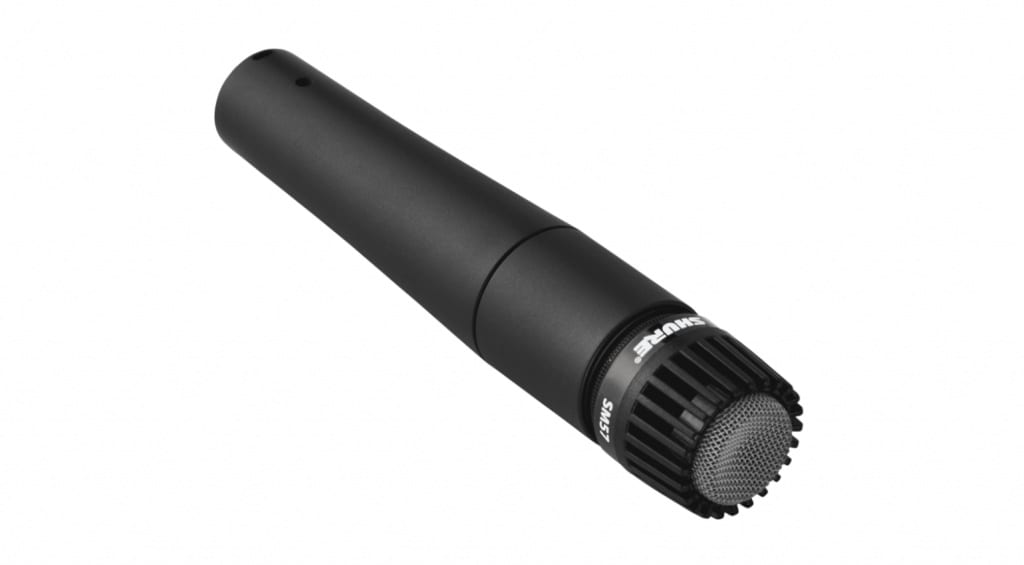
Ironically, the microphone’s legendary status in rock and roll music runs counter to the original intentions of its principal designer. Ernie Seeler was famously an avowed classical music and jazz enthusiast who harbored little appreciation for rock music. He originally designed the microphone for broadcast applications and orchestral recording. To ensure the product could withstand the rigors of field broadcasting, Seeler subjected the microphone to extreme prototype testing, which included baking the units, freezing them, and dropping them from multi-story buildings.
This rigorous quality control inadvertently forged an indestructible mechanical reputation. Combined with its punchy, mid-range-forward frequency response and high sound pressure level (SPL) handling—capable of capturing screaming guitar cabinets and thunderous snare drums without distortion—the SM57 became a staple of modern heavy music production. Its ability to capture transients cleanly while enduring physical abuse makes it an essential asset that continues to outsell many specialized, high-end ribbon and condenser alternatives.

Yamaha HS Series: Translating Studio Reality to the Masses
In the realm of monitoring systems, few names carry as much historical weight as the Yamaha NS-10M. Introduced in the late 1970s and originally marketed as a consumer bookshelf hi-fi speaker, the passive, white-coned monitor was famously adopted by top mix engineers worldwide for its unforgiving mid-range representation. Building upon this legacy, Yamaha launched the HS Series in the mid-2000s, intentionally mirroring the iconic visual aesthetic of white woofer cones encased in stark black cabinets.
However, the design philosophy behind the HS Series departed significantly from its predecessor. Engineered specifically for the burgeoning home studio market of the 21st century, the HS Series abandoned the passive, sealed-cabinet design of the NS-10 in favor of active, powered amplification housed within bass-reflex enclosures. This technological shift enabled smaller woofer configurations—such as 5-inch and 6-inch models—to reproduce a substantially broader and more accurate low-frequency spectrum than was previously possible in compact spaces.
Despite incorporating modern acoustic correction switches, the HS Series remains remarkably traditional in its internal architecture. Eschewing the complex digital signal processing (DSP) correction filters utilized by many contemporary competitors, Yamaha elected to equip the HS monitors with straightforward analog filters and crossovers. This unhyped, honest frequency response ensures superior mix translation across various consumer playback systems, preventing engineers from over-compensating for acoustic anomalies. Bolstered by its accessible price point and high-profile endorsements from elite producers and artists like FINNEAS, Metro Boomin, and Tame Impala, the Yamaha HS Series has secured its status as a global benchmark for project studios.
Sony MDR-7506: The Ubiquitous Industry Standard in Monitoring
Few audio accessories achieve true universal adoption, but the Sony MDR-7506 closed-back dynamic headphones achieved this rare distinction over the course of the 1990s, becoming the definitive standard for broadcast, tracking, and post-production environments worldwide. Like the Yamaha NS-10, the MDR lineage began as a consumer audio product, specifically with the introduction of the MDR-V6 in the mid-1980s.

The MDR-7506 relies on 40-millimeter neodymium drivers, delivering a high sensitivity rating of 106 dB/mW and a nominal impedance of 63 ohms. This technical specification yields a distinct frequency profile characterized by pronounced high-end clarity and tight low-end articulation. While this signature can occasionally prove fatiguing during prolonged mixing sessions, it makes the headphones exceptionally well-suited for tracking vocals and spoken word, as well as editing microscopic audio artifacts.
Furthermore, the low impedance design allows the MDR-7506 to perform optimally across both professional studio headphone amplifiers and consumer mobile devices without requiring dedicated external preamplification. Its precise transient response and reliable low-end translation have made it a preferred monitoring tool for modern Pop, Hip-Hop, and electronic dance music producers. While the synthetic leather ear pads are notoriously prone to flaking under heavy use—prompting widespread adoption of aftermarket replacements like Dekoni pads—the structural longevity and sonic accuracy of the core drivers ensure the MDR-7506 remains a perennial bestseller.

Focusrite Scarlett Series: Democratizing Multi-Channel Recording
Perhaps no single hardware product line symbolizes the modern home recording revolution quite as decisively as the Focusrite Scarlett series of USB audio interfaces. Launched in 2011, the distinctive bright red metal chassis quickly became a ubiquitous fixture on desks worldwide. The overarching design objective of the Scarlett series was to lower the technical barrier to entry, pairing an accessible price point with exceptionally stable driver architecture to enable immediate plug-and-play operation for novice creators.
Over more than a decade, Focusrite iteratively refined the Scarlett platform. Successive generations introduced marked improvements in analog-to-digital conversion, preamplifier signal-to-noise ratios, and sample rate support up to 192 kHz. Advanced functional features were progressively integrated, including automated gain staging (Auto Gain), digital distortion prevention (Clip Safe), and the proprietary "Air" mode, which digitally emulates the high-frequency harmonic characteristics of Focusrite’s historic transformer-based ISA console preamplifiers.

The product family expanded dynamically from ultra-portable 2-input/2-output configurations to comprehensive 18-input/20-output rack units. The introduction of the 4th generation Scarlett lineup further elevated performance metrics by incorporating upgraded headphone amplifiers and a dedicated "Harmonic Drive" setting, which introduces rich, tube-like mid-range saturation to recorded instruments. By successfully blending professional audio specifications with consumer-friendly ergonomics and pricing, the Focusrite Scarlett series redefined market expectations for entry-level hardware, cementing its place as the best-selling audio interface line in recording history.
Economic and Cultural Implications for the Future of Audio
The enduring commercial dominance of budget studio equipment—ranging from the Shure SM57 and Yamaha HS monitors to the Sony MDR-7506 and Focusrite Scarlett interfaces—points to a profound structural evolution in the music industry. The historical correlation between high financial expenditure and superior artistic output has been decisively broken.

Industry analysts note that as manufacturing tolerances improve and component costs decrease, entry-level gear no longer implies compromised quality. Instead, modern budget studio heroes represent the democratization of professional standards. By empowering a global community of independent artists to produce commercially competitive work from domestic spaces, these accessible tools have permanently decentralized the music production landscape, proving that creative vision and reliability far outweigh brand prestige and exorbitant price tags.
Related posts: