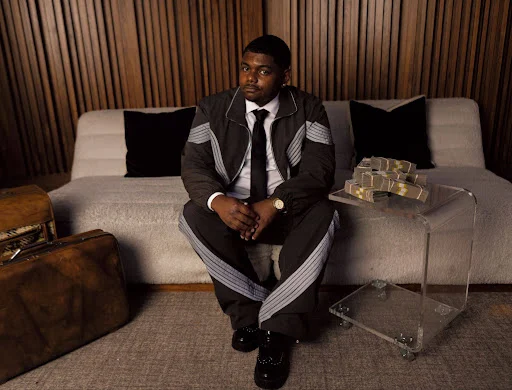
Atlanta-born multi-instrumentalist, producer, and vocalist Zacchaeus Paul has officially released his latest single, titled "STAY," featuring close friend, collaborator, and groomsman donSMITH. Issued via Candid Records, the track serves as a pivotal preview of Paul’s highly anticipated sophomore studio album, JAZZ MONEY VOL. 2: SWINGIN’ R&B, slated for a full-length release on October 16. Produced by Malachi Mabson under the moniker Down To Mars, the song pairs silky-smooth vocal deliveries from Paul and Safa with intricate trumpet work courtesy of Milena Casado. The resulting composition positions itself firmly within the modern R&B landscape while drawing heavily from foundational elements of Black American music.
The release of "STAY" follows a strategic rollout of singles designed to demonstrate Paul’s genre-blending methodology. It arrives on the heels of last month’s release, "BETTER MUST COME," a traditional gospel hymn reimagined through a swingin’ R&B framework. Co-produced by Paul and DJ OOOCHILD, that previous release featured lyrical contributions from Happy Qavah and donSMITH, alongside foundational basslines from Dezron Douglas. Together, these tracks form the bedrock of Paul’s overarching artistic thesis for his upcoming project: breaking down artificial genre barriers that historically segregate jazz, R&B, gospel, and soul into distinct commercial categories.
Breaking Down Genre Boundaries and Honoring the Black Musical Tradition
Speaking on the conceptual foundation of "STAY," Paul emphasized that the track is not an experimental foray into a secondary genre, but rather a natural extension of his musical identity.
"This right here is a classic R&B record featuring one of my closest friends and one of my groomsmen, donSMITH, produced by Malachi Mabson of Down To Mars," says Zacchaeus Paul. "I wanted a record that reminded people I have range—that I can step into this lane just as naturally as any other. This isn’t me trying R&B. This is part of who I artistically am. Today, people love to put artists into boxes. You’re the jazz guy. You’re the R&B guy. You’re the gospel guy. I’ve never looked at music that way."
Paul’s refusal to adhere to rigid industry classifications stems directly from his formative years in the church. According to the artist, this upbringing provided a holistic understanding of how disparate musical styles function as a singular family tree. He argues that authentic jazz cannot be executed without a comprehension of gospel, just as genuine R&B relies on foundational blues, jazz, and church harmonies.
"Growing up in the church gave me a foundation that allowed me to understand all of these genres because they’re all connected," Paul continues. "I couldn’t make authentic jazz without understanding gospel. I couldn’t make authentic R&B without understanding jazz, blues, and the church. They’re all part of the same family tree. I’m an R&B artist, and I’m a jazz artist. The only difference is that I’m presenting this work under the umbrella of jazz because my mission is to re-center jazz in a Black cultural context."
This cultural context draws from a broad spectrum of influences. Paul cites early introductions to the avant-garde movement, John Coltrane, and Duke Ellington alongside foundational R&B and soul icons such as Anita Baker, Maze featuring Frankie Beverly, K-Ci & JoJo, Marvin Gaye, Sam Cooke, and The O’Jays. Furthermore, he highlights the historical significance of the African American quartet tradition, referencing ensembles like the Canton Spirituals and his father’s group, Walt Beasley and the Gospel Explosion. In Paul’s view, these collective harmonies directly shaped what evolved into contemporary R&B, proving that the styles do not exist in isolation.
Chronology of the JAZZ MONEY VOL. 2 Rollout
The rollout for JAZZ MONEY VOL. 2: SWINGIN’ R&B has unfolded through a calculated sequence of releases over recent months, establishing a clear narrative arc for the October 16 album release.
Phase One: "LOOK TO THE SKY" and "SHE F*CK WITH THE RACKS"
The album campaign initially gained traction with the release of two contrasting singles that established the broad spectrum of the project. "LOOK TO THE SKY" emerged as a spiritual jazz and postbop composition reflecting on the cycle of life and death. Featuring lyrics by Paul about his expected child and saxophone work by Eric Wyatt—who dedicated the piece to his late mother—the track incorporated performances by GRAMMY Award-nominated jazz trumpeter Keyon Harrold.
Conversely, "SHE F*CK WITH THE RACKS" approached storytelling from a street-level perspective, examining themes of loyalty, materialism, and the concept of "hood rich." Bolstered by soulful harmonies, explicit hooks, and soprano saxophones by Kebbi Williams, the track solidified Paul’s definition of "jazz money" as the intersection of elegance, ambition, and urban grit.
Phase Two: "BETTER MUST COME"
Moving deeper into the spiritual lineage of the project, Paul dropped "BETTER MUST COME" last month. The single tackled the theme of divine love by taking a traditional spiritual hymn and reconstructing it through a groove-heavy R&B lens. By integrating producer tags, spoken-word bookends, and modern beat production alongside elite acoustic instrumentation, the single served as a bridge between sacred tradition and contemporary secular soul.
Phase Three: "STAY"
The current single, "STAY," completes the pre-release phase by leaning entirely into the sensual, groove-oriented traditions of classic R&B. By anchoring the track with donSMITH and enlisting production talent from Down To Mars alongside trumpet accompaniment from Milena Casado, Paul reinforces the commercial viability and authentic execution of his cross-genre aspirations.
Musical Architecture and Production Analysis
Industry analysts and critics observing the unfolding album campaign have noted the distinct alchemy at play within JAZZ MONEY VOL. 2: SWINGIN’ R&B. While numerous contemporary musicians attempt to fuse hip-hop, jazz, and R&B, few achieve the structural cohesion demonstrated by Paul.
The production framework of the upcoming album relies on a meticulous balance of opposing musical forces. Diamond-sharp, modern electronic beats sit comfortably alongside nimble, acoustic jazz drumming. Spoken-word interludes and producer tags—staples of modern hip-hop production—bookend tracks that feature extended, long-form improvisations by seasoned jazz soloists. This synthesis mirrors the spontaneous creation methods of classic mid-century jazz LPs while maintaining the cinematic narrative structures characteristic of the golden age of hip-hop.
By positioning himself simultaneously as a classically trained jazz instrumentalist, a street-aware hip-hop and R&B producer, and a neo-soul crooner, Paul avoids the dilution that often plagues genre-fusion projects. Instead, he constructs a unified aesthetic that honors the past while aggressively pushing the boundaries of modern Black music production.
Broader Implications for the Contemporary Jazz and R&B Markets
Paul’s explicit mission to re-center jazz within a Black cultural context carries significant implications for the contemporary music industry. In recent decades, mainstream jazz has frequently been categorized as an academic or niche genre, often removed from the socio-cultural environments that birthed it. By injecting the rhythms, vocal styling, and emotional directness of R&B, gospel, and hip-hop back into the jazz ecosystem, Paul aims to dismantle the commercial and racialized barriers that separate these listener bases.
Furthermore, the release of "STAY" and the broader JAZZ MONEY catalog challenges streaming-era categorization models. Algorithms and playlist curators traditionally demand that artists maintain a singular sonic profile to secure placement. By defiantly crossing lines between bedroom R&B, avant-garde jazz, and church-rooted gospel within a single album cycle, Paul establishes a precedent for multi-hyphenate artists seeking commercial success without artistic compromise.
As the October 16 release date for JAZZ MONEY VOL. 2: SWINGIN’ R&B approaches via Candid Records, the industry will be watching to see how commercial radio and streaming platforms receive this deliberate unification of Black musical traditions. With a robust catalog of singles already establishing critical momentum, Zacchaeus Paul continues to assert that the future of jazz and R&B lies not in separation, but in integration.