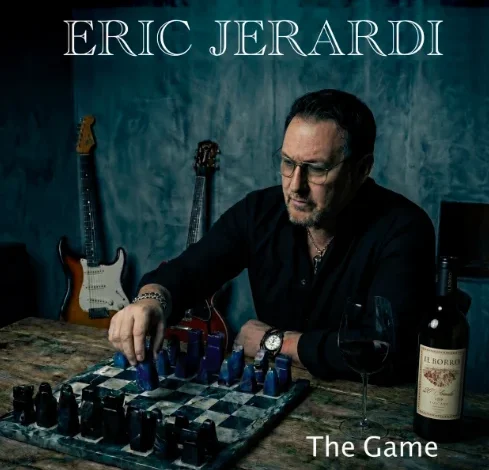
What began as an informal creative experiment during the social isolation of the COVID-19 pandemic has culminated in a defining artistic statement for blues-rock veteran Eric Jerardi. His upcoming album, The Game, scheduled for release on October 30, 2026, serves as a testament to the power of structured creative constraints. The project, which originated from a 12-week songwriting challenge proposed by his friend Todd Clemmer, has evolved into a deeply personal exploration of mortality, grief, and the complexities of the human condition. By shifting his focus from the rapid-fire guitar solos that once defined his performances to the narrative-driven craftsmanship favored by songwriters like Tom Waits and John Hiatt, Jerardi has produced what is arguably the most vulnerable and cohesive work of his three-decade career.
A Chronology of Creative Transformation
The genesis of The Game lies in the forced hiatus of the global music industry between 2020 and 2021. With live performance venues shuttered and tours canceled, many musicians found themselves adrift, lacking the regular feedback loop of an audience. Jerardi, a staple of the Midwestern blues-rock scene since his early days with the band 18th Emergency at Ohio University, sought a way to maintain his creative edge. The "12 songs in 12 weeks" challenge provided the necessary framework to break through the stagnation of the pandemic era.
However, the process was far from purely academic. As the weeks progressed, the songs began to function as an emotional repository for Jerardi, who was navigating a period of profound personal loss. The death of his brother to cancer, followed by the passing of his close friend Rob—also to pancreatic cancer—created an atmosphere of mourning that inevitably bled into the songwriting process. The track "Hard Being Here," written in a frantic, five-minute burst of catharsis, captures this raw vulnerability. For Jerardi, the song was a necessary confrontation with the trauma he had long suppressed, allowing him to process the parallels between witnessing his brother’s decline and watching his friend succumb to the same illness.
The Shift Toward Narrative Fiction
While Jerardi’s discography has traditionally been rooted in autobiographical storytelling, The Game represents a significant departure. The artist estimates that approximately 60% to 70% of the album remains rooted in his own lived experience, but the remaining portion relies on character studies—a technique he previously avoided. This departure was born out of necessity when prompts for the 12-week challenge yielded concepts that did not immediately align with his personal narrative.
One notable example is the track "Thorns and Roses." Initially, the prompt felt foreign and potentially "cheesy" to an artist accustomed to the grit of blues and soul. Rather than abandoning the concept, Jerardi leaned into the challenge, constructing a fictional persona to inhabit the lyrics. This approach allowed him to explore universal themes from a distance, ultimately resulting in one of the strongest tracks on the record. By adopting the perspective of characters outside his own experience, Jerardi discovered a newfound freedom that allowed his writing to transcend the limitations of his own biography, offering a broader, more empathetic look at the human experience.
Musical Influences and Genre Fluidity
To understand the sound of The Game, one must look at the diverse sonic palette that has influenced Jerardi since his youth in Dayton, Ohio. His early musical education was a collision of disparate worlds: the blues purity of Jimmy Reed and B.B. King, the soulful urgency of Stax Records and Otis Redding, and the high-voltage rock of Led Zeppelin, Black Sabbath, and Judas Priest.

In his formative years, these influences were often kept in separate silos. However, as his career progressed, they began to merge into the "soul-blues" hybrid that critics identified in his 2019 release, Occupied. Jerardi notes that this synthesis was never a deliberate branding choice but rather the natural output of his creative impulses. He has openly expressed dissatisfaction with being categorized strictly as a "blues guy," noting that while he respects the genre’s traditions, he finds greater fulfillment in incorporating gospel-soul chord changes and complex narrative structures. His admiration for Tom Waits is particularly telling; it is the storytelling, rather than the guitar-centric "noodling" often found in the blues-rock genre, that currently serves as his primary inspiration.
Reevaluating the Role of the Guitarist
Perhaps the most striking aspect of The Game is the restraint demonstrated in the instrumentation. Twenty years ago, Jerardi’s live performances were characterized by extended eight-minute solos and a focus on technical velocity. He admits that in his younger years, he felt a pressure to prove his worth through sheer dexterity—to be viewed as a "blazing killer guitar player."
The production of The Game reflects a maturation of this philosophy. On this record, the guitar serves the song rather than the ego. Solos are truncated, melodic, and purposeful, allowing space for the vocals to take center stage. This pivot toward "songcraft" is not a loss of ability, but a refinement of it. Industry peers and early listeners have noted that this restrained approach has yielded some of the most sophisticated guitar work of his career. By prioritizing "short, sweet, and thoughtful" passages, Jerardi has successfully moved away from the performative nature of his past and toward a more durable, listener-focused aesthetic.
Broader Implications for the Industry
The success of this creative challenge has wider implications for how legacy artists approach their craft in the post-pandemic landscape. Many musicians are currently reevaluating the viability of the "constant tour" model. Jerardi himself has acknowledged a shift in his performance cadence; after years of playing three or four shows a week, he has deliberately slowed his pace. The physical and mental toll of such a schedule, combined with the reflective nature of his recent work, suggests a move toward quality over quantity.
Furthermore, the "12-week challenge" model serves as a case study in how self-imposed discipline can revitalize a career. By the time the album was completed, Jerardi had not only produced a collection of songs that resonated with a diverse test audience—where all 12 tracks were cited as "favorites" by various listeners—but he also gained a newfound confidence in his abilities as both a writer and a vocalist. Working with a dedicated vocal producer allowed him to push his range and technique in ways he hadn’t previously attempted, signaling that the "mature" phase of his career may be his most prolific.
Looking Toward the Future
As October 30, 2026, approaches, the focus for Jerardi has shifted toward translating the nuances of The Game into a live environment. The challenge lies in maintaining the delicate balance of the studio recordings, which rely heavily on layered textures and restrained dynamics. Preparing these songs for the stage is a process he treats with the same intensity as the writing process itself, acknowledging that the "jitters" of performance never fully dissipate, regardless of one’s experience level.
Ultimately, The Game acts as a mirror for both the artist and the audience. It captures a musician at a crossroads—in his late 50s, processing the loss of peers, and embracing the limitations of time as a catalyst for deeper creation. It is a work that rejects the vanity of the guitar hero in favor of the vulnerability of the songwriter. For Eric Jerardi, the "game" of writing 12 songs in 12 weeks was merely the vehicle; the destination was a clearer, more honest understanding of his own voice and the stories he is finally ready to tell. As he prepares to share these songs with the world, the record stands as a firm reminder that the most compelling music often arrives when an artist stops trying to impress and starts trying to connect.