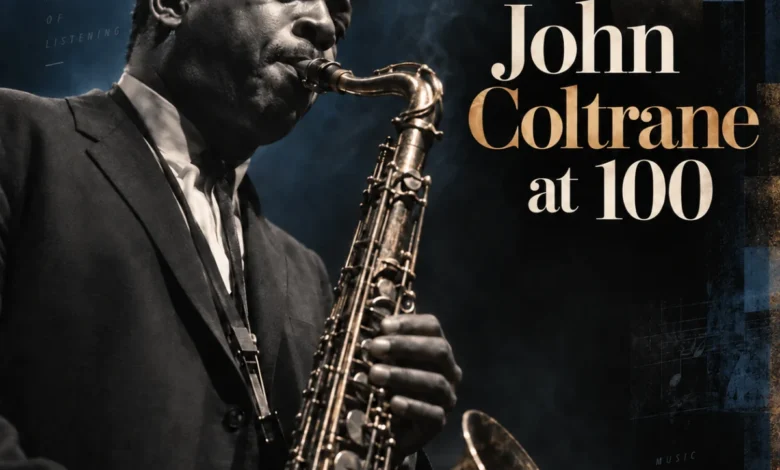
One hundred years after his birth, John Coltrane’s music remains less a historical artifact than a living language—one that musicians are still studying, questioning, and expanding today. Born on September 23, 1926, in Hamlet, North Carolina, Coltrane entered a world that would be irrevocably altered by his singular vision. Today, on what marks his centennial, the global jazz community pauses to celebrate a career that, despite its premature conclusion in 1967 at the age of 40, established a blueprint for modern musical expression that transcends genre, culture, and time.
A Chronology of a Meteoric Ascent
The trajectory of John Coltrane’s career is a study in relentless self-actualization. His professional life can be segmented into distinct phases, each characterized by a profound shift in technique and philosophy.
In the early 1950s, Coltrane was a journeyman, refining his craft in the bands of Eddie "Cleanhead" Vinson, Dizzy Gillespie, and eventually, the legendary Miles Davis. It was during his tenure with the Miles Davis Quintet in the mid-1950s that Coltrane’s "sheets of sound"—a term coined by critic Ira Gitler to describe his dense, rapid-fire improvisational style—began to gain notoriety.
By 1959, Coltrane had reached a point of harmonic saturation. His album Giant Steps, released on Atlantic Records, presented a series of chord progressions so complex they became the "Himalayas" for aspiring saxophonists. The album served as a bridge between the hard-bop sensibilities of his past and the modal, open-ended explorations that would define his future.
The 1960s ushered in the "Classic Quartet" era, featuring pianist McCoy Tyner, bassist Jimmy Garrison, and drummer Elvin Jones. This unit operated with a telepathic synergy, creating the sonic landscape for masterpieces like Crescent (1964) and the seminal A Love Supreme (1965). The latter, a four-part suite dedicated to the divine, marked the intersection of his technical mastery and his intensifying spiritual search.
In the final two years of his life, Coltrane moved toward the avant-garde, embracing a raw, ecstatic, and often dissonant style that sought to capture the totality of human experience. Albums like Ascension and Interstellar Space represent a period of total liberation, where the traditional constraints of melody and harmony were sacrificed for pure emotional and spiritual output.
Analytical Impact: Why Coltrane Still Matters
To analyze Coltrane’s influence is to examine the evolution of modern improvisation. His work did not merely provide new solos; it provided a new pedagogy. Music schools worldwide now treat his recordings as primary texts. The "Coltrane Changes"—the cycle of chord substitutions famously utilized on Giant Steps—are mandatory study for any serious student of Western music theory.
However, his influence transcends technical proficiency. Coltrane occupies a unique space in American history. He is one of the few jazz artists to have his work officially recognized by the Library of Congress; in 2015, A Love Supreme was inducted into the National Recording Registry for its "lasting cultural and historical significance." His music functioned as a mirror to the Civil Rights Movement, reflecting both the struggle for dignity and the pursuit of transcendental peace.
Economically and culturally, the "Coltrane industry" remains robust. Reissue campaigns, rare archival releases, and intellectual property management by the John Coltrane Estate continue to generate significant interest. The recent emergence of the "Tiberi Tapes"—bootleg-style live recordings from New York and Philadelphia clubs in the early 1960s—highlights the ongoing demand for "new" Coltrane material. These tapes, captured by musician Frank Tiberi, provide researchers with a clearer understanding of how Coltrane transitioned from established bop patterns to his later, freer style.
The COLTRANE 100 Centennial Celebration
The year 2026 serves as the focal point for the COLTRANE 100 initiative, a global, year-long celebration spearheaded by the Coltrane Estate in collaboration with cultural institutions, record labels, and jazz festivals. The program aims to move beyond simple nostalgia, focusing instead on the continued relevance of his work.
Events scheduled throughout the year include:
- The Global Listening Series: A series of curated events where A Love Supreme and Blue Train are played in high-fidelity environments, emphasizing the visceral experience of the music.
- Archival Symposia: Academic gatherings focused on the transcription and analysis of the Tiberi Tapes and other newly digitized recordings.
- Educational Outreach: Scholarships and workshops aimed at connecting younger generations with the improvisational principles Coltrane championed.
"The goal of the centennial is not to place John in a museum," says a spokesperson for the estate. "It is to ensure that the language he built remains accessible to the next generation of innovators who are looking for a way to express their own internal truths."
The Enduring Resonance of the "Classic" Recordings
The longevity of Coltrane’s music can be measured by its ubiquity in the modern digital landscape. Streaming platforms report millions of monthly listeners for his seminal tracks, with "Naima" and "My Favorite Things" consistently ranking as the most accessed jazz standards of the 20th century.
Why does this music continue to move listeners who may be entirely unfamiliar with the intricacies of bebop theory? The answer lies in the human element. Coltrane’s tone—described by many as "vocal" or "primal"—spoke directly to the listener’s psyche. Whether through the tender, melodic structure of his balladry or the frantic, searching wails of his later works, Coltrane maintained a level of sincerity that is rarely duplicated.
Institutional Perspectives and Broader Implications
Jazz historians often note that Coltrane’s death in 1967 marked the end of a "Golden Age" of jazz, but more accurately, it signaled the fragmentation of the genre into the many sub-genres we recognize today. By pushing the boundaries of what was acceptable in a recording studio, Coltrane essentially gave future musicians permission to abandon traditional song structures in favor of atmospheric or conceptual compositions.
From a sociological perspective, Coltrane’s trajectory mirrors the broader American experience of the mid-20th century: a move from the rigid structures of the post-war era toward a more individualistic, search-based, and ultimately diverse cultural identity. He navigated the racial complexities of the music industry with grace, maintaining artistic integrity even when commercial pressures urged him to repeat the success of his earlier, more accessible hits.
Reflections on a Century of Legacy
As we mark the 100th anniversary of his birth, the question remains: what is the most appropriate way to honor a man whose life was dedicated to the pursuit of the infinite?
The answer is found in the act of listening itself. It is a process of engagement. When a listener puts on a record like A Love Supreme today, they are participating in the same spiritual exercise that the artist intended in 1964. The music is not a static object; it is an active, ongoing conversation.
The jazz world of 2026 is vastly different from that of 1967. The advent of digital production, the blending of electronic music with traditional jazz, and the global democratization of music education have changed the soundscape entirely. Yet, at the core of these developments, one can still find the influence of John Coltrane. Every time a saxophonist pushes their instrument to its physical limit, or a composer seeks to incorporate meditative or devotional themes into their work, the legacy of Coltrane is present.
Happy 100th birthday, John Coltrane. While the man is long gone, the language he gave the world continues to be spoken, questioned, and expanded, ensuring that as long as there is an ear to listen, the giant steps will never cease.