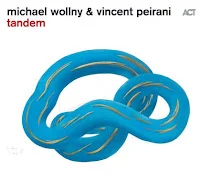
The European contemporary jazz landscape has long been defined by its ability to synthesize diverse musical traditions, effortlessly bridging the gap between classical composition, avant-garde improvisation, and folk idioms. In this rich tradition, the collaboration between acclaimed German pianist Michael Wollny and virtuoso French accordionist Vincent Peirani stands out as a masterclass in cross-border artistic dialogue. Released to critical acclaim, their collaborative project, simply titled Tandem, brings together two of the continent’s most inventive instrumentalists. The resulting body of work showcases a fearless exploration of repertoire, featuring striking original compositions alongside bold reinterpretations of works by icons such as Björk, Samuel Barber, Sufjan Stevens, and Tomás Gubitsch.
The partnership unites two distinct heavyweights of modern European jazz. Michael Wollny, celebrated for his eclectic approach and commanding keyboard technique, has spent decades establishing himself as one of Germany’s premier jazz pianists, earning numerous Echo Jazz awards and international acclaim for his trio work and solo projects. Across the Rhine, Vincent Peirani has fundamentally redefined the accordion’s role in contemporary music. Moving far beyond traditional folk associations, Peirani has utilized the instrument’s unique sonic capabilities in jazz, chamber music, and improvised settings, earning prestigious accolades including the Django Reinhardt Prize and Victoires du Jazz honors. Together, in a stripped-down, highly intimate two-man configuration, Wollny and Peirani strip away the safety nets of larger ensembles, relying entirely on mutual intuition, technical mastery, and a shared cavalier spirit of ingenuity.
Reinterpreting the Canon: A Genre-Defying Tracklist
At the heart of Tandem is an adventurous program that resists easy categorization. Rather than treating classical masterpieces, alternative pop anthems, and modern folk songs as static source material, Wollny and Peirani deconstruct and rebuild them. The project balances carefully structured arrangements with moments of dizzying, high-wire improvisation.
The stylistic breadth of the album is immediately evident in its treatment of classical and contemporary art music. Samuel Barber’s solemn and deeply melancholic "Adagio for Strings"—a piece deeply embedded in the Western classical consciousness—is given a startling new lease on life. The duo approaches the iconic composition with an enthusiastic swagger that gradually transforms into a racing, minimalist underburn. Rather than leaning solely into the tragedy of the piece, Wollny and Peirani capture its kinetic energy, driving the melody forward with rhythmic persistence.
Similarly, the selection of Björk’s "Hunter" highlights the duo’s knack for unexpected stylistic juxtapositions. The track is aptly set to a propulsive flamenco pulse, driven by the accordion’s percussive bellows and sharp articulation. From there, Wollny takes off with steadfast pacing, injecting Chick Corea-esque flourishes and full-handed, cascading chords that expand the sonic parameters of the original electronic arrangement.
Introspection plays an equally vital role on the album. Peirani delivers a deeply reflective, soul-searching sound on the original composition "Song Yet Untitled." Here, the accordion acts as a breathing, vocal entity, painting with subtle microtones and whispering dynamics. This is contrasted by Wollny’s skittering original piece, "Bells," which serves as a prime showcase for the telepathic rapport shared by the two musicians. Moving seamlessly in and out of chromatic nuances, they navigate complex harmonic terrain with absolute freedom.
Folk and singer-songwriter influences are handled with equal reverence. Sufjan Stevens’s hymnal "Fourth of July" is rendered with striking, unvarnished austerity. The musicians strip the song down to its emotional core, allowing the melancholy of the lyrics to resonate through sparse, elegiac instrumental exchanges. Meanwhile, their exploration of Argentinian composer Tomás Gubitsch’s "Travesuras" offers a masterclass in dynamic contrast. The performance alternates fluidly between carefree, exuberant traversing and hushed, delicate balladry themes, demonstrating the duo’s remarkable command of mood and tempo.
Background Context and the Evolution of European Chamber Jazz
To understand the significance of the Wollny-Peirani partnership, one must examine the broader evolution of European jazz over the past three decades. Unlike the American jazz tradition, which is heavily anchored in the blues and the classic Great American Songbook, European jazz has increasingly leaned into a pan-continental identity. This movement incorporates elements of European classical music, folk traditions from various regions, and contemporary sound design.
Labels such as ECM Records laid the groundwork for this aesthetic, championing a sound characterized by space, lyricism, and cross-genre fertilization. In the 21st century, artists like Wollny and Peirani have inherited this tradition while pushing it into more adventurous, contemporary territories. They grew up in an era where genre boundaries dissolved rapidly, influenced equally by rock, classical chamber music, electronica, and jazz history.
Michael Wollny’s career has been defined by constant reinvention. Whether leading his trio, collaborating with visual artists, or exploring the legacy of composers like Gustav Mahler and Heinrich Schütz, Wollny approaches the piano as an orchestra of possibilities. His touch can be aggressively percussive or feather-light, and his harmonic vocabulary draws as much from 20th-century classical composition as it does from post-bop jazz.
Vincent Peirani, meanwhile, represents a generation of accordionists who have rescued the instrument from the confines of traditional café music and musette. Alongside peers like Galliano and various contemporary classical performers, Peirani has treated the accordion as a sophisticated, polyphonic powerhouse capable of immense textural variety. By pairing the piano—a percussion-based harmonic instrument—with the accordion—a wind-driven, sustained-tone instrument—Wollny and Peirani create a unique sonic marriage. The accordion fills the gaps left by the piano, sustaining notes, bending pitches, and introducing reedy, organ-like textures that fundamentally alter traditional jazz voicings.
Critical Reception and Industry Implications
Upon its introduction to the live circuit and through recorded excerpts, the collaboration garnered widespread praise from jazz critics, musicologists, and industry professionals alike. Reviewers have consistently highlighted the telepathic nature of their interplay. In a duo setting, there is nowhere to hide; every hesitation, every dynamic shift, and every harmonic pivot is laid bare. Wollny and Peirani’s ability to maintain absolute cohesion while venturing into free improvisation has been cited as a high-water mark for contemporary European chamber jazz.
Industry analysts note that projects like Tandem reflect a growing commercial and critical appetite for intimate, high-concept acoustic collaborations. In an era dominated by heavily produced, digital music formats, audiences are increasingly drawn to the raw authenticity and virtuosity of two master musicians sharing a stage with minimal amplification. The album’s eclectic tracklist—bridging Barber, Björk, Stevens, and Gubitsch—also points to a shifting paradigm in how modern musicians curate their repertoires. Younger generations of jazz listeners no longer recognize strict genre boundaries; they consume music through algorithms and playlists that juxtapose classical arrangements with indie folk and electronic beats. Wollny and Peirani mirror this omnivorous listening habit in their live performances.
Broader Impact and Future Outlook
The implications of Wollny and Peirani’s work extend beyond individual acclaim, signaling a healthy and outward-looking future for European improvised music. By demonstrating that jazz can comfortably inhabit the worlds of minimalist classical music and alternative pop without losing its improvisational core, they provide a blueprint for future generations of musicians.
Furthermore, the collaboration underscores the cultural value of cross-border artistic partnerships within the European Union and beyond. At a time when geopolitical tensions and national borders have occasionally threatened international cooperation, cultural exchanges of this caliber—germinated through shared rehearsal spaces, festival circuits, and mutual artistic admiration—reinforce the unifying power of creative expression.
As Michael Wollny and Vincent Peirani continue to take their Tandem project to international stages, jazz festivals, and concert halls, they cement their status as two of the most daring voices in modern music. Their ability to transform disparate musical fragments into a cohesive, emotionally resonant narrative is a testament to what happens when supreme technical mastery meets unbridled artistic curiosity. Whether soaring through the minimalist corridors of Samuel Barber or breathing new life into the stark lyricism of Sufjan Stevens, Wollny and Peirani prove that the spaces between genres are where the most exciting musical discoveries await.