Equally Stupid Returns with a More Melodic and Spacious Approach on Escape from The Unhappy Society

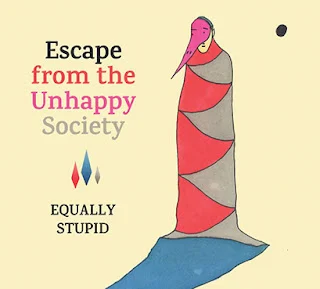
The contemporary European jazz landscape has long served as a fertile ground for boundary-pushing experimentation, genre-blending, and transatlantic artistic cross-pollination. Within this dynamic ecosystem, the multinational experimental jazz trio Equally Stupid has carved out a distinct and respected niche. Three years after introducing themselves to the global music community with their bracing, high-energy 2014 debut album, Exploding Head, the ensemble returned with their sophomore full-length recording, Escape from The Unhappy Society. This sophomore release marks a significant artistic pivot for the group, trading the raw, in-your-face aggression of their earlier work for a more measured, atmospheric, and deeply lyrical exploration of collective improvisation.
Comprising guitarist Sigurður Rögnvaldsson, saxophonist Pauli Lyytinen, and percussionist David Meier, Equally Stupid operates as a truly borderless European collective. The trio brings together distinct musical backgrounds and regional influences from across the continent, uniting under a shared philosophy of uncompromised artistic integrity. While their debut album established their technical prowess and penchant for explosive sonic confrontations, Escape from The Unhappy Society demonstrates a mature willingness to explore the quieter, more contemplative corners of contemporary instrumental music without sacrificing the muscularity and intricate interplay that initially defined their sound.
Evolution of the Ensemble Sound
The musical trajectory from Exploding Head to Escape from The Unhappy Society highlights a deliberate maturation in compositional and improvisational strategy. Where the debut release relied heavily on brash textures, rapid-fire dynamics, and an abrasive, high-octane delivery, the sophomore effort prioritizes space, texture, and melodic resonance. Music critics and jazz historians often note that a sophomore album serves as a critical litmus test for emerging ensembles, revealing whether a group can sustain its initial creative spark or merely replicate past formulas. Equally Stupid decisively answered this challenge by choosing evolution over repetition.
At the core of this sonic transformation is a meticulous recalibration of instrumentation and tone. Sigurður Rögnvaldsson anchors the harmony and rhythm not through a standard electric guitar, but through the rich, resonant depths of the baritone guitar. This choice introduces a darker, more expansive frequency range to the trio’s arrangements, laying a solid foundation for the broader harmonic movements of the songs. Meanwhile, Pauli Lyytinen expands his sonic palette across tenor, alto, and bass saxophones, supplementing his acoustic delivery with subtle electronic effects. Lyytinen’s tone is consistently described as round and warm, contrasting sharply with the biting, sharp-edged guitar lines of Rögnvaldsson. Binding these elements together is the physical, highly textured drumming of David Meier. Meier’s approach shifts effortlessly from muscular propulsion to delicate, brushed percussion, providing an organic heartbeat that adapts fluidly to the shifting moods of the compositions.
Chronology and Background of the Release
The formation of Equally Stupid and the subsequent rollout of their recorded works reflect the modern realities of the European independent jazz scene. Following their initial emergence in the early 2010s, the trio spent years touring underground venues, jazz festivals, and loft spaces across Europe. These live performances served as the laboratory where the material for Exploding Head was forged. The album was officially released in 2014 to favorable reviews within avant-garde circles, establishing the band as a formidable unit capable of merging the intensity of punk rock aesthetics with the structural sophistication of modern creative jazz.
Following a rigorous touring schedule in support of their debut, the trio retreated to the studio to conceptualize their next phase. Rather than rushing to capitalize on their early momentum, Rögnvaldsson, Lyytinen, and Meier took time to develop a new compositional vocabulary. This three-year gestation period culminated in the recording and release of Escape from The Unhappy Society. The album’s title itself hints at a thematic departure—a metaphorical flight from the rigidity and conformity of modern societal structures into the liberating, unbounded expanse of free-form musical expression. The tracklist, featuring nine distinct compositions ranging from "Politician’s Nightmare" to the title track "Escape from The Unhappy Society," maps out an intentional journey through varying emotional and sonic landscapes.
Detailed Track Analysis and Artistic Approach
A close examination of individual tracks on Escape from The Unhappy Society reveals the sophisticated interplay and compositional maturity of the trio. The album’s second track, "Fool’s Paradise," serves as an ideal case study for the group’s new aesthetic direction. The piece opens with the unusual, resonant tones of Rögnvaldsson’s baritone guitar, establishing a dark, contemplative mood. Instead of driving the rhythm with heavy distortion, Rögnvaldsson opts for deeper, rhythmic swells. He is accompanied by Meier’s gentle, brushed percussion, which creates a soft, tactile cushion for Lyytinen’s lilting saxophone phrasing. The result is a spacious, deeply atmospheric soundscape that feels both modern and rooted in classic jazz tradition.
However, the album successfully avoids drifting into overly ambient or sterile territory. Tracks such as "Paranoia" remind listeners of the fierce interplay and angular dexterity that characterized the band’s debut. On "Paranoia," the sax and guitar engage in a complex, recursive dialogue, weaving around one another in a manner reminiscent of a playful childhood chase. This motif eventually blossoms into a soaring lyrical solo before smoothly reverting to the aggressive, driving romp of the intro. This seamless transition between structured composition and wild improvisation highlights the technical mastery of the musicians, proving that their prowess remains fully intact beneath the album’s polished surface.
Industry Reception and Critical Analysis
Upon its release, Escape from The Unhappy Society received widespread critical acclaim from contemporary jazz publications and cultural critics. Reviewers frequently lauded the album for achieving a difficult balance: it maintains the high-level technical proficiency and artistic ambition of avant-garde jazz while retaining a vital, human warmth that prevents it from sounding clinical or inaccessible. In an era where many contemporary jazz recordings are heavily processed and meticulously scrubbed of natural imperfections, Equally Stupid’s commitment to an organic, breathing ensemble sound has been praised as a refreshing antidote.
Cultural analysts and musicologists examining the state of modern European jazz often point to groups like Equally Stupid as exemplars of a new wave of borderless collaboration. By defying rigid genre categorizations—borrowing freely from rock, contemporary classical, and free jazz idioms—the trio appeals to a diverse demographic of listeners who may not traditionally identify as jazz purists. The cross-cultural makeup of the band further reflects the broader socio-economic and cultural integration of the European Union’s creative class, where artists frequently cross national borders to live, compose, and perform together.
Broader Impact and Future Implications
The long-term implications of releases like Escape from The Unhappy Society extend far beyond the commercial metrics of niche genre charts. As the traditional music industry continues to grapple with the economic realities of streaming and digital distribution, independent avant-garde ensembles face mounting financial pressures. Yet, groups operating within the creative music networks of Europe have demonstrated resilience by cultivating dedicated, localized fan bases and utilizing international touring circuits to sustain their artistic output.
Equally Stupid’s refusal to pander to commercial radio formats or stylistic safety underscores a vital truth about the health of contemporary instrumental music: artistic growth often requires deliberate risk-taking. By transitioning from the brash aggression of Exploding Head to the spacious lyricism of their sophomore record, Rögnvaldsson, Lyytinen, and Meier have proven that they are not a one-note novelty act, but a durable, evolving ensemble capable of continuous self-reinvention.
As these three emerging European artists continue to write, record, and perform, their trajectory offers a compelling blueprint for the future of creative improvised music. They demonstrate that technical excellence, when paired with genuine emotional resonance and an adventurous spirit, can yield work that challenges the intellect while deeply engaging the listener’s humanity. Escape from The Unhappy Society stands not only as a high-water mark in the discography of Equally Stupid, but also as a significant contribution to the ongoing evolution of modern European jazz.