Triumphs in the Orchestra Pit Overshadow Misguided Staging as Verdi’s Simon Boccanegra Returns to Florence

Giuseppe Verdi’s operatic masterpiece, Simon Boccanegra, returned to the prestigious stage of Florence’s Teatro del Maggio Musicale Fiorentino on November 24, 2026, offering audiences a study in contrasting artistic fortunes. The opening night of this new production—co-produced with Valencia’s Palau de les Arts Reina Sofía and directed by Àlex Ollé of the famed theatrical collective La Fura dels Baus—delivered a mixed verdict. While the evening was saved and ultimately elevated by a series of world-class vocal performances and sensitive orchestral direction, the physical staging drew widespread criticism for stripping the opera of its vital historical, geographical, and maritime context.
The production brought together a stellar international cast featuring baritone George Petean in the formidable title role, tenor Luciano Ganci as Gabriele Adorno, bass Jongmin Park as Jacopo Fiesco, and soprano Carolina López Moreno as Amelia. Under the baton of veteran maestro James Conlon, the Orchestra and Chorus of the Maggio Musicale Fiorentino provided a rich musical foundation. Yet, despite the soaring vocalism, the theatrical realization struggled to connect with the dense political and psychological narrative that Verdi and his librettists labored to construct.
A Historical and Operatic Genesis: From 1857 Failure to 1881 Masterpiece
To understand the weight of expectations surrounding any mounting of Simon Boccanegra, one must examine its complex compositional history. The opera first premiered at Venice’s Teatro La Fenice on March 12, 1857. It was met with an unenthusiastic, even hostile, reception from audiences and critics alike. Musicologists generally attribute this initial failure to the convoluted and structurally weak libretto penned by Francesco Maria Piave, which struggled to clarify the dense web of medieval Genoese politics, family vendettas, and sudden shifts in time.
Recognizing the latent power within the score, Verdi waited nearly a quarter of a century before revisiting the work. In 1881, he enlisted the brilliant poet and composer Arrigo Boito—who would later collaborate with Verdi on his final masterpieces, Otello and Falstaff—to undertake a comprehensive revision of the libretto. Boito restructured the prologue, clarified the political motivations of the characters, and sharpened the psychological profiles, most notably in the grand Council Chamber scene in Act I.
The revised version premiered at La Scala in Milan on March 24, 1881, to immediate and resounding acclaim. The transformation yielded one of Verdi’s most sophisticated and psychologically acute creations. The work successfully fuses the high-stakes intrigue of statecraft with an intensely intimate exploration of paternal love, personal sacrifice, forgiveness, and ultimate reconciliation.
The Genoese Republic: Setting, Politics, and the Sea
The historical backdrop of medieval Genoa is not merely decorative; it is fundamental to the opera’s dramatic machinery. Alongside Venice, Pisa, and Amalfi, Genoa stood as one of Italy’s great medieval maritime republics—a fabulously wealthy commercial empire whose internal stability was constantly threatened by bloody factionalism between the aristocratic patricians and the populist plebeians.
In this volatile landscape, Simon Boccanegra emerges as a historical anomaly: a former corsair and pirate elected as the first Doge of Genoa by the common people. His lifelong political mission is to bridge the unbridgeable chasm between the warring social classes, seeking peace through inclusion and reform. Yet Boccanegra’s public aspirations are inextricably bound to a private tragedy. His primary emotional motivation is the search for Amelia, his long-lost daughter born out of wedlock to the noblewoman Maria Fiesco, whose death sparked the implacable hatred of her father, Jacopo Fiesco.
This profound father-daughter dynamic held deep personal resonance for Verdi, whose own infant children had died tragically young in the 1840s. The composer poured an extraordinary degree of tenderness and raw emotional vulnerability into the musical architecture connecting Boccanegra and Amelia, making the political arena a mere backdrop for a heart-wrenching human drama.
Staging and Direction: Àlex Ollé’s Minimalist Miscalculation
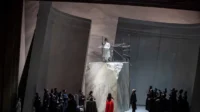
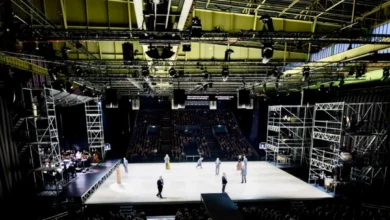
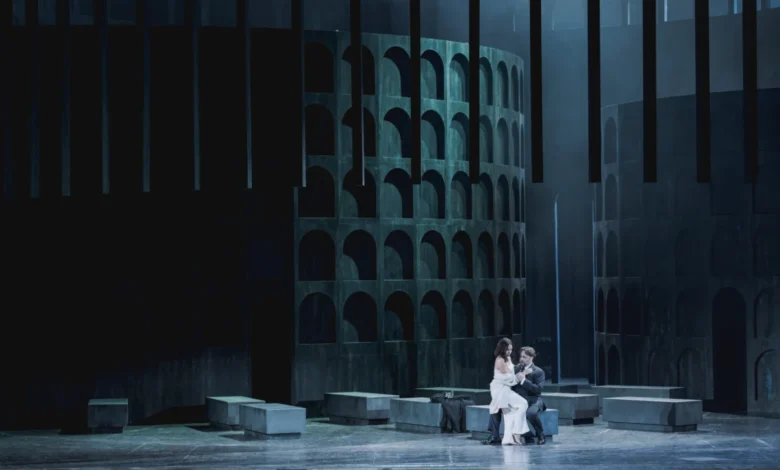
In the 2026 Florence revival, director Àlex Ollé chose to discard the specificity of medieval Genoa entirely, transposing the narrative into an indistinct, contemporary corporate and political environment. The central scenic architecture, conceived by designer Alfons Flores, relied upon an enormous, monolithic rotating structure. This brutalist architectural monolith was forced to serve as everything across the evening: Fiesco’s decaying ancestral home, Amelia’s palatial garden retreat, the Genoese Senate chamber, and the Doge’s private quarters.
The visual palette was relentlessly austere, dominated by heavy shades of black, grey, and cold concrete, creating an oppressive atmosphere of unrelieved gloom. Most critically, the sea—the literal lifeblood of the Genoese republic and the psychological sanctuary for Boccanegra himself—was completely excised from the physical production. In an opera where the dying Doge calls out for the refreshing sea breeze ("Oh refrigerio!… la marina brezza"), the absolute absence of maritime imagery or oceanic symbolism robbed the final act of its poetic and thematic payoff.
Furthermore, Ollé’s contemporary framing failed to generate a coherent critical perspective. While the conflict between patricians and plebeians offered a ripe opportunity to draw modern parallels—such as a struggle between corporate elites and harbor laborers or marginalized gig-economy workers—no such parallel was meaningfully developed. The crowd scenes lacked menace and theatrical urgency, while the intimate garden scene between Amelia and Gabriele was awkwardly transplanted to a cold, inhospitable courtyard.
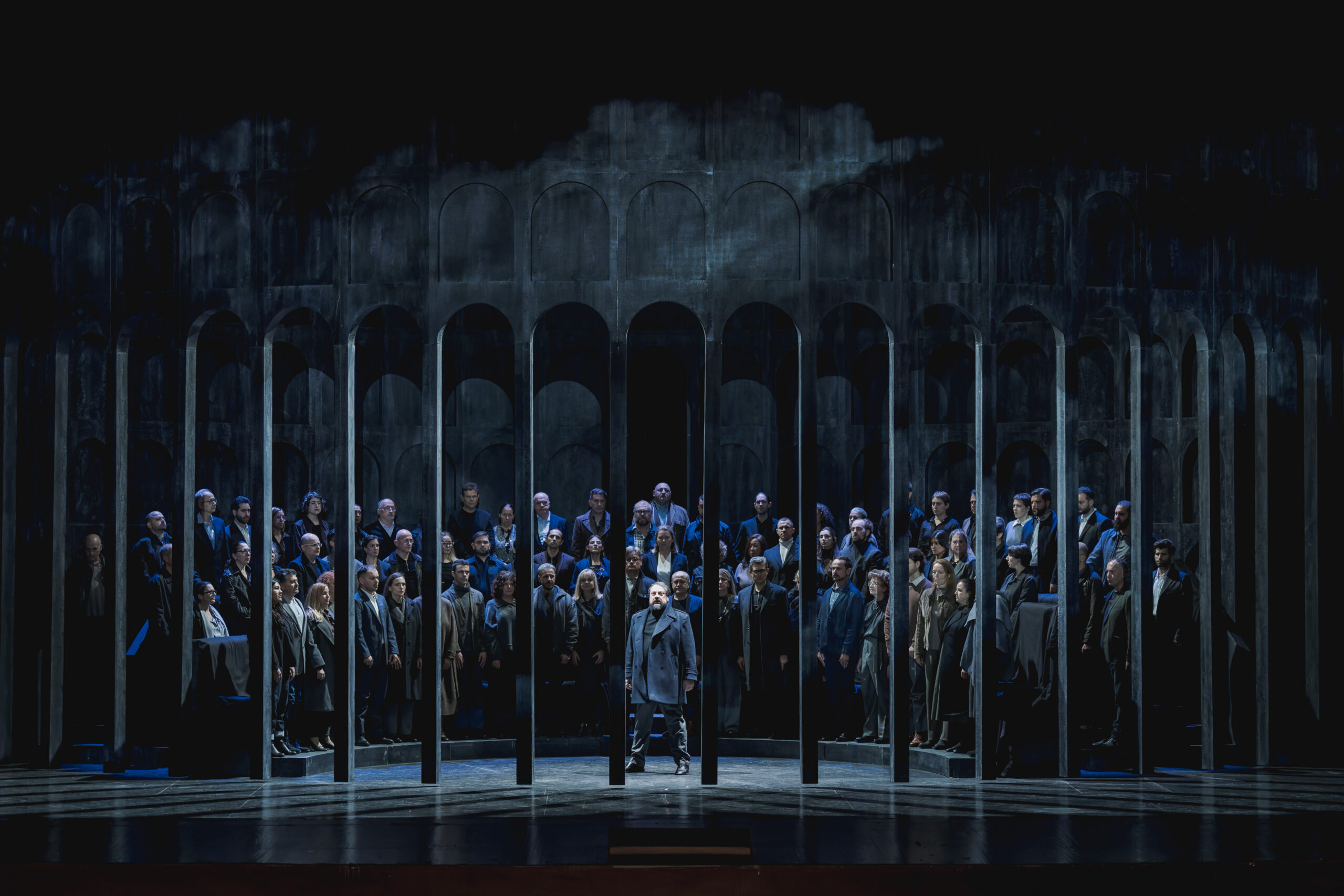
The staging reached a nadir of distraction in the final act, where a group of elegantly attired modern socialites milled about the stage during Boccanegra’s poignant death scene, actively pulling the audience’s attention away from one of the most tenderly vulnerable moments in the entire Italian operatic canon. Critics and audience members alike noted that a more historically grounded or imaginatively faithful production would have served Verdi’s masterpiece with far greater justice.
Vocal Triumphs: Petean, Ganci, Park, and Ravizza Save the Night
Fortunately, the musical execution provided ample compensation for the staging deficiencies, turning the evening into a notable vocal showcase.
At the center of the vocal triumph was Romanian baritone George Petean, who delivered an interpretation of the title role characterized by immense nobility and vocal control. Possessing a dark, rich timbre and homogeneous production across his register, Petean eschewed the temptation to portray Boccanegra as an over-the-tears, shouting populist. Instead, he presented a dignified statesman whose private suffering and yearning for reconciliation were never far from the surface. His delivery of the Act I recognition scene with Amelia ("M’abbraccia, o figlia mia") was delivered with exquisite, restrained tenderness, while his death scene captured the quiet tragedy of a ruler returning to the elemental peace of the sea.
Matching Petean in vocal splendor was tenor Luciano Ganci as Gabriele Adorno, delivering what many considered the standout vocal performance of the night. Ganci deployed a ringing, virile tenor voice featuring generous projection, a distinctly Italianate timbre, and the robust spinto resources demanded by the role. Even in his most demanding passages, his vocal production remained secure, blending youthful lyricism with fiery dramatic intensity. His soaring rendition of "Io la vidi" and his emotionally charged exchanges with Amelia demonstrated a complete mastery of Verdi’s mid-career idiom, drawing enthusiastic ovations from the Florentine audience.
Bass Jongmin Park brought a commanding physical and vocal presence to the role of Jacopo Fiesco. Possessing a deep, resonant instrument, Park avoided reducing the embittered patrician to a one-dimensional villain. His rendition of the famous aria "Il lacerato spirito" communicated the old aristocrat’s bottomless grief and thirst for vengeance with chilling gravity and authority.
Among the supporting cast, young baritone Lodovico Filippo Ravizza emerged as a genuine revelation in the thankless role of Paolo Albiani. Utilizing an insinuating vocal color, intelligent phrasing, and subtle characterization, Ravizza painted a portrait of ruthless, climbing ambition without resorting to cartoonish villainy. His nuanced performance forced the audience to almost pity the treacherous schemer.
Soprano Carolina López Moreno offered a more variable interpretation as Amelia. While she displayed a luminous upper register and a commanding stage presence, certain passages—particularly the aria "Come in quest’ora bruna"—strained her vocal resources and lacked the seamless legato required. However, she found her footing in the intimate recognition scenes with Boccanegra and her Act I aria "Nell’ora soave," conveying genuine vulnerability and emotional warmth. Solid contributions were also made by Huigang Liu as Pietro, Luca Tamani as the Captain, and the Teatro del Maggio Musicale Fiorentino Chorus, impeccably prepared by chorus master Lorenzo Fratini.
Orchestral Mastery Under James Conlon
In the orchestra pit, veteran American conductor James Conlon led the Maggio Musicale Fiorentino Orchestra with a profound sensitivity to Verdi’s intricate orchestral colors. The instrumental balance between pit and stage was managed with exceptional precision, allowing the complex harmonic undercurrents of the 1881 revision to shine through.
While Conlon’s tempi were occasionally measured, favoring a uniform melancholy that slightly reined in the dramatic momentum during the more turbulent political confrontations, his command of the score’s micro-details was exemplary. The woodwinds and strings executed Verdi’s maritime and nocturnal evocations with pristine beauty, ensuring that the musical narrative retained the emotional resonance that the physical staging failed to provide.
Broader Implications and Reception
The production of Simon Boccanegra at the Teatro del Maggio Musicale Fiorentino highlights a recurring debate in contemporary opera administration: the tension between conceptual, high-concept Regietheater (director-driven theater) and traditional, text-faithful staging. While adventurous directorial concepts can occasionally revitalize neglected or familiar repertoire, the Florence premiere demonstrated the risks of imposing an abstract, minimalist framework onto a work whose dramatic DNA is deeply rooted in specific historical, political, and geographical realities.
Despite the visual missteps by Àlex Ollé and his creative team, the production achieved its primary artistic mandate through the sheer excellence of its musical interpreters. George Petean, Luciano Ganci, Jongmin Park, and James Conlon proved that Verdi’s late-nineteenth-century revisions possess an enduring vitality capable of surviving even the most inhospitable theatrical surroundings. For the international opera community, the mounting serves as a reminder that while modern staging experiments will continue to divide audiences, vocal artistry of the highest order remains the ultimate currency of the lyric stage.