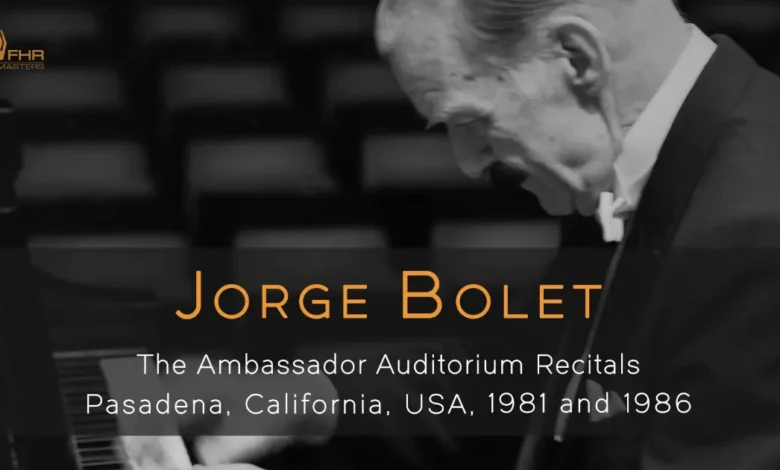
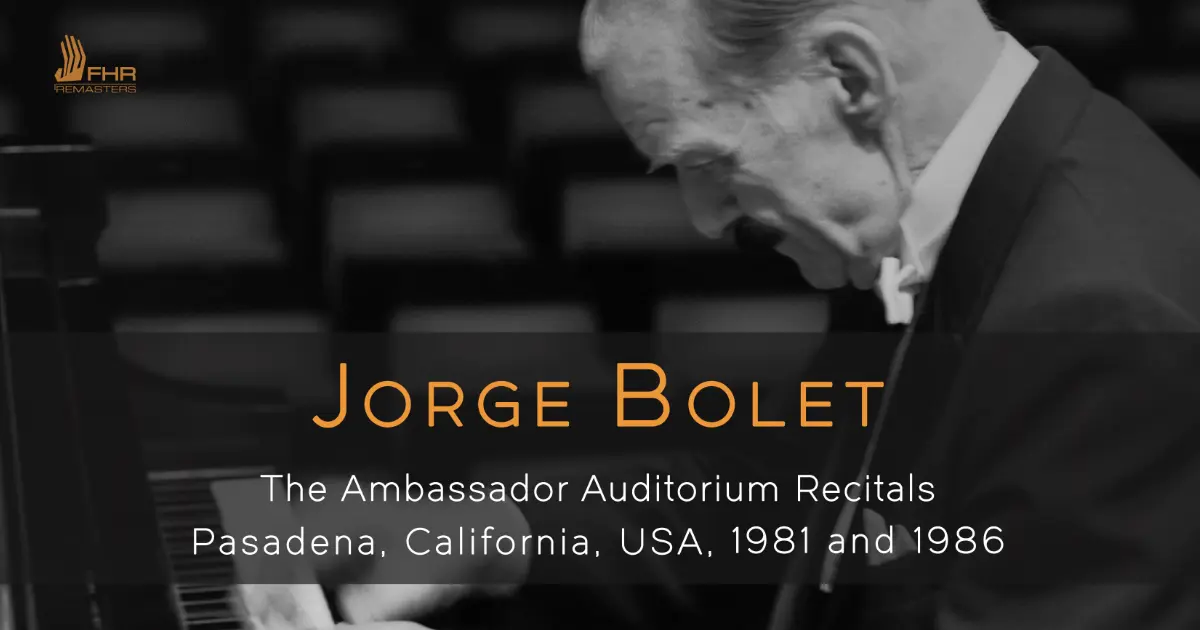
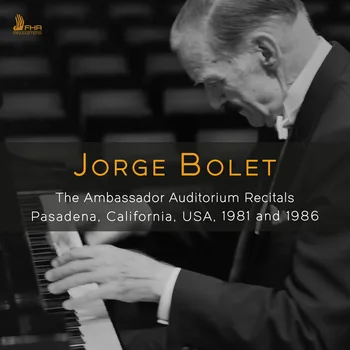
First Hand Records has announced the release of a significant three-CD box set featuring previously unissued live performances by the legendary Cuban-American pianist Jorge Bolet. Titled Jorge Bolet: The Ambassador Auditorium Recitals, this collection documents two complete performances given at the prestigious Pasadena, California, venue on November 11, 1981, and April 23, 1986. These recordings, originally captured on professional open-reel tapes for archival purposes, have undergone a rigorous 24-bit/96 kHz restoration and remastering process to bring them to the commercial market for the first time. The release offers a rare glimpse into the late-career artistry of a performer often described as the "Last Romantic," capturing him in the live concert setting he famously preferred over the controlled environment of the recording studio.
Historical Context and the Legacy of Jorge Bolet
Jorge Bolet (1914–1990) occupied a unique position in the 20th-century pianistic landscape. Born in Havana, Cuba, and trained at the Curtis Institute of Music under David Saperton and Leopold Godowsky, Bolet inherited a tradition of grand, expressive pianism that prioritized tonal beauty, inner-voice clarity, and a flexible approach to tempo. Despite his immense technical facility, his career saw a late flowering; it was not until the 1970s and 1980s, particularly after a series of acclaimed recordings for the Decca label, that he achieved global superstition.
The Ambassador Auditorium, often referred to as the "Carnegie Hall of the West," provided the ideal acoustic backdrop for Bolet’s massive yet nuanced sound. Known for its lush acoustics and elegant design, the venue hosted many of the world’s greatest musicians during its tenure as a premier cultural hub. For Bolet, who frequently expressed frustration with the "sterility" of studio sessions, these live recitals represent the authentic "Bolet sound"—unfiltered, spontaneous, and deeply communicative.
The 1981 Recital: Romanticism and Nuance
The first portion of the box set focuses on the November 11, 1981, recital, which highlights Bolet’s command of the German Romantic core repertoire and his unparalleled skill in the art of the transcription. The centerpiece of this performance is Robert Schumann’s Fantasy in C Major, Op. 17.
Analytical comparisons of this performance suggest a departure from the more introspective, contemplative readings typically associated with Sviatoslav Richter or Murray Perahia. Bolet’s approach is characterized by a notable extroversion. In the first movement, his use of emphatic dotted rhythms and punchy chordal attacks provides a sense of raw, passionate energy. However, this is balanced by a profound sensitivity in the movement’s quieter, hymn-like sections.
The middle movement showcases a jubilant energy that remains steadfast even through the occasional technical slips inherent in a live performance—imperfections that many purists argue add to the "human" quality of the recording. The final movement, Langsam getragen, is perhaps the most revelatory. While pianists like Maurizio Pollini emphasize tonal perfection and Martha Argerich focuses on fluid movement, Bolet adopts a more measured pace. This tempo allows for a greater degree of flexibility in phrasing, utilizing small pauses and subtle hesitations to heighten the expressive impact of the lines, aligning with the transcendent nature of Schumann’s writing.
Following the Schumann, the 1981 program delves into the Schubert-Liszt song transcriptions. These works were a staple of Bolet’s repertoire, serving as a bridge between Schubert’s melodic genius and Liszt’s virtuosic keyboard textures. In Der Müller und der Bach, Bolet demonstrates a masterclass in voice leading, imbuing the piano with a distinctly vocal quality. His interpretation of Erlkönig offers a stark contrast to the famous live recording by Evgeny Kissin from 1990. While Kissin utilizes sheer speed and aggressive octaves to convey terror, Bolet opts for an "austere presence." His portrayal of the character of Death suggests a chilling inevitability, proving that psychological horror can be just as effective as visceral drama.
The 1986 Recital: A Narrative Exploration of the Ballade
The second recital, recorded on April 23, 1986, is a thoughtfully curated program centered on the "Ballade" as a musical form. This recital includes Edvard Grieg’s Ballade in G Minor, Op. 24, Johannes Brahms’s Four Ballades, Op. 10, and Franz Liszt’s Ballade No. 2 in B Minor, S. 171, concluding with the definitive set of four Ballades by Frédéric Chopin.
The Grieg Ballade is a work of significant emotional weight, based on a Norwegian folk theme and structured as a series of variations. Bolet captures the work’s inherent tonal ambiguity, navigating the shifts between lyricism, whimsy, and cataclysmic outbursts. Critics noting this performance highlight Bolet’s ability to weave these disparate moods into a unified narrative of profound sadness and longing.
The performance of Brahms’s Op. 10 Ballades provides insight into the composer’s early development. Bolet highlights the "seeds" of Brahms’s later, more profound style by emphasizing the tension between stormy surges and subtle, recurring motifs. While some passages in the second Ballade are rendered with a stridency that reflects the live acoustic, the third Ballade (Intermezzo) is played with an inviting unpredictability, revealing some of the most tender moments in the entire box set.
The Chopin Cycle and Technical Prowess
The four Chopin Ballades serve as the emotional and technical climax of the 1986 recital. Bolet’s interpretation is defined by a "game of opposites," where grace and fury are placed in direct competition. In the Ballade No. 2 in F Major, the transition from the pastoral opening to the turbulent minor sections is handled with a recklessness that was rarely heard in Bolet’s more deliberate studio recordings.
The Ballade No. 4 in F Minor, Op. 52, widely considered one of the most challenging works in the piano literature, receives a performance that reflects decades of familiarity. Bolet’s sensitivity to Chopin’s harmonic shifts and his ability to maintain a bel canto melodic line even amidst dense textures are on full display. The concluding Coda is described as one of the most "electric" moments of the recital, showcasing a level of virtuosic fire that belies his age at the time of the performance.
Technical Restoration and Archival Significance
The technical pedigree of this release is a point of interest for audiophiles and historians alike. The original recordings were made on open-reel tapes, a format that, while high-quality for its time, is subject to degradation. The transfer to 24-bit/96 kHz digital audio was overseen by engineers Kabir Hermon and John Croft.
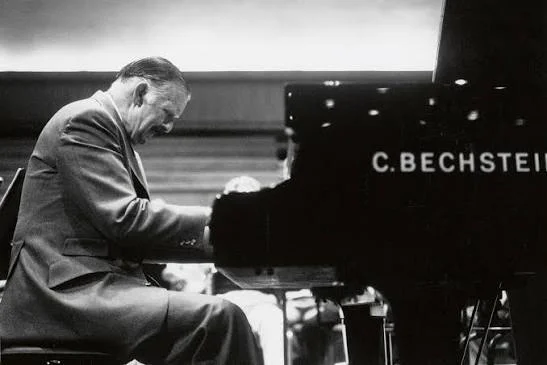
This high-resolution remastering ensures that the specific character of the piano—likely a Baldwin or Bechstein, both of which Bolet favored during different periods—is preserved with clarity. The restoration process has successfully minimized tape hiss while maintaining the dynamic range and "air" of the Ambassador Auditorium’s acoustic. For a pianist like Bolet, whose art was so dependent on the "shimmer" of his tone and the decay of his pedaling, this level of technical fidelity is essential for a proper appreciation of his work.
Broader Implications for the Classical Music Market
The release of Jorge Bolet: The Ambassador Auditorium Recitals by First Hand Records reflects a growing trend in the classical music industry: the "archival goldmine." As studio recording budgets for solo instrumentalists have tightened, independent labels are increasingly looking toward professional archives and private collections to find high-quality performances by the masters of the previous century.
This set serves several functions:
- Discographical Completion: It fills gaps in the Bolet discography, particularly regarding his live approach to large-scale works like the Grieg Ballade and the complete Chopin cycle.
- Educational Value: For students of the piano, these recordings provide a document of "Old School" technique—specifically the use of the wrist, the voicing of chords, and the application of rubato that is less common in the modern, more standardized competition style.
- Historical Preservation: By digitizing these tapes at a high sample rate, the label ensures that these performances are preserved for future generations before the physical media becomes unplayable.
Final Assessment of the Collection
The Ambassador Auditorium Recitals provide a comprehensive portrait of Jorge Bolet during his final decade. It shows a pianist who, despite being in the autumn of his career, possessed a formidable technique and an undiminished capacity for poetic communication. The contrast between the 1981 and 1986 recitals allows listeners to track the subtle shifts in his interpretive priorities, moving from the extroverted passion of the Schumann Fantasy to the narrative complexity of the Ballade program.
For collectors and enthusiasts of Romantic pianism, this three-CD set is more than just a historical curiosity; it is a vital document of an artist who believed that music was a living, breathing entity that could only truly be realized in the presence of an audience. The meticulous restoration by First Hand Records ensures that Jorge Bolet’s "last hurrah" at the Ambassador Auditorium can be heard with the clarity and impact it deserves.
Album Summary
- Jorge Bolet: The Ambassador Auditorium Recitals
- Label: First Hand Records
- Catalogue No: FHR178
- Format: 3-CD Box Set / Digital
- Recording Dates: November 11, 1981, and April 23, 1986
- Location: Ambassador Auditorium, Pasadena, California
- Engineers: Kabir Hermon and John Croft (Remastering)