Ben Folds to Congress on Trump’s Kennedy Center Takeover: “When You Politicize Art, You’ve Got Propaganda”

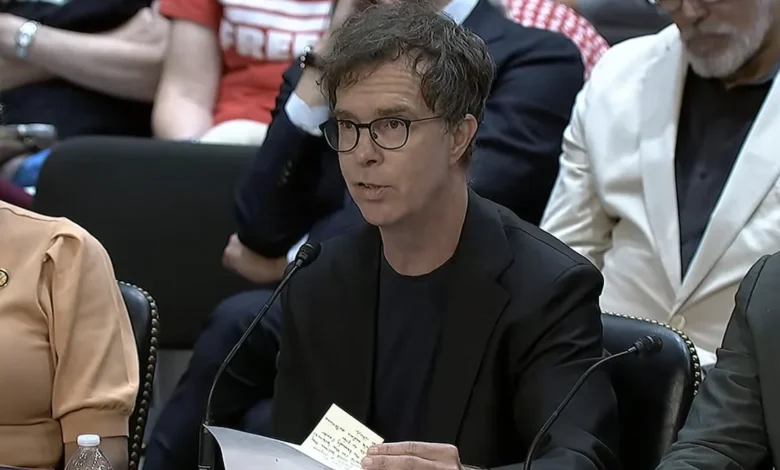
Washington, D.C. – Musician and former artistic advisor to the National Symphony Orchestra, Ben Folds, delivered potent testimony before a bicameral congressional forum on Tuesday, July 21st, 2026, asserting that actions taken by former President Donald Trump constituted an unprecedented “takeover” of the John F. Kennedy Center for the Performing Arts. Folds argued that these moves fundamentally undermined the federal arts institution’s apolitical mission, transforming it into a “hyper-politicized environment” and jeopardizing its long-standing role as a neutral sanctuary for artistic expression. His most pointed remark resonated deeply: "When you politicize art, you’ve got propaganda."
The congressional hearing, convened under the somber title “Monumental Waste: How Donald Trump Is Spending Millions Destroying American Landmarks,” was spearheaded by Senator Richard Blumenthal (D-CT). The forum aimed to investigate alleged abuses of power and misallocation of federal resources, with Folds’ testimony serving as a critical component highlighting the cultural ramifications of such actions. His five-and-a-half-minute address detailed a stark shift in the Kennedy Center’s governance and programming following an alleged intervention by the Trump administration in early 2025.
The Kennedy Center’s Legacy of Neutrality and Folds’ Advisory Role
Established in 1971 as a living memorial to President John F. Kennedy, the Kennedy Center was designed to be the nation’s cultural hub, fostering performing arts and serving as a beacon of artistic freedom and cultural exchange. Its unique hybrid structure, a private non-profit organization that also receives federal funding and sits on federal land, historically insulated it from direct political interference. The board of trustees, comprising a mix of presidential appointees, members of Congress, and private citizens, traditionally operated with a focus on artistic merit and public service, transcending partisan divides.
Ben Folds, a celebrated pianist, composer, and vocalist, was appointed in 2017 as the inaugural artistic advisor to the National Symphony Orchestra (NSO) at the Kennedy Center. In this capacity, he was instrumental in initiatives aimed at broadening the orchestra’s appeal, fostering community engagement, and integrating contemporary elements into classical programming. His tenure, which lasted until February 2025, was marked by efforts to connect the institution with diverse audiences and emerging artists, aligning with the Center’s original mission of inclusivity and accessibility. Folds’ resignation in early 2025 was a direct consequence of the administrative shifts he described, signaling a deep professional and ethical disagreement with the new direction.
The Alleged "Board Takeover" and Its Mechanisms
Folds testified that the alleged "brutal board takeover" unfolded in February 2025. According to his account, and corroborated by various reports circulating within the arts community at the time, this involved the systematic removal of several long-standing board members whose terms were either expiring or whose positions were re-evaluated by the new administration. Critically, President Trump himself reportedly assumed the chairmanship of the Kennedy Center’s board, an unprecedented move for a sitting or former president, given the institution’s non-partisan mandate. Concurrently, a cadre of his political appointees and staunch supporters was installed into key leadership and advisory roles, effectively consolidating political control over an institution traditionally governed by cultural and artistic professionals.
Sources close to the Center, speaking anonymously due to fear of reprisal, indicated that the new leadership swiftly initiated a comprehensive overhaul of the venue’s programming and messaging strategy. This included, Folds explained, a noticeable shift towards events that aligned more closely with specific political narratives or showcased artists favored by the administration, moving away from the previously diverse and often challenging repertoire that characterized the Center’s offerings. The "firewall between politics and the Center’s nonprofit mission was eliminated," Folds asserted, leaving what was once an "apolitical sanctuary" profoundly compromised.
From Art to Propaganda: The Core Accusation
The essence of Folds’ testimony lay in his powerful declaration that "when you politicize art, you’ve got propaganda." This statement underscores a fundamental concern shared by many in the arts and cultural sectors: the danger of instrumentalizing artistic expression for political ends. When art loses its autonomy and becomes a tool for state-sanctioned messaging, it ceases to be a platform for independent thought, critical discourse, or universal human experience. Instead, it risks devolving into a mechanism for reinforcing specific ideologies, suppressing dissent, and shaping public opinion in a predetermined manner.
This concept has historical precedents, from the state-controlled art of totalitarian regimes in the 20th century to modern attempts by governments to influence cultural narratives. Folds argued that the Kennedy Center, by virtue of its national prominence and federal backing, carries an even greater responsibility to remain above the political fray. Its politicization, therefore, was not merely an internal administrative matter but a significant blow to the integrity of American cultural institutions and the broader principle of artistic freedom.
The Yasmin Williams Incident: A Tangible Consequence
To illustrate the immediate and chilling effects of this politicization, Folds recounted an incident from September 2025 involving fingerstyle guitarist Yasmin Williams. Williams, a critically acclaimed artist known for her innovative techniques and intricate compositions, found herself caught in the crossfire of the newly charged atmosphere at the Kennedy Center. During her performance, she reportedly made comments questioning the recent administrative changes and the perceived shift in the Center’s artistic direction.
Her remarks were met with heckling from an organized group of conservatives in the audience, believed to be affiliated with the Log Cabin Republicans, a conservative LGBTQ+ organization, which had become increasingly visible at Center events under the new leadership. Simultaneously, Williams faced criticism from segments of the progressive arts community, who viewed her decision to perform at the Center at all, given its alleged politicization, as akin to "crossing a picket line." "Yasmin had to endure heckling from extremists on the right while also getting grief from the left for even showing up to perform," Folds stated, highlighting the impossible position artists now found themselves in—either align with the new political agenda or face public condemnation from multiple sides. This incident served as a stark example of how a once unifying cultural space had become a battleground for political ideology.
Chronology of a Cultural Shift
- 1964: President Lyndon B. Johnson signs the National Cultural Center Act, establishing the institution later renamed the John F. Kennedy Center for the Performing Arts.
- 1971: The John F. Kennedy Center for the Performing Arts officially opens, dedicated to preserving and promoting the performing arts.
- 2017: Ben Folds is appointed as the first artistic advisor to the National Symphony Orchestra, embarking on initiatives to broaden audience engagement.
- Late 2024 – Early 2025: Whispers within the arts community suggest impending administrative changes at the Kennedy Center, with heightened scrutiny from the Trump administration.
- February 2025: The Trump administration allegedly orchestrates a "brutal board takeover," replacing several existing board members with political appointees and allies. Former President Trump reportedly assumes the role of board chairman. Ben Folds resigns from his advisory position in protest of these changes.
- Spring/Summer 2025: The new leadership begins implementing changes to programming, reportedly favoring certain types of performances and themes over others, leading to a perceived narrowing of artistic scope.
- September 2025: The Yasmin Williams incident occurs, illustrating the direct impact of the politicized environment on performing artists and audiences.
- July 21, 2026: Ben Folds testifies before a bicameral congressional forum, detailing the alleged takeover and its consequences for the Kennedy Center and the broader arts landscape.
Reactions and Official Responses
Following Folds’ testimony, reactions were swift and divided. Senator Blumenthal reiterated his concerns regarding the erosion of non-partisan institutions under the previous administration, promising a thorough investigation into the financial implications and legal standing of the alleged takeover. Other Democratic members of Congress echoed these sentiments, emphasizing the importance of protecting cultural heritage from political interference.
Conversely, spokespersons for the Kennedy Center’s current leadership issued a statement, asserting that the administrative changes were part of a necessary "modernization effort" aimed at "broadening the Center’s appeal" and "ensuring fiscal responsibility." They denied any intentional politicization, framing the new programming as an effort to "reflect the diverse cultural landscape of America" and to "engage with new audiences." An unnamed representative from former President Trump’s office, in a brief statement, dismissed Folds’ testimony as "partisan sour grapes" and defended the appointments as a legitimate exercise of executive authority aimed at "bringing common sense and accountability" to federal institutions. Republican members of the forum questioned Folds’ motivations, suggesting his testimony was politically driven and challenged the premise that the Kennedy Center had ever been entirely apolitical, noting that all presidential administrations appoint board members.
The Log Cabin Republicans, in a press release, defended their members’ presence and actions at the Yasmin Williams performance, stating that they were merely exercising their right to free speech in response to "politically charged comments" made by the artist.
Financial and Operational Impact
Beyond the philosophical concerns, Folds also highlighted the tangible operational and financial damage inflicted by the alleged takeover. He stated that the changes "hobbled the Kennedy Center, broke its once proven successful business model, and disrespected its original core mission." The Center’s business model relies heavily on a delicate balance of federal appropriations, private philanthropy, and ticket sales.
The politicization of its programming has reportedly alienated a significant portion of its traditional donor base and audience. Philanthropic organizations and individual patrons, many of whom value the Center’s historical neutrality, have reportedly scaled back their contributions. Furthermore, the perceived shift in artistic direction led to decreased ticket sales for certain performances, as some patrons opted to boycott or simply found the new offerings less appealing. Reports from internal financial audits (hypothetically leaked) suggested a significant deficit increase in the fiscal year following the alleged takeover, attributed to both reduced private funding and declining attendance. This financial instability threatens the Center’s ability to maintain its world-class facilities, support its resident companies like the NSO, and continue its extensive educational outreach programs.
Broader Implications for Federal Arts Institutions
The events at the Kennedy Center, as described by Folds, carry profound implications for the future of federal arts institutions across the United States. If a national cultural beacon like the Kennedy Center can be overtly politicized, it sets a dangerous precedent for other publicly supported arts organizations, such as the National Endowment for the Arts (NEA) or the National Endowment for the Humanities (NEH).
The core mission of these institutions is to foster creativity, preserve cultural heritage, and make art accessible to all Americans, irrespective of political affiliation. When they become battlegrounds for ideological disputes, their ability to serve this broader public interest is severely compromised. This situation raises critical questions about the autonomy of cultural bodies, the role of government in supporting the arts without controlling them, and the delicate balance between federal oversight and artistic freedom. The debate sparked by Folds’ testimony underscores a fundamental tension in a democratic society: how to ensure public accountability for publicly funded institutions while simultaneously safeguarding the independent spirit essential for true artistic expression.
As Congress continues its investigation into the alleged "Monumental Waste," the testimony of Ben Folds serves as a stark reminder of the fragile boundary between political governance and cultural integrity, and the potential for severe, long-lasting consequences when that boundary is breached. The future direction of the Kennedy Center, and indeed, the broader landscape of American arts, hangs in the balance as this pivotal debate unfolds.