Reimagining the Boundaries of Recorded Sound: Peter Saltzman Unveils Blues, Preludes & Feuds: A Musical Memory

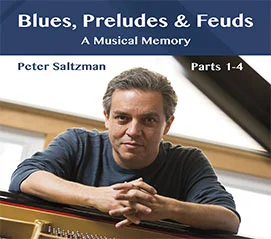
Pianist, composer, and innovator Peter Saltzman has once again challenged the traditional conventions of the music industry with the release of his latest project, Blues, Preludes & Feuds: A Musical Memory. Defying conventional categorization from the very first moment the listener interacts with the physical packaging—where Saltzman boldly declares that the listener is holding "not a CD"—the project represents a significant departure from standard commercial audio releases. Available as a hybrid music-eBook, the release merges avant-garde jazz, classical baroque structures, and literary stream-of-consciousness narratives into a singular, multi-disciplinary artistic statement.
Main Facts of the Release
At its core, Blues, Preludes & Feuds: A Musical Memory is an ambitious solo piano recording that explores the intersections of classical discipline and jazz improvisation. Performed entirely by Saltzman, the project spans an expansive tracklist divided into four distinct parts, featuring compositions such as "Blues for the End of Time," "Ostinato Asymmetrique," "Fanatical in A," and various reinterpretations of Johann Sebastian Bach, alongside politically and historically charged originals like "Eggman’s Lament" and "Blues en Français."
Unlike traditional albums designed for passive listening, this project functions as an evolving auditory document. The hybrid music-eBook format allows listeners to engage with text, philosophy, and musical scores simultaneously, creating an immersive environment that mirrors the complexity of the audio. Saltzman’s approach treats recorded music not as a static final product, but as a living, breathing archive of an artist’s intellectual and emotional evolution.
Chronology and Background Context
The genesis of Blues, Preludes & Feuds can be traced back to Saltzman’s earlier Kickstarter-funded campaign for Piano Diaries. While that previous recording was widely received by critics as a successful exploration of intimate, diary-like composition, Saltzman viewed it merely as a preliminary work-in-progress. The creative momentum generated during the production of Piano Diaries laid the foundational architecture for the dense, interconnected themes present in his new work.
Saltzman’s artistic identity was forged in the crucible of 1960s Chicago—an era defined by intense political upheaval, social friction, and cultural transformation. Growing up amid the harsh sociopolitical climate of the American Midwest during the civil rights movement deeply influenced his musical sensibility. The "Blues" and "Feuds" embedded within the titles and textures of his compositions are not abstract aesthetic choices; they are direct reflections of a worldview shaped by turbulence, resilience, and a persistent questioning of authority.
Classically trained yet deeply seduced by the liberating vocabulary of jazz, Saltzman spent decades honing his craft across various ensembles, most notably his work with the Revolution Ensemble. These experiences cultivated an uncompromising dedication to originality. Over the years, his trajectory moved away from standard ensemble playing toward an introspective yet fiercely independent solo career, culminating in this monumental current venture.
Musical Architecture and Influences
A rigorous examination of Blues, Preludes & Feuds reveals a complex tapestry of historical and stylistic influences. Musically, the project serves as a peripatetic caravanserai bridging the baroque era with contemporary avant-garde improvisation. Saltzman explicitly invokes the majestic inventions of J.S. Bach, weaving foundational baroque structures—such as preludes, fugues, and two-part inventions—into the contemporary cultural topography of his own original compositions. Tracks like "Bach Prelude #1 Remix," "Bach Prelude #2," and "Fantasy on Bach Fugue #2" demonstrate a deep reverence for counterpoint, recontextualized through a modern harmonic lens.
However, Bach is not the sole architect haunting Saltzman’s musical universe. The project bears the distinct aesthetic fingerprints of jazz iconoclast Thelonious Monk, whose whimsical, angular phrasing and penchant for rhythmic dissonance inform much of the album’s structural tension. Furthermore, the spiritual and intellectual gravity of classical masters like Ludwig van Beethoven can be felt hovering over the proceedings.
This synthesis of historical eras creates a listening experience that music theorists and theoretical physicists alike might playfully compare to the mechanics of an alternate universe. The music moves seamlessly from moments of structural rigor to spontaneous combustion. For instance, the short, jabbing motifs in "Fanatical in A" contrast sharply with the palpable, deeply felt emotional sighs transitions heard in "Temporary Cessation of Hostilities" as it gracefully bleeds into a rendition of "Amazing Grace."
Industry Implications and the Hybrid Music-eBook Format
The decision to release Blues, Preludes & Feuds as a hybrid music-eBook highlights ongoing shifts in how independent artists distribute complex, multi-media works in the digital age. By bypassing conventional streaming-only models and physical-only compact disc markets, Saltzman addresses a growing demand among audiophiles and collectors for contextual depth.
In an era dominated by algorithmic playlists and bite-sized audio snippets, Saltzman demands sustained attention. The hybrid format functions similarly to James Joyce’s literary stream-of-consciousness, requiring the audience to piece together a narrative through recurring motifs, veiled themes, and counter-themes. Tracks such as "Prelude #0 (The Theme)" and "Feud #0 (The Counter-Theme)" establish a dialectical relationship that persists throughout the four-part sequence, turning the listening experience into an intellectual dialogue between the artist and the audience.
Broader Impact on Modern Solo Piano
Saltzman’s latest offering arrives at a time when contemporary solo piano music occupies a fascinating space between neoclassical minimalism and experimental jazz. While many artists lean toward accessible, ambient soundscapes, Saltzman moves in the opposite direction, offering music that is intellectually demanding, historically conscious, and fiercely idiosyncratic.
Critics and industry observers have noted that works of this magnitude redefine the expectations placed upon solo instrumentalists. By refusing to conform to genre boundaries, Saltzman establishes a benchmark for artists seeking to merge academic musicology with the visceral immediacy of jazz improvisation. The inclusion of tracks like "Star Spangled Minor," "Prevaricate," and "Similitude" showcases a pianist operating at the absolute peak of his technical and compositional faculties.
Conclusion
Ultimately, Blues, Preludes & Feuds: A Musical Memory is far more than a collection of piano pieces; it is a comprehensive artistic statement documenting a lifetime of inquiry. Through a meticulous blend of baroque counterpoint, Monk-inspired angularity, and deeply personal historical reflections, Peter Saltzman has crafted a monumental work that rewards repeat listening and deep critical engagement. As the music industry continues to grapple with questions of format, value, and artistic integrity, Saltzman’s hybrid release stands as a compelling testament to the power of uncompromising original creation.