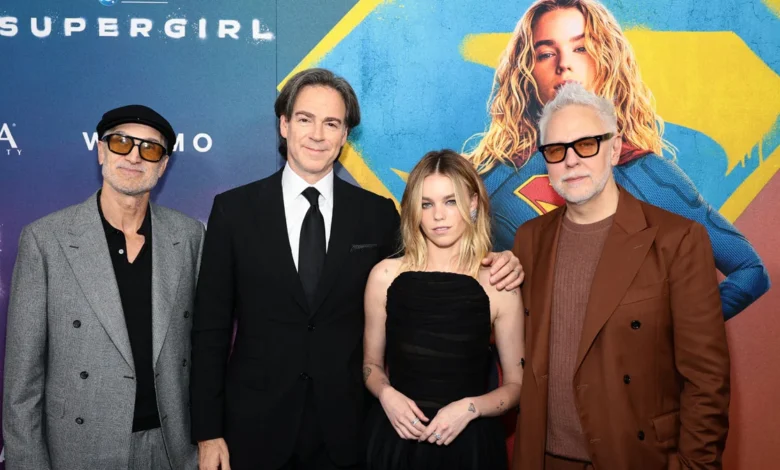
The abrupt departure of James Gunn and Peter Safran from their leadership roles at DC Studios this past Monday marks yet another seismic shift in the volatile history of Warner Bros.’ stewardship of its comic book intellectual property. For observers of the industry, the move was startling, not only for its suddenness but for the timing: the studio’s ambitious, long-term roadmap for the DC Universe (DCU) appeared to be finding its footing. Having successfully navigated the transition from the previous regime to a new, unified vision, the duo had overseen a series of projects that suggested a more disciplined, interconnected future for the franchise.
The strategy initiated by Gunn and Safran was designed to mirror the success of the Marvel Cinematic Universe (MCU) by prioritizing cohesive storytelling. The 2025 release of Superman served as the cornerstone of this new era. Not only did the film achieve significant critical acclaim, but it also performed robustly at the box office, providing the necessary momentum to validate the studio’s strategic pivot. However, the internal pressures of a post-merger corporate landscape, coupled with the unpredictable nature of modern blockbuster performance, appear to have curtailed this vision before it could reach its full, multi-phase potential.
A Timeline of Recent Strategic Shifts
To understand the current state of flux at DC Studios, one must examine the rapid succession of creative and administrative changes that have defined the studio’s output over the last three years. Following the initial announcement of the new DCU slate, the studio focused on a "quality over quantity" approach.
- 2025: The year began with the launch of the DCU via Superman, establishing a new continuity. This was bolstered by television projects such as Creature Commandos and Peacemaker, which aimed to weave television and film into a singular narrative tapestry.
- 2026 (First Half): The release of Supergirl, starring Milly Alcock, represented a significant creative challenge for the studio. The film’s lukewarm reception, characterized by criticism that its tone felt overly derivative of previous genre tropes, served as a turning point. Internally, the project’s performance raised questions about whether the "house style" imposed by the leadership was too narrow.
- 2026 (Second Half): Despite the Supergirl setback, other projects showed promise. The HBO series Lanterns emerged as a ratings success, drawing in a broad audience and introducing high-profile talent like Kyle Chandler and Aaron Pierre. Simultaneously, the R-rated thriller Clayface defied budget expectations, grossing $100 million worldwide on a modest $40 million production budget.
- November 2026: The unexpected exit of Gunn and Safran was finalized, signaling a change in direction from the top of the corporate hierarchy following the Skydance merger.
The Challenge of Franchise Cohesion
The difficulty in establishing a "clean slate" for the DC Universe is rooted in the studio’s long-standing reliance on disparate, often overlapping projects. Unlike the early days of the MCU, which benefited from a period of relative isolation, the DC Universe has been plagued by "brand dilution." Even as Gunn and Safran attempted to streamline the narrative, the existence of Matt Reeves’ The Batman—a successful, distinct, and standalone franchise—created a bifurcated reality for audiences.
The complexity of this landscape was further exacerbated by the recent decision to enlist director Steven Soderbergh to complete photography on The Batman Part II, a development that underscored the logistical hurdles of managing multiple, high-budget creative visions under one corporate roof. When one considers that these projects coexist with legacy television efforts and a history of canceled projects like Batgirl, it becomes clear that the studio has struggled to achieve the singular, unified identity that the modern blockbuster model demands.
Data-Driven Performance and Market Realities
The financial performance of these films reveals a market that is increasingly selective. While Clayface proved that modest budgets and creative risk-taking can yield profit, the failure of Supergirl demonstrated that mid-tier superhero films no longer carry the guarantee of audience engagement.

The industry is currently witnessing a broader trend: the "superhero fatigue" often cited by analysts is, in practice, a "mediocrity tax." Audiences are proving less likely to support films that feel like assembly-line products. The budgetary constraints now being imposed by the new management at Warner Bros. reflect a pragmatic realization that the era of "guaranteed" billion-dollar returns has ended.
Furthermore, the upcoming competition between Avengers: Doomsday and the third installment of the Dune franchise, both slated for December 18, 2027, highlights the shift in market focus. Warner Bros., acting as the studio behind Dune, may find that prestige, visionary-led filmmaking is a more reliable engine for growth than the traditional superhero cycle.
Official Responses and Future Outlook
In a statement released on Monday, James Gunn emphasized that despite the change in leadership, the projects currently in production—most notably Man of Tomorrow—will continue. The film, which functions as a direct sequel to 2025’s Superman, is set to feature a complex web of characters, including Aaron Pierre’s John Stewart, a returning Milly Alcock, and the integration of Jaime Reyes, previously seen in 2023’s Blue Beetle.
Gunn’s note suggested a sense of closure, stating, "We’ll see where it goes after that. And, of course, the characters we set up will live on." This indicates that while the "Gunn-era" of DC may be concluding, the studio is unlikely to discard the entire infrastructure of talent and world-building that has been established over the last two years. The retention of actors like David Corenswet suggests that the studio is looking to salvage the successful elements of the recent past while pivoting toward a potentially more conservative, risk-averse model.
Broader Implications for the Superhero Genre
The current crisis at Warner Bros. is reflective of a wider industry struggle. The model established by Kevin Feige at Marvel in the late 2000s—a four-year sprint toward an "interconnected" climax—is increasingly difficult to replicate. The economic landscape has shifted: interest rates, corporate mergers, and the high cost of production mean that studios are under unprecedented pressure to justify every line item in a budget.
When the original MCU began, superhero films were still considered a novelty in their ability to maintain long-term audience retention. Today, the market is saturated. Without a "Spider-Man level" anchor—a character with near-universal, multi-generational appeal—studios are finding that building a cinematic universe from scratch is a precarious, high-stakes gamble.
As the industry moves into 2027, the focus for Warner Bros. will likely shift away from the "DCU" as an all-encompassing brand and toward a more traditional studio model where individual films are judged by their own merits rather than their placement within a larger, interconnected puzzle. Whether this strategy will appease shareholders in the wake of the Skydance merger remains to be seen, but one thing is certain: the era of the "all-encompassing superhero universe" is undergoing a forced, and perhaps necessary, re-evaluation. The "curse" of the DC Universe—the enduring, conflicting popularity of its characters—may finally be forcing the studio to abandon the quest for a perfect replica of the MCU in favor of a more flexible, if less "epic," future.
Related posts: