Kanye West’s latest studio album, Bully, has secured a formidable yet heavily contested debut on the global music charts, arriving at number two on the Billboard 200 following a first-week performance marked by strong streaming numbers and fierce commercial competition. According to official data published by Billboard and tracked by data provider Luminate, the album generated 152,000 equivalent album units during its inaugural tracking week, navigating a turbulent rollout overshadowed by ongoing public controversies surrounding the artist.
The project’s commercial entry brings a definitive halt to a historic milestone in West’s career. For over two decades, the rapper and producer maintained an unbroken streak of consecutive number-one solo studio albums, a legendary run that began with his critically acclaimed 2004 debut, The College Dropout. Ironically, The College Dropout also peaked at the number two position upon its initial release, mirroring the chart placement of Bully twenty-two years later.
A Breakdown of the Numbers and Chart Competition
The pathway to the top of the Billboard 200 was blocked by international K-pop powerhouse BTS, whose tenth studio album, ARIRANG, continued its dominant chart reign. During the same tracking week, ARIRANG secured 187,000 equivalent units in its second week on the charts, following a massive, blockbuster debut of 641,000 units.
An analysis of Bully‘s 152,000 equivalent units reveals a heavy reliance on streaming consumption rather than traditional retail purchases. The project accumulated 96,000 streaming-equivalent units, translating to an impressive 98.43 million official on-demand audio and video streams across participating platforms within the United States alone. Meanwhile, traditional album sales—comprising digital downloads and physical formats—accounted for 56,000 units of the total figure.
However, the official chart positioning has sparked a high-profile dispute between industry data trackers and the album’s distribution camp. Gamma., the independent music and technology company founded by former Apple Music executive Larry Jackson, which handled the distribution and rollout of Bully, has publicly challenged the official tally provided by Billboard and Luminate.
The Gamma. Dispute and Discrepancy Claims
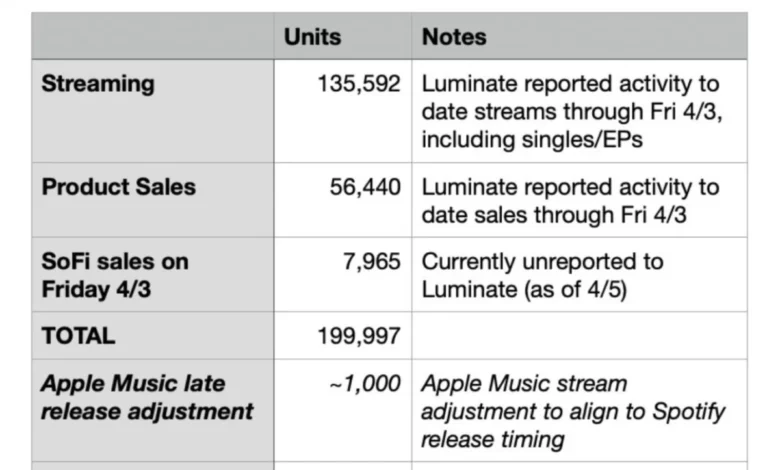
Shortly after the official charts were published, Gamma. utilized its official corporate social media channels to publish what it termed a "full seven-day sales and consumption" breakdown. According to the internal metrics released by the distributor, Bully actually accumulated a total of 200,997 equivalent album units during its first week of availability.
If verified and officially recognized by charting authorities, a figure exceeding 200,000 units would have been more than sufficient to eclipse BTS’s second-week numbers, potentially propelling West to the number-one position and preserving his historic chart streak. Despite the widespread circulation of these internal figures within the music industry, neither Billboard nor Luminate has issued a formal response or adjusted their published tracking metrics, leaving the official number-two placement standing as definitive for the chart record.
Expansion Plans and Upcoming Releases
Even as debates persist regarding the precise volume of first-week consumption, the rollout for Bully is far from complete. The standard edition of the album arrived with a generous tracklist featuring 18 songs, satisfying fans who had awaited new solo material. Yet, evidence suggests that additional music is already prepared for release.
In a follow-up posting on its corporate social media pages, Gamma. teased the imminent arrival of an expanded project, dropping a concise yet telling announcement: "Bully deluxe on the way." As of press time, neither the distributor nor West’s creative team has disclosed a concrete release date, the exact number of bonus tracks, or whether the deluxe edition will feature additional guest collaborations.
The announcement of expanded material follows a pair of high-profile, sold-out live performances at Los Angeles’s SoFi Stadium, where West showcased the new material to thousands of attendees, signaling his intent to push the album through large-scale live productions despite a shrinking pool of conventional promotional opportunities.
International Backlash and Festival Controversy
While Bully continues to perform strongly on streaming networks and digital storefronts, West’s concurrent live touring announcements have triggered severe international backlash, commercial fallout, and political condemnation. The controversy centers on West’s newly announced headlining appearances at London’s historic Wireless Festival, scheduled for July, where the artist is slated to headline all three nights of the multi-day event.
The booking has drawn intense public scrutiny and direct protests from British political leaders, driven by West’s history of widely condemned antisemitic remarks, public praise for Adolf Hitler, and repeated invocation of Nazi ideology. Prime Minister Sir Keir Starmer publicly addressed the booking, labeling the decision "deeply concerning" and questioning the appropriateness of providing a prominent international platform to an artist who has promoted hate speech and celebrated Nazism. Similarly, London Mayor Sadiq Khan voiced strong opposition to the festival’s lineup decisions.
The political pressure has quickly translated into severe financial consequences for the festival organizers. Over the span of several days following the lineup announcement, a wave of major corporate sponsors severed ties with Wireless Festival, pulling their financial backing and branding from the event. Among the prominent corporate entities withdrawing sponsorship are beverage giant Diageo, global payment processor PayPal, and soft drink titan Pepsi.
Broader Industry and Cultural Implications
The dual narrative surrounding Bully—comprising commercial resilience on digital streaming platforms coupled with severe corporate and political alienation in the live events sector—highlights the complex reality of Kanye West’s current career trajectory.
On one hand, the album’s strong streaming figures, regardless of the ongoing debate over the final 152,000-unit versus 200,000-unit tally, demonstrate that a substantial global consumer base remains eager to engage with his recorded output. The impending release of a deluxe edition indicates that momentum for the project will be sustained through the spring and summer months.
On the other hand, the mounting sponsor boycotts in the United Kingdom illustrate that West remains a profound reputational liability for mainstream corporate entities. Promoters and festival organizers face an increasingly difficult economic landscape when attempting to integrate the artist into mainstream public events, as the cost of severed corporate sponsorships and intense political pushback threatens the viability of large-scale festival partnerships.
As the music industry monitors whether Billboard will address Gamma.’s data challenges—an unlikely outcome given the strict auditing standards of Luminate—all eyes remain on how the commercial performance of Bully will interact with the unfolding logistical and social hurdles surrounding West’s international tour dates.
Related posts: